Lev. 8:1-12:16
Zech. 2:10(14)-4:7
This next portion of the scheduled reading is called B’ha’alotkha (When You Set Up) and it was read in synagogues June 6 this year. Sorry for the delay, folks, but I’m hoping that by getting thoroughly through the parsha this reading year, I can use this content, expand upon it, and begin a video series on YouTube on Messiah and God’s faithfulness to Israel in the parsha, and actually be on schedule. There are many people who don’t have time to read that may appreciate a YouTube version. I have swept the floor and washed dishes many times to sermons and lessons on YouTube on audio book.
The Scriptures covered in this portion are cited above. The verse number in parenthesis is as it is assigned in the Complete Jewish Bible. I will primarily use the ESV because that’s what most people I know use. Again, please read them yourself either before or as you go along through this post. This is not a substitute for reading the Word yourself and never should be. This portion covers some more instructions for the menorah, setting apart the Levites, for observing the Passover if you were unclean at the actual time of Passover, for how Israel followed the Shekinah through the wilderness, instructions for the silver trumpets and the shofar, the first journey of Israel since parking at mount Sinai, and their first three stops in the wilderness along with the sad stories of discontent, greed, and slander that created the names of those places. Again, we are going to examine this portion related to the Messiah and God’s faithfulness to Israel and what we can take away from that understanding in relation to our own lives.
Instructions for the Menorah
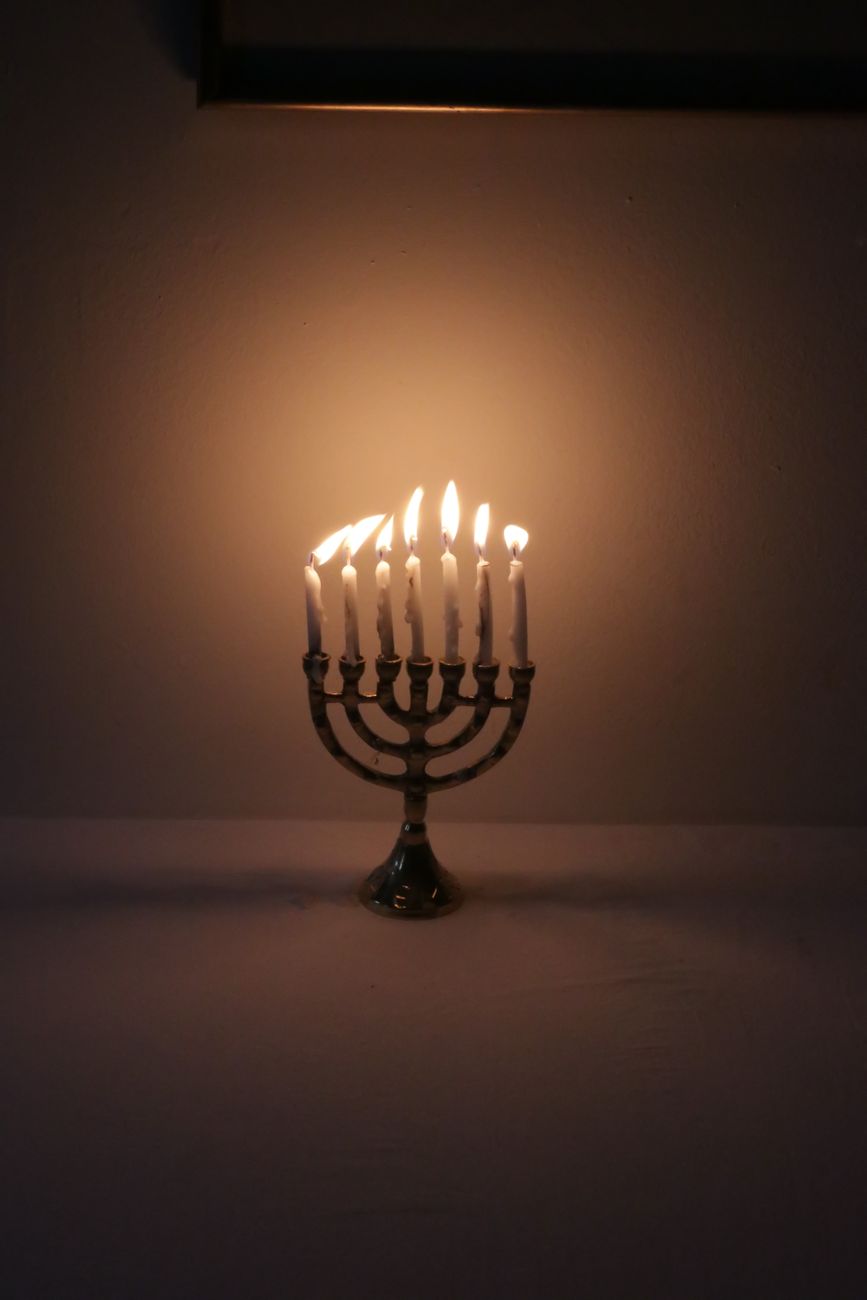
I’ve already talked about how the menorah is like the Messiah in my earlier post The Light’s Contribution to the World, so I won’t repeat myself here. Jesus said he is the vine (the main stalk of the menorah) and we are the branches. Go check out my explanation of that and what Jesus was also saying when He said He is the Light of the World and Israel (and by implication all believers) are the light of the world.
But I will point out now that God’s instructions for how the lamps were to cast their light forward in front of the menorah “reveals that the wicks on the right and on the left were all directed at the menorah’s central stem, thus concentrating its light at the middle” (Complete Jewish Study Bible, 184). Keep that understanding of the menorah in your mind as you read these words of Jesus:
14 “You are the light of the world. A city set on a hill cannot be hidden. 15 Nor do people light a lamp and put it under a basket, but on a stand, and it gives light to all in the house. 16 In the same way, let your light shine before others, so that they may see your good works and give glory to your Father who is in heaven (Mt. 5:14-16).
Jesus is telling His disciples to function the same way the branches should function on the menorah. The branches’ wicks were all directed at the menorah’s stem, and disciples should direct the light of their good works back to God. Believers should direct their light back to the Lord that it may magnify Him and illuminate the dark world for His glory. Jesus did this for God the Father ultimately through the crucifixion. Jesus, the light of the world (Jn 8:12), shone His light back to God the Father. He said,
“Now is my soul troubled. And what shall I say? ‘Father, save me from this hour’? But for this purpose I have come to this hour. Father, glorify your name.” Then a voice came from heaven: “I have glorified it, and I will glorify it again” (Jn. 12:27-28).
Jesus poetically calls His death by execution His “hour.” Jesus asks God to glorify Himself through the crucifixion, for that is Jesus’ “purpose.” The Father responds audibly that He has glorified His Name already and will glorify it again through the crucifixion. Jesus is our ultimate example for how to glorify God with our good works because he did it, and ultimately at the cross.
The Complete Jewish Study Bible also says, “Because the lights are not spread out, the rabbis teach that the menorah reveals that God is the source of all light, and there was no additional need for illumination within the Mishkan” (184). Knowing this, the following New Testament passage has so much more meaning:
Every good gift and every perfect gift is from above, coming down from the Father of lights, with whom there is no variation or shadow due to change (James 1:17).
I am just loving discovering how the Torah and the New Testament fit together like a hand in glove.
Now pulling in the haftarah portion from Zechariah, it says this:
4 And the angel who talked with me came again and woke me, like a man who is awakened out of his sleep. 2 And he said to me, “What do you see?” I said, “I see, and behold, a lampstand all of gold, with a bowl on the top of it, and seven lamps on it, with seven lips on each of the lamps that are on the top of it. 3 And there are two olive trees by it, one on the right of the bowl and the other on its left.” 4 And I said to the angel who talked with me, “What are these, my lord?” 5 Then the angel who talked with me answered and said to me, “Do you not know what these are?” I said, “No, my lord.” 6 Then he said to me, “This is the word of the Lord to Zerubbabel: Not by might, nor by power, but by my Spirit, says the Lord of hosts. 7 Who are you, O great mountain? Before Zerubbabel you shall become a plain. And he shall bring forward the top stone amid shouts of ‘Grace, grace to it!’” (Zech. 4:1-7).
Did the angel actually answer Zechariah’s answer? Did he actually say who the two olive trees are and what the menorah is there for? In Revelation, we get a little more, well, revelation:
11 Then I was given a measuring rod like a staff, and I was told, “Rise and measure the temple of God and the altar and those who worship there, 2 but do not measure the court outside the temple; leave that out, for it is given over to the nations, and they will trample the holy city for forty-two months. 3 And I will grant authority to my two witnesses, and they will prophesy for 1,260 days, clothed in sackcloth.”
4 These are the two olive trees and the two lampstands that stand before the Lord of the earth. 5 And if anyone would harm them, fire pours from their mouth and consumes their foes. If anyone would harm them, this is how he is doomed to be killed. 6 They have the power to shut the sky, that no rain may fall during the days of their prophesying, and they have power over the waters to turn them into blood and to strike the earth with every kind of plague, as often as they desire (Rev. 11:1-6).
The two olive trees are two witnesses who are given authority to consume their foes with fire and stop the rain like the fiery prophet Elijah who was sent to bring revival to Israel whom God poetically called Sodom (Ez. 16:46-56). They are given the power to turn water into blood and send plagues like Moses who was called to lead Israel out of Egypt. It’s interesting that Jerusalem at this time is symbolically called Sodom and Egypt (vs. 8). Now are the witnesses literally going to breathe fire? I don’t know about that. I won’t limit in my mind what God would or could do, but I do think it’s important to remember the angel’s words, “Not by might, nor by power, but by my Spirit, says the Lord of hosts.” John the Baptist, of whom Jesus said, “he is Elijah who is to come” (Mt. 11:14) (concerning Malachi’s prophecy in Malachi 4:5), spoke to the people by the Jordan and said,
“Even now the axe is laid to the root of the trees. Every tree therefore that does not bear good fruit is cut down and thrown into the fire.
“I baptize you with water for repentance, but he who is coming after me is mightier than I, whose sandals I am not worthy to carry. He will baptize you with the Holy Spirit and fire” (Mt. 3:10-11).
He did not literally call down fire on people, but he sure started a spiritual fire in Israel during his days, He gave the glory back to God through Messiah, and he was killed just as the two witnesses will be killed. God builds and builds on His stories.
These two witnesses will be lights in a dark place at a dark time in the earth’s history. They will be like menorah’s shining their light in the world back to the source of all light, the Father of lights, God Himself. Like an olive tree that is cut to the stump but always grows back (a symbol for Israel), they will be killed but raised back to life by God and taken to be with Him (Rev. 11:7-12). They will accomplish their goal not by might nor power, but by God’s Spirit.
The temple was destroyed and Zerubbabel rebuilt it. Jesus, the descendant of Zerubbabel (Mt. 1:13; Lk. 3:27), said, “Destroy this temple, and in three days I will raise it up (Jn. 2:19), the temple being His body (vs. 21). Just as Zerubbabel was commissioned to rebuild the destroyed temple, Jesus rebuilt the temple of His body by the resurrection from the dead.
The two witnesses, whose bodies are temples of the Holy Spirit, will be destroyed and raised again by God not by might nor power, but by His Spirit.
The menorah teaches us we should shine our light back to God to glorify Him, as his servants and prophets always do. Though evil may triumph for a time, John says, “The light shines in the darkness, and the darkness has not overcome it” (Jn 1:5).
Instructions for Setting apart the Levites
The dedication of the Levites to the service of the priesthood has already been covered in the first portion reading for Numbers, B’midbar. Concerning this, I already discussed it relation to Messiah in my post I’ve Been Through the Desert with a Lion Who’s Named, and at that time I connected it to Zechariah’s vision of Joshua the high priest before God in filthy clothing. Let me just say that this is my first time going through the parsha in the order it was scheduled by the sages. So, on my own (with God’s help), I had already connected Zechariah to the substitutionary service of the Levites and Messiah, and here in this portion, which again talks about the substitution of the Levites for Israel, the sages themselves connected Zechariah’s vision with this material. I am blown away. I really do believe it is a confirmation that God is leading me down the right path here as His Holy Spirit brings passages to my remembrance. Please go read about Zechariah’s vision in my previous post under the header “Not by What My Hands Have Done.”
In this portion from Zechariah, we have words to both Joshua the high priest and Zerubbabel the descendant of David. God also says, “Sing and rejoice, O daughter of Zion, for behold, I come and I will dwell in your midst, declares the Lord…and you shall know that the Lord of hosts has sent me to you” (Zech. 2:10, 11b). God says, “I will dwell in your midst” and simultaneously “the Lord of hosts has sent me to you.” How do you reconcile that? It makes complete sense in Messiah Jesus.
1 In the beginning was the Word, and the Word was with God, and the Word was God. 2 He was in the beginning with God…14 And the Word became flesh and dwelt among us, and we have seen his glory, glory as of the only Son from the Father, full of grace and truth (Jn. 1:1, 14).
Just like this portion combines God sending Himself and combines the priesthood and the Davidic line, the Lord of Hosts sent Himself to us in Messiah as priest and King.
Jesus, the Messiah, is after the priestly order of “Melchizedek, king of Salem, priest of the Most High God” (Ps. 110:1, 4; Heb. 7:1,; Mt. 22:45). Only in Messiah are the higher priesthood and the greater rule joined.
The Apostle John also said in one of his letters,
14 And we have seen and testify that the Father has sent his Son to be the Savior of the world (1 Jn. 4:14).
In Zechariah, God sends Himself, and in John’s writings, the Father sent the Son Who also “was God.” When you put the pieces together, they fit!
Zechariah also says when God sends Himself that “many nations shall join themselves to the Lord in that day, and shall be my people” (Zech. 2:11). Jesus said, “And I have other sheep that are not of this fold. I must bring them also, and they will listen to my voice. So there will be one flock, one shepherd” (Jn. 10:16). In Revelation, we see the fulfillment of God’s words through Zechariah and Jesus’ words during His earthly ministry,
After this I looked, and behold, a great multitude that no one could number, from every nation, from all tribes and peoples and languages, standing before the throne and before the Lamb, clothed in white robes, with palm branches in their hands (Rev. 7:9).
They are waving palm branches as is customary for Sukkot, the holy day that even the rabbis say is for the nations to worship God. They are in white robes because the Lord has washed their sins away with the atonement of the Sacrifice, as is customary for Jews to wear on Yom Kippur, the day their sins are atoned for.
The promises of God in Zechariah are fulfilled in the Messiah, Jesus.
Following God’s Exact Instructions
Reading this time, a literary emphasis given through repetition stood out to me. God literarily emphasized that Israel followed all His instructions. God gave directions for the menorah, and that section concludes, “according to the pattern that the Lord had shown Moses, so he made the lampstand” (Num. 8:4). God gave instructions for setting apart the Levites, and that section of instructions concludes with, “as the Lord had commanded Moses concerning the Levites, so they did to them” (Num. 8:22). Concerning observing Passover, it is written in conclusion that “they kept the Passover in the first month, on the fourteenth day of the month, at twilight, in the wilderness of Sinai; according to all that the Lord commanded Moses, so the people of Israel did” (Num. 9:5). And concerning Israel’s travels at God’s direction, “At the command of the Lord they camped, and at the command of the Lord they set out. They kept the charge of the Lord, at the command of the Lord by Moses” (Num. 9:23). They did everything as God told them to do. Good job, guys. The text organizes all this in such a way to juxtapose such a contrast in Israel’s behavior once they start traveling from Sinai, but I will get to that and the end of my next section.
Just as God told the Israelites to follow His instructions exactly, Jesus followed the exact instructions of the Father in both words and deeds. Concerning words, Jesus says,
10 Do you not believe that I am in the Father and the Father is in me? The words that I say to you I do not speak on my own authority, but the Father who dwells in me does his works…24 Whoever does not love me does not keep my words. And the word that you hear is not mine but the Father’s who sent me. (Jn. 14:10…24).
Concerning His deeds, He says,
19 So Jesus said to them, “Truly, truly, I say to you, the Son can do nothing of his own accord, but only what he sees the Father doing. For whatever the Father does, that the Son does likewise (Jn. 5:19).
Like God expected the Israelites to obey His instructions as He gave them, Jesus obeyed His Father’s instructions.
The Israelites didn’t stick with the program very well once they actually left Sinai. They complained about their misfortunes and God’s anger burned against their complaining, so He sent fire to consume some of them and the place was named after the event, Taberah (Burning). In Messiah, we have this command:
14 Do all things without grumbling or disputing, 15 that you may be blameless and innocent, children of God without blemish in the midst of a crooked and twisted generation, among whom you shine as lights in the world (Phil. 2:14-15).
The next stop, where the mixed crown longed for an easier life and the Israelites cried about eating just manna, they both craved something they thought was better, and the place was named Kibroth-hattaavah (Graves of Greed). In Messiah, we have these instructions:
But each person is tempted when he is lured and enticed by his own desire. Then desire when it has conceived gives birth to sin, and sin when it is fully grown brings forth death.
Do not be deceived, my beloved brothers. Every good gift and every perfect gift is from above, coming down from the Father of lights, with whom there is no variation or shadow due to change (James 1:14-17).
At the next stop, in Hazeroth (Courts or Villages), Miriam is cast out of the camp because she stirred up dissent against Moses for superficial reasons.
But Jesus did everything the Father told Him without grumbling or disputing. He was content with what He had, even though it was oftentimes considered insufficient. He went forty days without food (Lk. 4:2). He had no place to lay His head (Mt. 8:20). But even when it wasn’t easy or comfortable, Jesus followed God’s instructions perfectly.
Following the Shekinah
17 And whenever the cloud lifted from over the tent, after that the people of Israel set out, and in the place where the cloud settled down, there the people of Israel camped. 18 At the command of the Lord the people of Israel set out, and at the command of the Lord they camped. As long as the cloud rested over the tabernacle, they remained in camp (Num. 9 17-18).
The special presence of God, called the Shekinah, manifested as a cloud to Israel during the day and as a pillar of fire by night. Israel was to follow the cloud wherever the cloud went whenever the cloud moved. Sometimes the cloud stayed a long time in one place. Sometimes the cloud remained only a few days in one place, but one thing was clear: wherever the Lord went, Israel followed. They did not know where they would be going, when they would be going, how long it would take to get there, nor how long they would stay. It was a journey of faith.
Personally, this is an appropriate portion for me to write about my family’s decision to leave our current church. This makes me very sad, but I trust this is a journey of faith for my family too. I don’t know where we are going, how long it will take to get there, nor how long the Lord will have us stay in a new place. But I believe the Lord has made it abundantly clear to me that it is time to move on. When your pastor tells you from the pulpit that you are a heretic and refuses to baptize let alone examine your seven-year-old child because she is “too young,” then what else do you do? When your elder refuses your help with a counseling ministry he begs for assistance with from the pulpit because you are not a five-point Calvinist, what is left? When you meet a dead end, have your growth stunted, and are set on a shelf to collect dust, what else is there? Yes, my pastor actually teaches that anyone who believes people can choose to put their faith in Jesus are Pelagianists or semi-Pelagianists, and since Palagius was declared a heretic, anyone who believes a person has free will is a heretic or semi-heretic (whatever that is). Surprise! Most of the Christian world throughout all of Church history are heretics then. Most of those Christians never agreed with let alone knew who Pelagius was, but according to my pastor they are Pelagianists or semi-Pelagianists simply because he likewise believed in free will. Forget about all the things for which he was actually declared a heretic, like that Jesus wasn’t divine or like people can earn their salvation. Wow. And as for my daughter whom they say does not meet the requirements for baptism simply because of her age? You know what Jesus said? He said, “Let the little children come to me and do not hinder them, for to such belongs the kingdom of heaven” (Mt. 19:14, emphasis mine).
You know, I just met in a home church and got to meet a missionary in Hong Kong, and among the many amazing stories she told, she talked about the opportunity to visit the largest leper colony in the world which is in Indonesia. She talked about the miraculous healings that happened while they went door to door and prayed over people, and while they worshiped together in a church that had been set up in the middle of the colony. Seven-year-olds went with their parents, believers from every continent on the earth short of Antarctica, and when seven-year-olds prayed over people, they were healed. In corporate worship, a seven-year-old girl laid her hands on an elderly woman’s knees who was wheelchair bound because of her bad knees. She prayed over her and the woman got up and started dancing. When they went door-to-door, a seven-year-old boy laid his hands on a man’s crippled arthritic hands. His arthritis was so severe, he couldn’t pick up a glass of water. When the boy prayed over him, his hands were completely healed. They were perfectly healthy and all the disfigurement was gone. Moreover, his spirit was healed when he received eternal salvation that day. The specific age of those children who God worked miracles through is the exact same age as my daughter whom my church won’t even baptize. My daughter has received Jesus as her Savior and given her life to Him, and she has asked repeatedly to be baptized, but my pastors won’t even give her the time of day to talk to her.
As for the growing exclusivity of Calvinist doctrine, this is a Reformed non-denominational church, and the Southern Baptists are going the same direction. As they become Reformed Baptist, this exclusivity is being applied more and more to believers in their seminary faculty, in the ordination of pastors, and obviously now to the congregants as well. They say if they aren’t Calvinists, they have bad theology and they can’t serve. Yes, my elder told me that my husband and I have bad theology because we believe a person can choose to trust in the saving work of Jesus. I care very much for my elder. He’s a great guy, he helped us move, but he makes Calvinism such a dividing factor. And to put the cherry on top, just when I decided to keep my head low for the rest of my time there, he finds me Sunday morning and begins arguing with me about replacement theology when I was caught off guard with insufficient time to respond. You could say I was ambushed. And for what? Because I asked, “How are you doing?” I’m telling you, reformed theology and replacement theology oftentimes go together. I was raised a Calvinist, you know, and after my own study, I concluded that is not what the Bible explicitly says. But what has also really convinced me is the lack of love I see in Calvinists concerning their attitude toward doctrine, their air of superiority, the notion that a free willer is sub-Christian. I am not making this a dividing factor. I never did even when I was a Calvinist. I married a free will believing Baptist. The Reformed pastors are showing preference and excluding us from the ministry. That alone, the way they treat other believers, is telling. I share this with you because this is the direction many evangelical churches are going. It’s going to be hard for my kids in their lifetime if the Lord doesn’t come back by the time they are adults.
I don’t feel sorry for myself. I’m actually excited for what God has next for me and my family. But I do feel sorry for them, because I think they are missing out a lot on the grace of God (which would sound ironic to them). What you believe about this doesn’t change that you should believe in Jesus and share the gospel, but it does determine your understanding of the nature of God. You might be Calvinist, and I get it. That’s fine. Work it out between you and God (Phil. 2:12). This post isn’t necessarily about you. This is about my experience and the correlations I see with the Calvinists around me. When I was a Calvinist, I would have been very saddened if I heard about Calvinists treating other believers this way simply because they are not. Hey, I’m just thankful they aren’t going to drown my husband and me with our hands tied behind our backs like the Anabaptists and raise our children the way they think they should be raised. I’m glad they aren’t going to burn us at the stake like John Calvin’s community did to a man who disagreed with him. I’m glad all they’re doing is calling us heretics and giving us freedom to leave peacefully. Hopefully I’ll see them on the other side and we can have a better understanding of each other one day. In the meantime, I’ll pray for the Church’s unity (which is not the same as conformity). I did not think this would be a thing in the American Bible belt, but now it is.
But in my upcoming journey, I need to guard myself against complaining like the people of the desert wandering, growing greedy for an easier life like the mixed crowd, weep for the way things used to be like the Israelites, or whine over God’s sustaining provision like they did with the manna. I need to be careful I don’t criticize my spiritual leaders for superficial ungodly reasons like Miriam criticized Moses for marrying and Ethiopian. I’m not superior to them. I’m human just like they were. Rather, the Apostle Paul says, “Now these things took place as examples for us, that we might not desire evil as they did” (1 Cor. 10:6). If I’m smart, I’ll learn from the example.
Jesus followed God’s will wherever it led, even to the cross. He expects no less of me nor any believer.
The Silver Trumpets Verses the Shofar
Numbers 10 gives instructions about fashioning two silver trumpets that should be used to gather the people. One was sounded to gather just the leaders, but two were sounded to gather the entire assembly. On the other hand, when they needed to sound an alarm concerning a natural disaster or a military attack, they sounded an alarm specifically on the shofar (ram’s horn) (Complete Jewish Study Bible, 186). Could this explain the trumpet that gathers believers unto the Lord verses the seven trumpets in Revelation that sound over the earth bringing plagues on the earth? Like the function of the silver trumpets, there is a trumpet that will sound over the earth, God’s trumpet, gathering God’s assembly unto Himself, both living and dead (1 Cor. 15:52; 1 Thes. 4:16). And like the function of the shofar, the sound of the alarm will go out over the earth by the seven angels who bring plagues on the earth like a military attack. Those blasts are also meant to bring calls for repentance, for people are not the enemy, but the enemy is spiritual, that is, the devil and his angels. However, Revelation tells us that people “did not repent” (Rev. 9:20; 16:9, 11). That means they at least had to have the chance to repent. So the battle blast is not against people, but the enemy, Satan. Might I add that before the Feast of Trumpets, during the month Elul, the shofar is sounded every day in preparation for the day it should be sounded on the Feast of Trumpets. Is there a deeper meaning behind only Aaron and his sons being able to sound the silver trumpets? I am not spending a whole lot of time on this because I’m behind schedule, but I would enjoy coming back around to this and exploring it if there is something more to the instructions of Numbers 10 concerning trumpets and shofars and the last days.
Manna from Heaven
The last thing I want to address is the imagery of manna in relation to the Messiah. Jesus said He is the Manna from heaven:
“I am the living bread that came down from heaven. If anyone eats of this bread, he will live forever. And the bread that I will give for the life of the world is my flesh” (Jn. 6:51).
And just like the Israelites of the wandering years complained, “there is nothing at all but this manna to look at” (Num. 11:6), the Jews of Jesus’ time were discontent with Him too.
41 So the Jews grumbled about him, because he said, “I am the bread that came down from heaven.” 42 They said, “Is not this Jesus, the son of Joseph, whose father and mother we know? How does he now say, ‘I have come down from heaven’?” (Jn. 6:41-42).
So like the Israelites complained about the manna, the Jews complained about Jesus. Jesus said He is greater than the manna that sustained Israel in the desert for forty years. He says He is “the bread that came down from heaven, not like the bread the fathers ate, and died. Whoever feeds on this bread will live forever” (Jn 6:58).
Jesus is the Bread of Heaven that gives all eternal life. The Israelites had to go out of their tents six days of the week and gather the manna. It’s didn’t land in their tents. And they had to do it on the days allowed, that is, six days of the week. We have to get out of our present abode, go search for Him, and do it during the time God allows. Just as the author of Hebrews says, citing Psalm 95, “Today, if you hear his voice, do not harden your hearts as in the rebellion, on the day of testing in the wilderness (Heb 3:7-8). The consequence of hardening your heart and not going to find Him is that you cannot enter His rest, that is, eternal life. Concerning the Israelites who rejected God in the wilderness, God says, “As I swore in my wrath, ‘They shall not enter my rest’” (Heb. 3:11). But if we soften our hearts and seek Him, He gives us the Bread of Heaven by which we live forever.
Conclusion
My prayer for our world is that we would look to the Messiah as our Light and shine our light to glorify our God in heaven like the lamps were oriented to the central stem, trust in the substitutionary work of Jesus on our behalf like the Levites were for Israel, follow God’s instructions to us exactly as He gave them in His Word, follow God wherever He leads us in our wilderness, gather together when He sounds His trumpet for us, repent and defect from the enemy at the sound of the alarm, and eat of the Manna of Heaven by which we will live forever. Amen, and until next time, God bless.
The Shepherd tells His sheep to go
With one call and they rise.
He leads them down the path He'll show,
A sunrise in the skies.
They pant to pastures that are green
And waters that are still,
A place none of the sheep have seen.
They go to where He will.
The path is old and worn down well,
The Shepherd always tread,
A narrow valley, shadowed dell.
But some sheep might instead
Prefer the grass greener o'er there
Or smoother paths beside,
But I will keep apace right where
My Shepherd's feet abide.
Some sheep might wander if they follow
Their companion's tail
Instead of where the sheep should go,
Though not an easy trail.
Some follow the lead in the herd,
But I, I follow the Shepherd.
Sources
The Bible. English Standard Version. Biblegateway.com. Accessed 19 Jun. 2026.
The Complete Jewish Study Bible. Peabody, Hendrickson Publishers, 2016.

 Valley Princess
Leave a comment