Numbers 4:21-7:89
Judges 13:2-25
The next portion of Scripture in the reading schedule is Naso (Take), which was read this year on May 23. The Scripture is cited above for your convenience. I suggest you look at the Scripture first before reading my post, or at least as you go through my post. Like always, I’m going to identify the Messiah in this strip of the Word. This section takes us through laws for restitution, suspicion of an adulterous wife, the Nazarite, the Aaronic blessing, and the offerings of tribal leaders for the newly consecrated tabernacle. It also covers the origin story of Samson.
The Restitution
5 And the Lord spoke to Moses, saying, 6 “Speak to the people of Israel, When a man or woman commits any of the sins that people commit by breaking faith with the Lord, and that person realizes his guilt, 7 he shall confess his sin that he has committed. And he shall make full restitution for his wrong, adding a fifth to it and giving it to him to whom he did the wrong. 8 But if the man has no next of kin to whom restitution may be made for the wrong, the restitution for wrong shall go to the Lord for the priest, in addition to the ram of atonement with which atonement is made for him (Num. 5:5-8).
When Israel committed any sin, man or woman, that sinner was instructed to confess his or her sin and give restitution with an extra 20 percent on top. In the physical realm, we are supposed to try to make good on our mistakes. But what do you do when what you did cost someone’s trust? What about their livelihood? What if what you did cost someone their wife or their children? How do you restore that? Moreover, how do you repay the God Whom you have wronged? I know the Torah has civil laws in those instances that I’ve already covered in this series, but now I’m trying to get at the spiritual dimension and the realm of conscience. What do you do when you cannot repay the debt? For any sin, whether you see it as big or small, the Apostle John says, “If we confess our sins, he is faithful and just to forgive us our sins and to cleanse us from all unrighteousness” (1 Jn. 1:9). Just like in Numbers where the transgressor should confess his sin, John’s audience should confess their sin. But instead of John’s audience being told to make restitution, John says this: “…Jesus Christ the righteous…is the propitiation for our sins, and not for ours only but also for the sins of the whole world” (1 Jn. 2:1b, 2:2). Jesus, Messiah, the Righteous is the restitution plus 20 percent. This is far from saying that people are off the hook for their sins and can do whatever because the Torah is obsolete. To the contrary, John says,
2 My little children, I am writing these things to you so that you may not sin. But if anyone does sin, we have an advocate with the Father, Jesus Christ the righteous. 2 He is the propitiation for our sins, and not for ours only but also for the sins of the whole world. 3 And by this we know that we have come to know him, if we keep his commandments. 4 Whoever says “I know him” but does not keep his commandments is a liar, and the truth is not in him, 5 but whoever keeps his word, in him truly the love of God is perfected. By this we may know that we are in him: 6 whoever says he abides in him ought to walk in the same way in which he walked.
7 Beloved, I am writing you no new commandment, but an old commandment that you had from the beginning. The old commandment is the word that you have heard. 8 At the same time, it is a new commandment that I am writing to you, which is true in him and in you, because the darkness is passing away and the true light is already shining. 9 Whoever says he is in the light and hates his brother is still in darkness. 10 Whoever loves his brother abides in the light, and in him there is no cause for stumbling. 11 But whoever hates his brother is in the darkness and walks in the darkness, and does not know where he is going, because the darkness has blinded his eyes (1 Jn. 2:1-11).
John says this is “no new commandment, but an old commandment that you had from the beginning,” that is, in the Torah. You fulfill Torah by loving your brother, and you love your brother by providing restitution as the Torah requires, but ultimately, in the spiritual (which is eternal), Jesus the Righteous is both our “advocate with the Father” and “propitiation for our sins”.
I think it is so amazing how the New Testament uses the language of the Torah and most readers don’t even realize it! I was one of those concerning this passage until now!
Jesus, therefore, is the restitution plus 20 percent of Numbers chapter 5.
The Offering of Jealousy
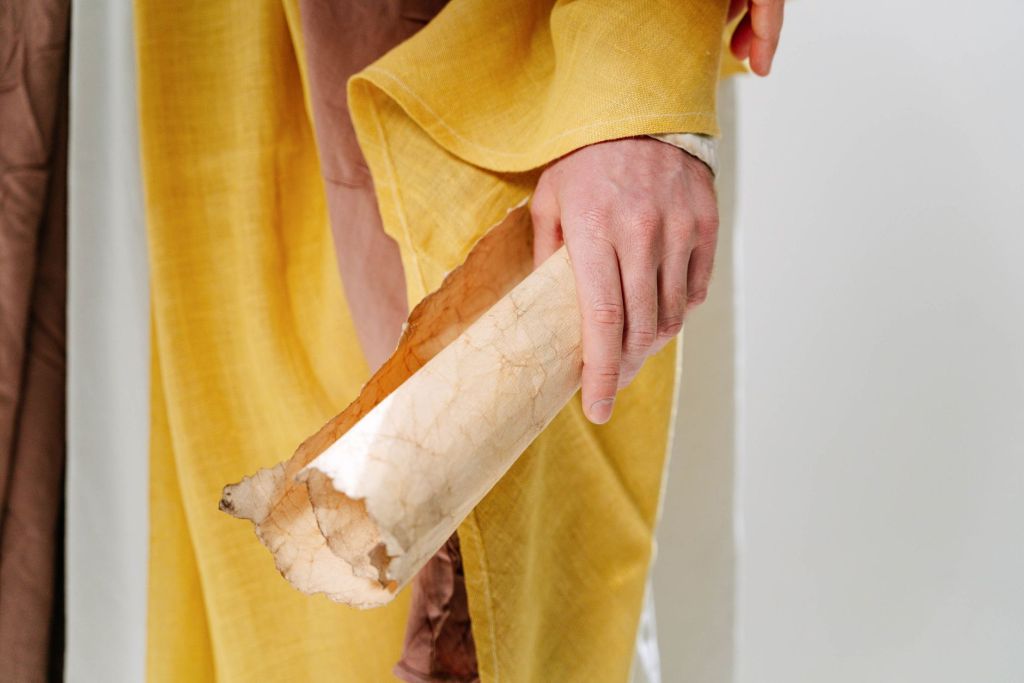
The next section of Naso is about the offering of jealousy. It’s a long section, so I’ll paraphrase (but please read it yourself!). If a husband suspected his wife committed adultery, but he couldn’t prove it, he could bring her to the tabernacle with a grain offering (which is treated the same as grain for a sin or guilt offering. Please see my posts “The Grain Offering He Called for” and “The Sin Offering and the Guilt Offering He Called for“). The priest would put holy water and dust of the tabernacle floor in a clay pot, put the woman before God, unbind her hair, and put the grain offering in her hands. With the pot of holy water in his hand, the priest would make the woman promise that if she had sinned by adultery, that specific curses would come upon her, but if she was innocent, then nothing would happen to her. The priest would “wash” (ESV) or “scrape” (CJB) the curses he just iterated off of a scroll or “book” (ESV) and into the holy water. The woman would then drink the water.
This is really weird to a 21st century western mind, and some might think its chauvinistic even. Even pastors can scratch their heads and throw up their hands and say, “We just have to trust God that this was good then but thank goodness that’s over with!” But we can do better than that, guys. Yes, this was God’s way of protecting innocent women from an unjust punishment at that time in history, but I want to take it deeper and bring it full circle back to Messiah. First, let’s look at a New Testament passage while we keep this passage in Numbers 5 in our back pocket.
2 Early in the morning he came again to the temple. All the people came to him, and he sat down and taught them. 3 The scribes and the Pharisees brought a woman who had been caught in adultery, and placing her in the midst 4 they said to him, “Teacher, this woman has been caught in the act of adultery. 5 Now in the Law, Moses commanded us to stone such women. So what do you say?” 6 This they said to test him, that they might have some charge to bring against him. Jesus bent down and wrote with his finger on the ground. 7 And as they continued to ask him, he stood up and said to them, “Let him who is without sin among you be the first to throw a stone at her.” 8 And once more he bent down and wrote on the ground. 9 But when they heard it, they went away one by one, beginning with the older ones, and Jesus was left alone with the woman standing before him. 10 Jesus stood up and said to her, “Woman, where are they? Has no one condemned you?” 11 She said, “No one, Lord.” And Jesus said, “Neither do I condemn you; go, and from now on sin no more” (Jn. 8:2-11).
I’m going to do a compare and contrast between Numbers 5 and this passage. First, Numbers prescribes what should be done if a man suspects his wife is committing adultery and he becomes jealous. In John, a woman is clearly accused of adultery, in fact caught in the very act (and we’re all wondering where the guy is, right?). In Numbers, the woman is supposed to be brought to the tabernacle. In John, the adulteress is brought to the temple. In Numbers, the priest combines holy water and dust from the tabernacle floor in a clay jar and wipes the curses from the scroll into it for the woman to drink. In John, Jesus wrote with His finger on the temple floor (presumably sand aka dust). The question that never gets answered but everyone wonders is what He wrote. I’ve heard that it could have been the sins of the accusers, or the Ten Commandments. Perhaps it could also have been the imprecations for the adulteress in Numbers 5. I don’t know. It’s worth considering though, I think, given the other parallels between these passages. Whatever it was, it was enough to get the woman’s accusers off her back.
John 8:2-11 is placed right after the last day of Sukkot, when Jesus stood up in the temple and cried out in a loud voice, “If anyone thirsts, let him come to me and drink. 38 Whoever believes in me, as the Scripture has said, ‘Out of his heart will flow rivers of living water’” (Jn. 7:37b-38). So right before the passage of the adulterous, Jesus connects Himself to Living Water, that is, the Holy Spirit, holy water. In my post, “The Order, Fire, Clay Pot, and Third Day,” I connect Jesus’ body to an earthenware vessel (aka clay pot). So He is the clay pot and in Him is the holy water, the living water, the Spirit, which He gives.
In Numbers 5, the curses are scraped or wiped into the pot. What of that? If Jesus is the pot, then the curses are put into Jesus. As Isaiah says, “upon him was the chastisement that brought us peace” (Is. 53:5). Instead of having her take the curses into herself, Jesus took the curses into Himself. Instead of her having to drink the cup, Jesus drank the cup. The night He was betrayed, He prayed, “My Father, if it be possible, let this cup pass from me; nevertheless, not as I will, but as you will” (Mt. 26:39). Jesus drank the cup for the adulteress and He drank it for everyone, for everyone is guilty of adultery spiritually. During the last portion, we read Hosea, whose entire life God orchestrated to allegorize His relationship to Israel. Hosea married a promiscuous woman who was unfaithful, and God entered covenant with an idolatrous people, people who were unfaithful to worshipping only Him, the only true God.
We are all worse than the woman who might have committed adultery. We did commit adultery by not loving God with our whole hearts. Exodus 43:14 says, “for you shall worship no other god, for the Lord, whose name is Jealous, is a jealous God.” As a man can be jealous of his wife, God is jealous for his people. When you are jealous for what rightfully belongs to you, there is nothing wrong with that. Because we, His creation, were not faithful to Him, we deserve the curses of Numbers 5 and even death. But Jesus took both for us. And he says, “Neither do I condemn you; go, and from now on sin no more.”
The Nazirite
The portion called Naso includes the passage in the Torah concerning Nazirites, and it also includes a passage from the life story of a man who was a Nazirite from the womb, Samson. A Nazirite was someone who made a vow to God, and until that vow was completed, they did not drink wine (or even grape juice given the slightest risk of fermentation), cut their hair, or come in contact with the dead. When their vow was completed, they could drink wine again and cut their hair.
Jesus was not necessarily a Nazirite (at least the Bible doesn’t specify Him as such), but there are some fascinating parallels between the birth story of Samson and the birth story of Jesus that I want to compare, and there are some fascinating aspects of Jesus’ final hours that match the requirements of a Nazirite. Even in the instructions for the Nazirite, we can see a little foreshadowing of Messiah.
First, let me just block quote the two passages I will compare, and then we will dive into to the explanations.
And the people of Israel again did what was evil in the sight of the Lord, so the Lord gave them into the hand of the Philistines for forty years.2 There was a certain man of Zorah, of the tribe of the Danites, whose name was Manoah. And his wife was barren and had no children. 3 And the angel of the Lord appeared to the woman and said to her, “Behold, you are barren and have not borne children, but you shall conceive and bear a son. 4 Therefore be careful and drink no wine or strong drink, and eat nothing unclean, 5 for behold, you shall conceive and bear a son. No razor shall come upon his head, for the child shall be a Nazirite to God from the womb, and he shall begin to save Israel from the hand of the Philistines” (Judges 13:1-5).
26 In the sixth month the angel Gabriel was sent from God to a city of Galilee named Nazareth, 27 to a virgin betrothed to a man whose name was Joseph, of the house of David. And the virgin’s name was Mary. 28 And he came to her and said, “Greetings, O favored one, the Lord is with you!” 29 But she was greatly troubled at the saying, and tried to discern what sort of greeting this might be. 30 And the angel said to her, “Do not be afraid, Mary, for you have found favor with God. 31 And behold, you will conceive in your womb and bear a son, and you shall call his name Jesus. 32 He will be great and will be called the Son of the Most High. And the Lord God will give to him the throne of his father David, 33 and he will reign over the house of Jacob forever, and of his kingdom there will be no end” (Lk. 1:26-33).
When Samson was born as a judge and savior, it was not during a time of revival and repentance for Israel. No, instead, the Bible tells us, “And the people of Israel again did what was evil in the sight of the Lord” (Judges 13:1). Likewise, when Jesus was born, what was our spiritual condition? The Apostle Paul writes, “but God shows his love for us in that while we were still sinners, Christ died for us” (Rom. 5:8). Just like Israel, we were doing what was evil in the sight of the Lord. We were sinners too. But just as God did not leave Israel in the consequences of its evil (oppression by the Philistines), God did not leave us in our sin. (Just as a side note, if God gave Israel a deliverer while it did what was evil in His sight, and Jesus died for us while we were still sinners, why would God replace His people and reject His chosen right after the Messiah completed His task? I’m just sayin’.)
Secondly, just as Samson’s birth and calling were heralded by the angel of the Lord, Jesus’ birth and calling were heralded by the angel Gabriel. The angel of the Lord told Manoah’s wife, “you shall conceive and bear a son…for the child shall be a Nazirite to God from the womb, and he shall begin to save Israel from the hand of the Philistines” (Judges 13:5). Gabriel told Mary, “you will conceive in your womb and bear a son, and you shall call his name Jesus. 32 He will be great and will be called the Son of the Most High. And the Lord God will give to him the throne of his father David, 33 and he will reign over the house of Jacob forever, and of his kingdom there will be no end” (Lk. 1:31b-33). And though Gabriel told Mary what to name Him, an angel of the Lord separately told Joseph why He should have that name: “you shall call his name Jesus, for he will save his people from their sins” (Mt. 1:21). In both instances, heavenly beings specified their purposes and callings. Herein lies a difference. Whereas the angel of the Lord told Manoah’s wife that Samson would “begin to save Israel from the hand of the Philistines” (emphasis mine), an angel of the Lord told Joseph Jesus would “save his people from their sins.” Both of their callings and purposes were divinely announced, but Jesus’ calling is higher. Whereas Samson would begin a saving work from an earthly enemy, Jesus would actually completely save from an eternal enemy: sin. The Complete Jewish Study Bible says, “The P’lishtim continued to frustrate the Israelites until David subjugated them early in his reign (ca. 1004 B.C.E; 2 Sam. 5:17-25)” (323). Jesus, the Son of David, finishes the job like David finished the job against the Philistines. David defeated the Philistines in a particular region on the western coast of the Mediterranean sea, but Jesus overcame the world. He said, “In the world you will have tribulation. But take heart; I have overcome the world” (Jn. 16:33). In Revelation, one of the elders in heaven says, “Weep no more; behold, the Lion of the tribe of Judah, the Root of David, has conquered” (Rev. 5:5). Samson began overcoming the Philistines, but Jesus completely overcame the world.
Thirdly, just as Samson was set apart as a Nazirite from the womb, Jesus was set apart as Messiah from the womb. The angel of the Lord told Manoah’s wife, “the child shall be a Nazirite to God from the womb,” (Judges 13:5). Psalm 22, which Jesus began quoting on the cross concerning Himself, says,
[Y]ou are he who took me from the womb;
you made me trust you at my mother’s breasts.
On you was I cast from my birth,
and from my mother’s womb you have been my God. (Ps. 22:9-10).
Both Jesus and Samson were set apart from the womb. The words of Gabriel also distinguish Jesus’ high calling before He was conceived in the flesh: “He will be great and will be called the Son of the Most High. And the Lord God will give to him the throne of his father David, and he will reign over the house of Jacob forever, and of his kingdom there will be no end.”
So far, I have discussed Jesus’ birth story compared to Samson’s birth story, but for the rest of this section, I want to move back to Number 6 to look at the obligations of the Nazirite and compare them to some similar signs surrounding Jesus’ death. A Nazirite gave a vow, and with the vow, he could not drink wine until the vow was completed. Now think about this: during the Last Supper, Jesus said He would not drink wine or juice again until the kingdom of God came. Three of the four gospel writers record His words:
“I tell you I will not drink again of this fruit of the vine until that day when I drink it new with you in my Father’s kingdom” (Mt. 26:29).
“Truly, I say to you, I will not drink again of the fruit of the vine until that day when I drink it new in the kingdom of God” (Mk. 14:25).
“For I tell you that from now on I will not drink of the fruit of the vine until the kingdom of God comes” (Lk. 22:18).
Well, the kingdom of God must have come while Jesus was on the cross, because He drank wine on the cross right before He died.
28 After this, Jesus, knowing that all was now finished, said (to fulfill the Scripture), “I thirst.” 29 A jar full of sour wine stood there, so they put a sponge full of the sour wine on a hyssop branch and held it to his mouth. 30 When Jesus had received the sour wine, he said, “It is finished,” and he bowed his head and gave up his spirit (Jn. 19:28-30).
Wow. John makes it a point that we know “all was finished” and “[i]t is finished” when He drank wine again. And this, he specifically states, is to fulfill Scripture. That is very interesting. Like the Nazirite could not drink wine until his vow was completed, Jesus did not drink wine again until “all was finished.” He ushered in the kingdom of God in the invisible spiritual realm. He began His ministry proclaiming the kingdom of God was at hand (Mt. 4:17; Mk. 1:15) and He ended it by ushering it in. His kingdom in this instance is to be with His people forever. We can be with God forever now because of the propitiation of Jesus.
Secondly, a Nazirite could not touch a dead body until his vow was completed. If he did, he had to reconsecrate himself and start over: “the previous period shall be void, because his separation was defiled” (Num. 6:12b). Even “if any man dies very suddenly beside him,” it would defile him and nullify his vow (vs. 9). Wait a minute, Jesus was put between two criminals sentenced to death. There is no way Jesus can be compared to that aspect of the Nazirite vow, right? Actually, Jesus finished His work and breathed His last before they died. He did not come in contact with the dead, nor did either of those criminals die suddenly beside him.
31 Since it was the day of Preparation, and so that the bodies would not remain on the cross on the Sabbath (for that Sabbath was a high day), the Jews asked Pilate that their legs might be broken and that they might be taken away. 32 So the soldiers came and broke the legs of the first, and of the other who had been crucified with him. 33 But when they came to Jesus and saw that he was already dead, they did not break his legs (Jn. 19:31-33).
Why did the soldiers come around to break their legs? To kill them. If their legs were broken, they would be unable to push themselves up to breathe, and they would die by asphyxiation. Jesus gave up His spirit before either one of the criminals died, and therefore no man suddenly died beside him, just like the requirement for a Nazirite. Again, I’m not saying the Bible says Jesus was a Nazirite, but there are some very interesting correlations between the requirements of a Nazirite and the death of Jesus. It’s just another facets of the intricacies of Scripture to wonder about and be in wonder of His majesty.
The Blessing
The Lord bless you and keep you;
the Lord make his face to shine upon you and be gracious to you;
the Lord lift up his countenance upon you and give you peace (Num. 6:24-26).
Aaron and his sons were supposed to speak this blessing over the people of Israel. By this blessing Israel was blessed, and according to this blessing God ultimately blessed Israel and all humanity through the Messiah.
Jesus blessed the people throughout His ministry but also specifically blessed His disciples as He ascended into heaven: “And he led them out as far as Bethany, and lifting up his hands he blessed them. 51 While he blessed them, he parted from them and was carried up into heaven” (Lk. 24:50-51). Jesus kept the people. At His arrest, He said, ““Of those whom you gave me I have lost not one” (Jn. 18:9). Through Jesus the Lord shone His face to us and was gracious to us. John 1:14 says, “14 And the Word became flesh and dwelt among us, and we have seen his glory, glory as of the only Son from the Father, full of grace and truth.” At the Last Supper,
8 Philip said to him, “Lord, show us the Father, and it is enough for us.” 9 Jesus said to him, “Have I been with you so long, and you still do not know me, Philip? Whoever has seen me has seen the Father. How can you say, ‘Show us the Father’? (Jn. 14:8-9).
The Lord’s face shone on us through Jesus. The Lord lifted up His countenance upon us in Jesus. The Lord also gives us His peace through Jesus. Jesus said at the Last Supper, “Peace I leave with you; my peace I give to you. Not as the world gives do I give to you. Let not your hearts be troubled, neither let them be afraid” (Jn. 14:27). And after Jesus’ resurrection, twice He appeared to them locked away in privacy and thrice proclaimed, “Peace be with you” (Jn. 20:19, 21, 26). Even when you are as alone as you can get, locked away in your privacy, God is ready to give you His peace through Jesus. Wow. When Aaron and his sons blessed the people, it was done over the assembly in public settings. But God’s peace through Jesus reaches you even in your most secluded and private place. God’s peace in the Messiah is that powerful, the peace that He made by the blood of His cross (Col. 1:20).
Conclusion
My prayer is that we trust in Jesus as our restitution to God for sin, the One Who took our curses for adultery in the cup of God’s wrath on the cross, the One Who completed all He was born to do and fulfilled all His promises, and the One through Whom we receive God’s blessing, favor, grace, and peace.
While she was deep in her adultery,
Unfaithful to the soul, solid sinner,
Her First Love was provoked to jealousy
To change her guilty charge before augur.
Her robbery required restitution.
Her damage demanded restoration.
Her poverty served her no solution,
'Til He paid for her propitiation,
Her First Love, Savior, stronger than Samson,
Rushed in, bore the blow, and caught her curse,
Paid her penalty and completely won,
A love story foretold in every verse,
Because as soon as she to Him confessed
He faithfully forgave and gladly blessed.
Starting July 4, I will post daily for 40 days from my book, Learning to Love: a Collection of Poetry and 40 Daily Devotions while I also continue this series through the parsha. If you or your friends are looking for a good devotional series over the summer, check back here daily starting July 4. You can also purchase the devotional series in book format on Amazon. Until next time, God bless.
Sources
The Bible. English Standard Version. Biblegateway.com. Accessed 18 Jun. 2026.
The Complete Jewish Study Bible. Peabody, Hendrickson Publishers, 2016.


Leave a Reply