Vayak’hel (He Assembled):
Exodus 35:1-38:20
Haftarah: 1 Kings 7:13-26, 40-50
P’kudel (Accounts):
Torah: Exodus 38:21-40:38
Haftarah: 1 Kings 7:40-8:21
Long ago, the Jewish sages created reading calendars to be read annually throughout all the synagogues every sabbath. They are the Parsha (from the Torah, the first five books of the Bible), and the Haftarah (selected readings from the prophetic books of the Old Testament). Today, I continue my series exploring the Messiah in each of these portioned readings that was planned and scheduled in ancient days and appointed for our present days.
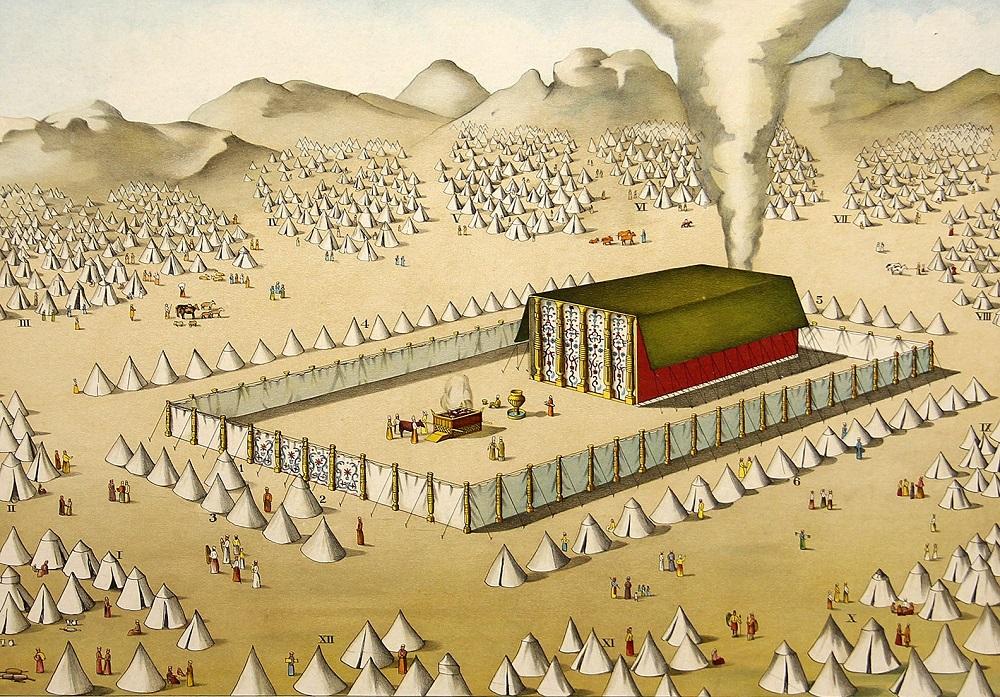
This week is a double portion reading according to the schedule. So for March 14, 2026, we have Vayak’hel (He Assembled) and P’kudel (Accounts). The specific passages under these readings are cited above for your reference. Between these two passages, we as readers are taken from a reiteration of Shabbat, to the voluntary contribution, to the making of the tabernacle, to the presentation of the tabernacle material to Moses, to God-given instructions for erecting the tabernacle, to a detailed description of Moses erecting the tabernacle, to God accepting the tabernacle with His presence. And then we have the close of Exodus. Again, it’s a lot, but we’re going to tackle it and find Messiah.
I set out on this project searching for every single detail that Messiah is in, and I quickly found I just can’t do it. It’s too much for me. But God is rewarding me for my efforts with a lot of material, though it’s not exhaustive. There is a wonderful woman who is a kindred spirit to mine, named Myra Groce, a fellow author and poet, who went to be with the Lord four years ago. I meant to feature her on my blog with an interview, but I sadly missed the chance. Before her health declined, I told her at church what my next venture would be. I told her I wanted to find every single metaphor and simile and trope in the Old Testament about Jesus. I’m two-fifth’s of the way there now, and maybe she is in heaven right now shaking her head with a smile and saying, “Nice try, anyway.”
I’ve already talked in earlier posts about how the tabernacle is a foreshadowing of Messiah, and how Bezalel and Oholiab are a foreshadowing of Messiah, and how the voluntary contribution to the tabernacle teaches us how God wants us to desire Him voluntarily. So I won’t go over all that again in this post, though it would be relevant. For that material, I’d encourage you to check out some of my other posts about Exodus: “The Light’s Contribution to the World,” “The Pure Order,” and “When You Take the Chance to Stand up and be Counted in God’s Census with Unveiled Face“. This time, I’ll focus on three things: the repetition of the tabernacle instructions and what it has to do with Jesus, the glory of the Lord in the tabernacle and what that has to do with Jesus, and the leading of the cloud and what that has to do with the relationship between a believer and Jesus.
As Adonai Had Ordered Moshe
Exodus chapter 40 “provides allusions of the Creation account in Gen. 2:3 and the act of Adonai consecrating Shabbat for all future generations” (126). I definitely see that. In the JSB, the phrase, “as Adonai had ordered Moshe” appears six times, just like the repetition of “So there was evening and there was morning” six times in Genesis 1. Then Bezalel and all the artisans brought the completed tabernacle and furnishings to Moses and he blessed them, just like we see in Genesis 2:3 that God blessed the seventh day when He looked at all His work. This is amazing parallel.
2 Thus the heavens and the earth were finished, and all the host of them. 2 And on the seventh day God finished his work that he had done, and he rested on the seventh day from all his work that he had done. 3 So God blessed the seventh day and made it holy, because on it God rested from all his work that he had done in creation (Gen 2:1-3).
42 According to all that the Lord had commanded Moses, so the people of Israel had done all the work. 43 And Moses saw all the work, and behold, they had done it; as the Lord had commanded, so had they done it. Then Moses blessed them (Ex. 39:42-43).
Bezalel made cherubs for the mercy seat and wove them into the curtains of the tabernacle, just like the cherub was placed in Eden to guard the way into the garden to the presence of the Lord (Gen. 3:24). Pomegranates surround the skirt of the high priest’s robe, just like the garden was full of fruit that Adam and Eve could eat. The tabernacle is about God’s intended pattern for creation and coming back to Him.
God does not deviate from His design and His pattern. He reiterates it in the tabernacle, and He reiterated it in Jesus. Jesus’ life and ministry was a living repetition of God’s instructions. Jesus said,
17 “Do not think that I have come to abolish the Law or the Prophets; I have not come to abolish them but to fulfill them” (Mt. 5:17).
Through Jesus, God makes all things new (Rev. 21:5), and through Jesus, people can come back to God. Romans 5:2 says, “Through him we have also obtained access by faith into this grace in which we stand, and we rejoice in hope of the glory of God.”
Indeed, Jesus rested in the tomb on the Sabbath, just like God rested from creation on the Sabbath. Jesus said on the sixth day of the week, on the cross, that it was finished (Jn. 19:30). He then rested from His life ministry work on the Sabbath. Then on the first day of the week, when the women came to the garden tomb where Jesus was buried, they were encountered by angels who did not block their way as Adam and Eve had been blocked out of Eden, but rather the angels encouraged the women to go in and see the empty tomb for themselves and then tell others. When Jesus died, the curtain in the temple that separated the priests from the presence of God, the curtain that separated the holy place from the holy of holies, was torn in two from top to bottom (Mt. 27:51). This is the curtain that had the cherubim woven upon it. The angels blocking the way to God no longer had to do so as in Eden after sin entered the world. God keeps with His pattern. In Jesus, He completed His pattern and brought us back to Himself.
“The Glory of the Lord Filled the Tabernacle”
34 Then the cloud covered the tent of meeting, and the glory of the Lord filled the tabernacle (Ex. 40:34).
Once the tabernacle was complete, and Moses erected it, and it was consecrated with the holy anointing oil, the holy incense, and a sacrifice, God filled it with His glory. The Complete Jewish Study Bible explains a Jewish understanding of this glory:
God’s Sh’khinah (Divine Presence) led the children of Isra’el by a column of cloud in the day and a column of fire at night…Compared to Deuteronomy 1:33, where Adonai showed Isra’el which way they should go, Rashi portrays the Divine Presence as the Ruach ha-Kodesh, who acts as Isra’el’s messenger while leading them to the place they should go (127).
So you could argue then that the glory that filled the tabernacle and led the people in the wilderness was the Holy Spirit, the Ruach ha-Kadosh. There is another tent that was filled with the Holy Spirit and was led by the Spirit in the wilderness. After Jesus was set apart to begin His earthly ministry (like the tabernacle was set apart at the end of Exodus), He, “full of the Holy Spirit, returned from the Jordan and was led by the Spirit in the wilderness (Lk. 4:1). Just as the Israelites were led by the Spirit in the wilderness that rested in the tabernacle, Jesus was led by the Spirit in the wilderness that rested in His tabernacle, His body. Not only did Jesus follow the Spirit, He led others by His Spirit.
14 And Jesus returned in the power of the Spirit to Galilee, and a report about him went out through all the surrounding country. 15 And he taught in their synagogues, being glorified by all (Lk. 4:14).
After His fasting in the wilderness for forty days (kind of like how Israel was in the wilderness forty years), He returned in the power of the Spirit and began His ministry. He began to call people to follow Him. He was full of the Ruach ha-Kadosh like the tabernacle was. And just as the tabernacle was full of the Lord’s glory after it was complete and dedicated, the power and glory of God also raised Jesus’ dead body, His temple, the first day after Jesus’ atoning work for humankind to rededicate us back to God was finished and after the Sabbath. It was an affirmation of God’s acceptance of Jesus’ work as the Divine Presence filling the tabernacle was an acceptance of the work. His presence filled both spaces as a sign of acceptance. This leads me into my third focal point for this post.
Where I Am You May Be Also
36 Throughout all their journeys, whenever the cloud was taken up from over the tabernacle, the people of Israel would set out. 37 But if the cloud was not taken up, then they did not set out till the day that it was taken up. 38 For the cloud of the Lord was on the tabernacle by day, and fire was in it by night, in the sight of all the house of Israel throughout all their journeys (Ex. 40:36-38).
The Israelites followed the visible manifestation of God’s presence wherever He went. When He parked, they parked. When He moved, they moved. Likewise, Jesus told people to follow Him. People following Jesus or Jesus’ command to follow occurs 26 times in the Gospel of Matthew alone. Just as the Israelites followed the cloud and fire in the wilderness, Jesus told people to follow Him. Finally, at the end of all the earthly traveling, at the Last Supper, Jesus told His disciples,
14 “Let not your hearts be troubled. Believe in God; believe also in me. 2 In my Father’s house are many rooms. If it were not so, would I have told you that I go to prepare a place for you? 3 And if I go and prepare a place for you, I will come again and will take you to myself, that where I am you may be also. 4 And you know the way to where I am going.” 5 Thomas said to him, “Lord, we do not know where you are going. How can we know the way?” 6 Jesus said to him, “I am the way, and the truth, and the life. No one comes to the Father except through me. 7 If you had known me, you would have known my Father also. From now on you do know him and have seen him.”
8 Philip said to him, “Lord, show us the Father, and it is enough for us.” 9 Jesus said to him, “Have I been with you so long, and you still do not know me, Philip? Whoever has seen me has seen the Father. How can you say, ‘Show us the Father’? 10 Do you not believe that I am in the Father and the Father is in me? The words that I say to you I do not speak on my own authority, but the Father who dwells in me does his works. 11 Believe me that I am in the Father and the Father is in me, or else believe on account of the works themselves (Jn. 14:1-8).
Jesus intends us to follow Him not only in this earthy walk, but into the next level. We follow Him in death, resurrection, glorification, and ascension. At the end of that journey, all people who followed Him will be where He is.
For to this you have been called, because Christ also suffered for you, leaving you an example, so that you might follow in his steps (1 Pet. 2:21).
In Revelation is a sampling of some of those who followed Jesus:
14 Then I looked, and behold, on Mount Zion stood the Lamb, and with him 144,000 who had his name and his Father’s name written on their foreheads. 2 And I heard a voice from heaven like the roar of many waters and like the sound of loud thunder. The voice I heard was like the sound of harpists playing on their harps, 3 and they were singing a new song before the throne and before the four living creatures and before the elders. No one could learn that song except the 144,000 who had been redeemed from the earth. 4 It is these who have not defiled themselves with women, for they are virgins. It is these who follow the Lamb wherever he goes. These have been redeemed from mankind as firstfruits for God and the Lamb, 5 and in their mouth no lie was found, for they are blameless (Rev. 14:1-5).
Just as the high priest had a gold plate on his turban that said he was holy to the Lord, these followers have God’s Name on their foreheads. They are holy, and they are with God wherever He is.
I hope this brief explanation of these things blessed you, and I hope and pray that you follow the unchanging pattern of God in Jesus Christ, and follow His Spirit and Messiah wherever He leads you. Until next time, God bless.
As Bezalel fulfilled all Your command,
Making the tabernacle as You showed,
As Moses erected its breadth and span,
According to Your Word, from which he glowed,
It was but a shadow of Your Abode,
The greater coming Tent of frames and skin,
A premonitionary seed You sewed,
Heralding the Temple You’d dwell within,
Completing Your plan You had to begin
With. You came to tabernacle with us
To truly, once for all, atone for sin.
You followed every step, fastened each truss.
Therefore I follow You where’r You go
And copy every pattern that You show.
Sources
The Bible. English Standard Version. Biblegateway.com. Accessed 12 Mar. 2026.
The Complete Jewish Study Bible. Peabody, Hendrickson Publishers, 2016.

 Valley Princess
Leave a comment