Torah: Exodus 25:1-27:19
Haftarah: 1 Kings 5:12(26)-6:13
Long ago, the Jewish sages created reading calendars to be read annually throughout all the synagogues every sabbath. They are the Parsha (from the Torah, the first five books of the Bible), and the Haftarah (selected readings from the prophetic books of the Old Testament). Today, I continue my series exploring the Messiah in each of these portioned readings that was planned and scheduled in ancient days and appointed for our present days.
The Torah portion for February 21, 2026, T’rumah (Contributiuon), concerns the material contribution and instructions for the tabernacle, God’s dwelling place among His people. The Haftarah portion concerns how this tabernacle structure meant for a nomadic people in the wilderness became a permanent structure in Jerusalem on the mountain God chose to put His Name forever, Mount Moriah, where Abraham offered Isaac. It would be on this same raised geographical feature that God would sacrifice His own Son, Jesus, two thousand years later (and we are 2000 years from that sacrifice of Jesus, just to put the length of time between Abraham and Jesus into perspective). The temple built there by Solomon and later rebuilt by Zerubbabel after the Babylonian exile would be based on the instructions given for the tabernacle in the Torah. Today, I want to talk about some of the highlights of this tabernacle and how they point to Jesus Christ, Messiah Yeshua.
The Voluntary Contribution
2 “Speak to the people of Israel, that they take for me a contribution. From every man whose heart moves him you shall receive the contribution for me (Ex. 25:2).
The contributions from the people to the tabernacle was voluntary. It was set up to be voluntary from the beginning. I think this truth hold a beautiful fundamental for us. God wants us to want Him. God wants us to want to give to Him, to love Him, and to please Him. This is so basic. What means more to you: a gift someone wants to give you or a give someone has to give you? Well, if they had to, it wouldn’t be a gift, would it? God doesn’t force anyone to worship Him. He has set us in this world in such a way that He wants us to choose Him, but that choice is voluntary. This same principles carries over to the New Testament:
7 Each one must give as he has decided in his heart, not reluctantly or under compulsion, for God loves a cheerful giver (2 Cor. 9:7).
My prayer for you is that you desire to seek, love, and please God.
The Ark of the Covenant and the Mercy Seat
The first thing God tell Moses to make is the ark of the covenant. The box of the ark is to be made of acacia wood and overlaid with gold, into which the testimony was laid. Over this was set a solid gold mercy seat. So you have mercy over the testimony, or Torah, or instruction, what is commonly translated as law. In the Torah was a warning of judgement if the Torah was not obeyed, but over that was mercy. If the law was broken, mercy was waiting to cover that transgression, but not for the unrepentant. James, the brother of Jesus, says this,
13 For judgment is without mercy to one who has shown no mercy. Mercy triumphs over judgment (James 2:13).
The testimony was the word of God. Jesus is called the Word (Jn. 1), and He said He is God’s testimony:
31 He who comes from above is above all. He who is of the earth belongs to the earth and speaks in an earthly way. He who comes from heaven is above all. 32 He bears witness to what he has seen and heard, yet no one receives his testimony. 33 Whoever receives his testimony sets his seal to this, that God is true. 34 For he whom God has sent utters the words of God, for he gives the Spirit without measure. 35 The Father loves the Son and has given all things into his hand. 36 Whoever believes in the Son has eternal life; whoever does not obey the Son shall not see life, but the wrath of God remains on him. (Jn. 3:31-36).
Just like whoever trusted in and obeyed the testimony resting in the ark received mercy, whoever trusts in and obeys Jesus receives mercy. Just like whoever rebuffed the testimony of God resting in the ark received wrath, whoever does not receive the testimony of Jesus receives wrath. They effectively refuse to acknowledge the mercy God placed over the judgement.
The mercy seat is pure solid gold, whereas the ark holding the testimony is only overlaid with gold. Mercy is pure. Mercy is solid.
My prayer for you is that you trust in God’s mercy.
The Table of Showbread
30 And you shall set the bread of the Presence on the table before me regularly (Ex. 25:30).
God gave Moses instructions to build a table for the showbread or the bread of the presence. In the Talmud, it was put on the table fresh and hot, and it was removed still fresh and hot (Chagigah 26b:7). The Talmud records another miracle that occurred with the showbread, during the lifetime of a man named Simeon the Righteous, a high priest of the third century B.C.:
All the time that Simeon the Righteous was alive, there was a “sending” blessing on the Showbread and on the double bread, and every one would get their piece, and even if it was an olive-sized piece, there were those who felt satisfied and those who eat and leave. When Simeon the Righteous died, the blessing was suspended from the double bread and the Showbread. (Jerusalem Talmud Yoma 6:3).
The lifetime of Simeon the Righteous may not have been the only time this type of miracle occurred. Maybe it used to be more regular. 1 Samuel 21:1-6 records that David and his men took the two loaves of showbread and ate them while they were on the run from King Saul. The hallah bread today is reminiscent of that showbread. Now I don’t know about you, but my family of six can scarf down one loaf of hallah in a day, and four of my family members are kids. This was a group of grown men who were on the run. Could two loaves of bread be sufficient for them? Probably not, unless it was blessed with a multiplying effect.
I know a miracle Jesus performed that sounds exactly like what happened with the multiplication of the showbread as recorded in the Talmud and possibly in 1 Samuel. Actually, He did it twice.
13 Now when Jesus heard this, he withdrew from there in a boat to a desolate place by himself. But when the crowds heard it, they followed him on foot from the towns. 14 When he went ashore he saw a great crowd, and he had compassion on them and healed their sick. 15 Now when it was evening, the disciples came to him and said, “This is a desolate place, and the day is now over; send the crowds away to go into the villages and buy food for themselves.” 16 But Jesus said, “They need not go away; you give them something to eat.” 17 They said to him, “We have only five loaves here and two fish.” 18 And he said, “Bring them here to me.” 19 Then he ordered the crowds to sit down on the grass, and taking the five loaves and the two fish, he looked up to heaven and said a blessing. Then he broke the loaves and gave them to the disciples, and the disciples gave them to the crowds. 20 And they all ate and were satisfied. And they took up twelve baskets full of the broken pieces left over. 21 And those who ate were about five thousand men, besides women and children. (Mt. 14:13-21).
32 Then Jesus called his disciples to him and said, “I have compassion on the crowd because they have been with me now three days and have nothing to eat. And I am unwilling to send them away hungry, lest they faint on the way.” 33 And the disciples said to him, “Where are we to get enough bread in such a desolate place to feed so great a crowd?” 34 And Jesus said to them, “How many loaves do you have?” They said, “Seven, and a few small fish.” 35 And directing the crowd to sit down on the ground, 36 he took the seven loaves and the fish, and having given thanks he broke them and gave them to the disciples, and the disciples gave them to the crowds. 37 And they all ate and were satisfied. And they took up seven baskets full of the broken pieces left over. 38 Those who ate were four thousand men, besides women and children. (Mt. 15:32-38).Jesus said, “
Jesus fed 5,000 and again 4,000 men with a few loaves of bread on two separate occasions, not even including women and children present. Those familiar with the miracle of the bread during the lifetime of Simeon the Righteous and heard about or even witnessed Jesus’ miracles would not be able to miss the connection. Jesus was sent from God. Jesus was doing the same or more in the wilderness with the masses that God did in the temple with the Levites and priests.
Jesus said, “I am the bread of life; whoever comes to me shall not hunger, and whoever believes in me shall never thirst” (Jn. 6:35).
My prayer for you is that you partake of the Bread of Life, and if you have, that you distributed it to others so that no one around you goes hungry.
The Menorah
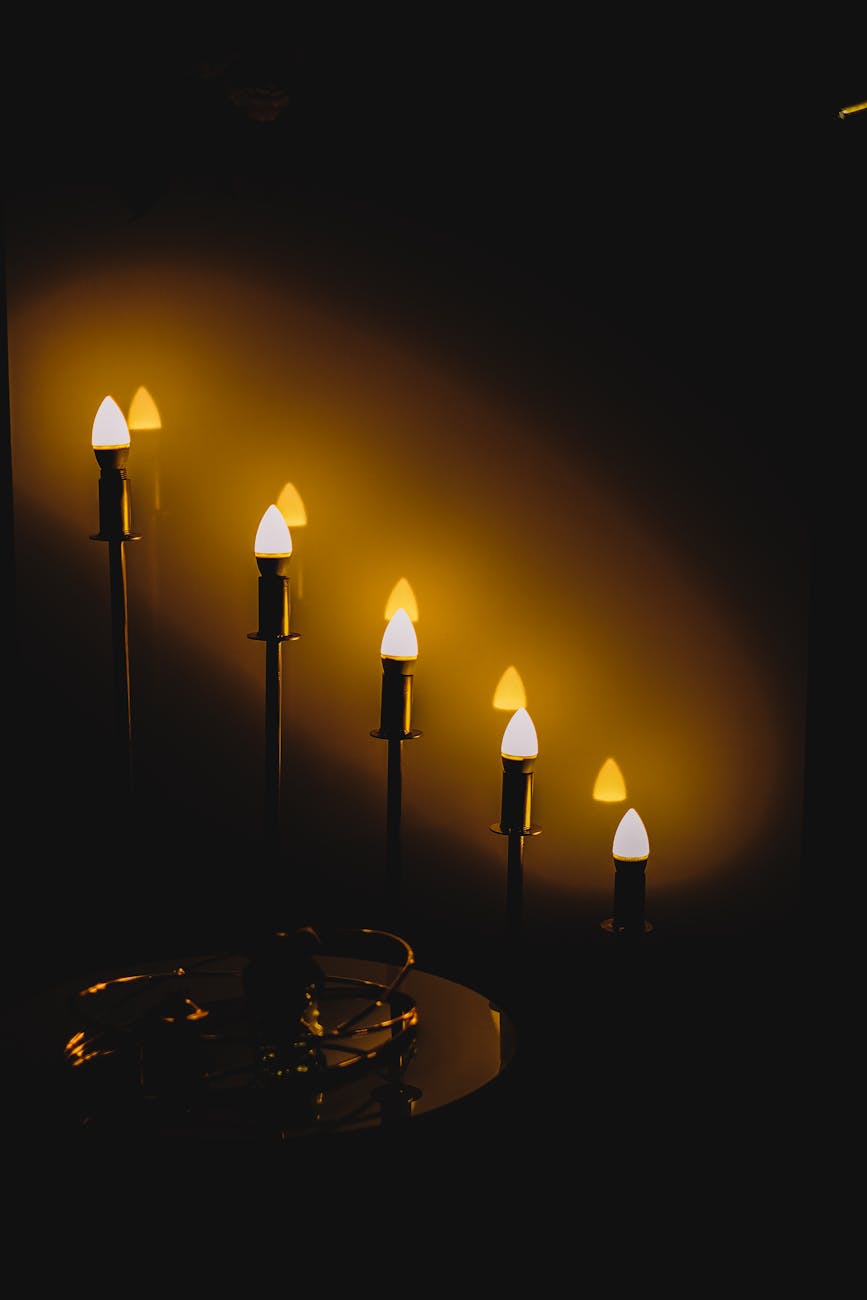
In Exodus, God commanded Moses to make a seven-branched lamp, the menorah, to shine in the holy place. In the holy place was the altar of incense and the table of showbread were also placed. It was the only light in the entire tabernacle. According to Biblical archaeologist Kevin Diekilman, the holy place was called the world. The Talmud also records that the temple was called the light of the world (Bava Batra 4a:3). The menorah, therefore, was the light of the world. Does that sound familiar?
12 Again Jesus spoke to them, saying, “I am the light of the world. Whoever follows me will not walk in darkness, but will have the light of life.” (Jn. 8:12).
Jesus said He is the light of the world. Jesus said He is the menorah! But there is someone else He said is the light of the world.
14 “You are the light of the world. A city set on a hill cannot be hidden. 15 Nor do people light a lamp and put it under a basket, but on a stand, and it gives light to all in the house. 16 In the same way, let your light shine before others, so that they may see your good works and give glory to your Father who is in heaven” (Mt. 5:14-16).
When Jesus said these words, He was speaking to Jews. He said the Jews are the light of the world. The Talmud says when God created Adam, Adam was the light of the world (Jerusalem Talmud Shabbat 2:6:12). The Talmud also teaches that the Torah sages were the light of the world (Bava Batra 4a:3). The Jews were the continuation of that light. Concerning the nation as a whole, Isaiah 42:6 says, “I am the Lord; I have called you in righteousness; I will take you by the hand and keep you; I will give you as a covenant for the people, a light for the nations.” See also Isiaah 49:6. Therefore, the Jews were also the menorah. Let’s keep going deeper. The Bible says there is another group of people who are the menorah, not exclusive from the Jews, but a broader encompassment. In Revelation, the Church is compared to lampstands or menorahs.
2 Then I turned to see the voice that was speaking to me, and on turning I saw seven golden lampstands, 13 and in the midst of the lampstands one like a son of man, clothed with a long robe and with a golden sash around his chest. 14 The hairs of his head were white, like white wool, like snow. His eyes were like a flame of fire, 15 his feet were like burnished bronze, refined in a furnace, and his voice was like the roar of many waters. 16 In his right hand he held seven stars, from his mouth came a sharp two-edged sword, and his face was like the sun shining in full strength.
17 When I saw him, I fell at his feet as though dead. But he laid his right hand on me, saying, “Fear not, I am the first and the last, 18 and the living one. I died, and behold I am alive forevermore, and I have the keys of Death and Hades. 19 Write therefore the things that you have seen, those that are and those that are to take place after this. 20 As for the mystery of the seven stars that you saw in my right hand, and the seven golden lampstands, the seven stars are the angels of the seven churches, and the seven lampstands are the seven churches (Rev. 1:2-17).
The menorah is the Church too!
But God gave a warning to the Church. If they did not repent, their light would go out (Rev. 2:5). They would stop being the light of the world. This happens to many churches, unfortunately. But God never will forsake the Church just like He never forsook Israel. The Talmud says,
All the time that Simeon the Righteous was alive, the western lamp would shine. When Simeon the Righteous died, sometimes it would flicker out, and sometimes it would burn (Jerusalem Talmud Yoma 6:3).
According to the Talmud, this is when the priesthood stopped blessing the people with the covenant Name of God (Yoma; Tosefta Sotah 13), and this is also the intertestamental period when no Scripture was given.
When we get to Jesus’ lifetime, the Talmud says this:
It has been taught: Forty years before the destruction of the Temple the western light went out (Jerusalem Talmud Yoma 6:3).
The light went from sometimes flickering out to going out altogether. What happened 40 years before the destruction of the temple? The crucifixion of Jesus. Simeon may have been righteous, but Jesus was the Righteous One.
The Jewish leadership largely rejected Jesus and sentenced him to death. After Jesus’ death and resurrection, the priests, scribes, Pharasees, and Saducees still did not repent. They even tried to cover up his resurrection with a false story (Mt. 28:11-15). They arrested the disciples and told them to stop preaching (Acts 4:1-3, 18). The pattern given in Revelation is if God’s representatives do not repent, their light will go out. The timing given for the light going out correlates with the life and ministry of Jesus. Of course the composers of the Talmud would not associate it with Jesus because they rejected Him. The Talmud was considered the oral Torah and it was written down in the fourth century A.D. Believers had been expelled from the temple while it stood, and by the fourth century, they were not welcome in synagogues either. The divide between the Jews and the Church was well established. The Church did not help this division. It only increased it after Christianity became the established religion of the Roman Empire, but that is another story. I simply bring that up to say this contention was not one-way. Rarely is any conflict completely one-way.
So the warning in Revelation of extinguishing the lamps of the churches had a precedent that already occurred in the intertestamental time period and at the time of Jesus’ crucifixion. So what’s the take-away? The Talmud attests to Jesus’ righteousness in a way the Bible does not record, but also none of God’s children (Jew or Christian) are exempt from His chastisement if they are living in sin. With that chastisement, though, there is not abandonment. That’s a promise for Israel and the Church (Heb. 13:5). Not every Israelite and Jew believed with an active and real faith, and not every “Christian” throughout Church history and today do either. My prayer for you is that, if you are a believer, your light does shine, and if you are not, that you are reading this and considering these things.
The Skin Covering
14 And you shall make for the tent a covering of tanned rams’ skins[a] and a covering of goatskins on top (Ex. 26:14).
The tabernacle that housed the holy vessels of God was to be covered with skin. Jesus, the Holy One of God, the Testimony of God, the Bread of Life, the Light of the World, was covered with skin:
1 In the beginning was the Word, and the Word was with God, and the Word was God…14 And the Word became flesh and dwelt among us, and we have seen his glory, glory as of the only Son from the Father, full of grace and truth (Jn. 1:1, 14).
That word translated “dwelt” literally means tabernacled.
My prayer is that as the Israelites looked to the tabernacle to find and worship God, you will look to the one Who put on skin and worship.
Blue, Scarlet, and Purple
The tabernacle had two points for curtains. One was to separate the holy place from the holy of holies, and one separated the courtyard from the holy place. Both were woven with blue, purple, and scarlet thread.
31 “And you shall make a veil of blue and purple and scarlet yarns and fine twined linen. It shall be made with cherubim skillfully worked into it.
16 For the gate of the court there shall be a screen twenty cubits long, of blue and purple and scarlet yarns and fine twined linen, embroidered with needlework. It shall have four pillars and with them four bases. (Ex. 27:16).
I want to focus on the symbolic meaning of these three colors: blue, purple, and scarlet. Blue is the color of the sky, the heavens. Red is the color of the earth. Red represents man. Purple is a mixture of blue and red, the joining of blue and red. It is also the color of royalty. When God became man in Jesus Christ, you get the King. As a matter of fact, Jesus was born and died as the King of the Jews (Mt. 2:2, 27:37).
The Dividing Curtains
33 And you shall hang the veil from the clasps, and bring the ark of the testimony in there within the veil. And the veil shall separate for you the Holy Place from the Most Holy (Ex. 26:33).
If the holy place was the world, then the holy of holies was heaven. It was the seat, the throne, of the presence of God. No one but the high priest once a year could pass beyond the curtain into the holy of holies. But when Jesus died on the cross, God forgave our sins and gave us free access to Himself through the righteous substitute, our High Priest. Hebrews 4:14 and 16 says,
“14 Since then we have a great high priest who has passed through the heavens, Jesus, the Son of God, let us hold fast our confession…Let us then with confidence draw near to the throne of grace, that we may receive mercy and find grace to help in time of need.”
The gospels record how this barrier between heaven and earth, as represented by the curtain between the holy place and holy of holies, was removed upon the death of Jesus.
51 And behold, the curtain of the temple was torn in two, from top to bottom. And the earth shook, and the rocks were split. 52 The tombs also were opened. And many bodies of the saints who had fallen asleep were raised, (Mt. 27:52).
38 And the curtain of the temple was torn in two, from top to bottom (Mk. 15:38).
44 It was now about the sixth hour, and there was darkness over the whole land until the ninth hour, 45 while the sun’s light failed. And the curtain of the temple was torn in two (Lk. 23:44-45).
The Bible attests that the barrier between the holy place and holy of holies was removed, but there were two more barriers in the temple between the average person and holy of holies. By the time of the temple, the curtains of the tabernacle became doors. There were two spots for doorways between the temple entrance and the holy place. The Talmud and the first century Jewish historian Flavius Josephus both record these barriers being removed too. That means that complete and total access was given from the temple’s entrance to the holy of holies.
There were golden doors separating the courtyard from where the altar was. This was the Nicanor Gate or Great Gate. It was covered in gold. Forty years before the destruction of the temple, that is, at the time of Jesus’ crucifixion, the Talmud says,
They would close the gates of the Temple by night and get up in the morning and find them wide open. Said [to the Temple] Rabban Yohanan ben Zakkai, “O Temple, why do you frighten us? We know that you will end up destroyed (Jerusalem Talmud Yoma 6:3).
Ben Zakkai attributes this phenomenon to an omen that the temple will be destroyed, but what if it means that at the time of Jesus’ sacrifice, He gave access to the common person to the Father, and God was demonstrating that physically by opening these doors on His own? The priests shut the doors at night, but by morning, God kept opening the doors. Isn’t that how it is? We repeatedly shut the door to God that He has opened. The Mishnah, Talmud, and Halakha elsewhere say these doors could only be unlocked from the inside. The priest had to enter the temple area by a side door and use a key in a hidden spot, stretching his arm up to the armpit, to unlock the door from the inside (Bava Metzia 33a:13, Mishnah Tamid 3:6, Tamid 30b:2). So the curtain was torn from top to bottom and the Great Gate was opened from the inside. It’s as if God was bringing His presence out of the holy of holies to be with man. This was an act of God. It didn’t happen on its own, and people didn’t do it.
Furthermore, Josephus records this same thing happening with the outer brass doors in his work The Wars of the Jews. In Book 6, chapter 5, part 3, he says,
Moreover, the eastern gate of the inner [court of the temple,] which was of brass, and vastly heavy, and had been with difficulty shut by twenty men, and rested upon a basis armed with iron, and had bolts fastened very deep into the firm floor, which was there made of one entire stone, was seen to be opened of its own accord about the sixth hour of the night. Now, those that kept watch in the temple came thereupon running to the captain of the temple, and told him of it; who then came up thither, and not without great difficulty was able to shut the gate again. This also appeared to the vulgar to be a very happy prodigy, as if God did thereby open them the gate of happiness. But the men of learning understood it, that the security of their holy house was dissolved of its own accord, and that the gate was opened for the advantage of their enemies.
Josephus does not give the details of the specific year other than it was “before the Jews’ rebellion, and before those commotions which preceded the war, when the people were come in great crowds to the feast of unleavened bread.” The war began in 66 A.D., and this event preceded the uprising before the war when people still pilgrimaged to Jerusalem in great throngs. We don’t have the year, but we do have the feast during which this occured: Unleavened Bread. Unleavened Bread coincided with Passover. They overlapped. Jesus died and was raised during Unleavened Bread and Passover, when great throngs were pilgrimaging to Jerusalem. That’s the feast during which the New Testament says the curtain of the holy of holies was torn top to bottom. So we have the huge brass doors opening of their own accord during the same feast and during the time general span of years in which the Bible records the curtain was torn with the death of Jesus. Wow.
The “vulgar” understood what it meant, that is, the people who the priesthood considered wrong or uneducated. Well, they also considered Jesus’ followers wrong. So yes, if Jesus’ disciples understood this as God opening the gates of access to Himself because of Jesus, then of course the priests would consider their understanding wrong because they themselves rejected Jesus. We see this dynamic clearly demonstrated in the gospels. When Jesus taught, they said He had a demon (Jn. 8:48). When he cast out demons, they said he did it by the power of Satan (Mt. 12:24, Mk. 3:22, Lk. 11:15). But the crowds, the “vulgar,” according to Josephus, understood no one could do these signs without the power of God.
The priests understood the doors opening as a threat to their security and an opening to their enemies. That same attitude is shown in the gospel of John after Jesus raised Lazarus from the dead. The Pharisees and priests said, “If we let him go on like this, everyone will believe in him, and the Romans will come and take away both our place and our nation” (Jn. 11:48). The way the “vulgar” people reacted to the sign of the doors opening and the way the priests understood the sign lines up exactly with the way the people received Jesus and the threat the religious leaders understood Jesus was to them. Jesus said whoever rejects Him rejects the Father (Lk. 10:16). So if Jesus was their enemy, the Father, God, was their enemy, so of course then it makes perfect sense that the open doors gave advantage to their enemies. They had made themselves enemies of God and His people, those who put their faith in Jesus as Messiah. This is incredible.
So Jesus died at Passover 40 years before the temple’s destruction and the Gospels record the curtain separating the holy place from the holies of holies being torn top to bottom. The Tamlud records that the same year the Great Gate opened of its own accord from the inside. Josephus records that during the same festival, the brass doors opened wide of their own accord. So between all the sources, every division between God and people was removed. If we put them all together, we get a perfect picture of God coming out to dwell with people, just like He promised. And it’s because of the atonement Jesus made for people. Revelation 21:3 says, “3 And I heard a loud voice from the throne saying, “Behold, the dwelling place of God is with man. He will dwell with them, and they will be his people, and God himself will be with them as their God.” Keep going, and verses 22-25 say this:
And I saw no temple in the city, for its temple is the Lord God the Almighty and the Lamb. 23 And the city has no need of sun or moon to shine on it, for the glory of God gives it light, and its lamp is the Lamb. 24 By its light will the nations walk, and the kings of the earth will bring their glory into it, 25 and its gates will never be shut by day—and there will be no night there.
Wow. According to Josephus, along with the gates opening, there was another sign: “at the ninth hour of the night, so great a light shone round the altar and the holy house, that it appeared to be bright day-time; which light lasted for half and hour” (Wars of the Jews book 6 chapter 5 section 3). Just like in Revelation, the divine daylight and the open gates go together. The three divisions between God and man given with the tabernacle were all opened at the same time Jesus was crucified. The gates were no longer shut. The Bible records the curtain to the holy of holies being ripped open. The Talmud records the middle golden doors opening on their own, and Josephus records the outer brass doors opening on their own.
Jesus was ripped so we can access the Father. He is the door that opened unto us to access the Father. He even said He is the Door (Jn. 10:9).
My prayer is that you enter His court with thanksgiving and His gates with praise (Ps. 100:4).
Closing Thoughts
Bringing this full circle, God wants us to voluntarily give to him, just like He wanted the Israelites to give to the tabernacle because it was on their heart. Do you have anything on your heart that you desire to give Him: your worship, your love, your sacrifice, your service, your money, your stuffy, your family, your job, your education, your friendships? Maybe you need to give Him your heart for the first time. If so, I pray that is on your heart. Thank you for following this post. I hope it blessed you. I will close like I always do, with an original poem. Until next time, God bless.
Light of light, Very God of Very God,
This world, it is Your tapestry of time,
A masterpiece, a work hardly slipshod,
A shadow of all that is You, divine.
Your golden throne of mercy is sublime.
Your Testament, my Bread, fresh every day,
Your Light, the world’s sole lumination shine.
Take my skin and make it holy, I pray,
My inmost being where Your presence stay.
Lead me through Your Door with praise, thanksgiving.
I know, three times over, You are the Way.
With Nicanor’s Levite choir I’m singing.
I am compelled, not my compulsory,
To give all to the God of history.
5 They serve a copy and shadow of the heavenly things. For when Moses was about to erect the tent, he was instructed by God, saying, “See that you make everything according to the pattern that was shown you on the mountain” (Heb. 8:5).
Sources
The Bible. English Standard Version. Biblegateway.com. Accessed 15 Feb. 2026.
The Halakha. Sefaria.org. Accessed 20 Feb. 2026.
The Jerusalem Talmud. Sefaria.org. Accessed 19 Feb. 2026.
The Mishnah. Sefaria.org. Accessed 20 Feb. 2026.
Whiston, William. Josephus: Complete Works. Kregel Publications. Grand Rapids, MI, 1960.

 Valley Princess
Leave a comment