B’shallach (After He Had Let Go)
Torah: Exodus 13:17-17:16
Hartarah: 4:4-5:31
Before I get into this week’s content, I want to talk about something big that just happened in relation to last Saturday’s reading. Joseph told the Israelites to carry his bones out of Egypt and bury them in the Promised Land, and that is exactly what they did when the time came. This very week, right after that reading, Isael brough back to Israel the last deceased hostage from Gaza, Ran Gvili. Just as Joseph’s bones were carried out of Egypt, so Ran Gvili’s bones were carried out of Gaza. And with the Messiah we have the hope of a resurrection. And when the IDF identified his body, they sang, “I believe in the coming of the Messiah, and even if he tarries, I will wait for him until he comes.” It’s just a confirmation to me that as we go through this reading schedule, we are a part of something much bigger than ourselves, all of us. We are all a part of His plan.
I’d like to regularly make a new post on Wednesdays, but life happens. I’m not paid to do this, and I’m a homeschool mom, so I do what I can. You can pray for me that God would enable me to post at a more consistent time.
Long ago, the Jewish sages created the parsha, a reading calendar to be read annually throughout all the synagogues every sabbath. They are from the Torah (the first five books of the Bible), and the Haftarah (selected readings from the prophetic books or Nevi’im of the Old Testament or Ketuvim). Today, I continue my series exploring the Messiah in each of these portioned readings that was planned and scheduled in ancient days and appointed for our present days. For January 31, 2026, B’shallach (After He Had Let Go), the readings are cited above. I would encourage you to read those passages first before you read my post, or at least read them in tandem.
This portion takes us through the beginning journey of the Israelites out of Egypt, to the parting of the Red Sea, to the bitter water at Marah, to Elim with twelve springs and seventy palm trees, to the wilderness of Sin where they received quail and manna for the first time and the institution of shabbat as a commandment or mitzvah, to Rephidim where Moses struck the rock for water and where the Amalekites attacked Israel. It’s another full portion, but I’m going to break it down, as I always have, focusing on Messiah in these sections.
The Parting of the Red Sea
The parting of the Red Sea made a great epic scene for Cecille B. DeMille.
19 Then the angel of God who was going before the host of Israel moved and went behind them, and the pillar of cloud moved from before them and stood behind them, 20 coming between the host of Egypt and the host of Israel. And there was the cloud and the darkness. And it lit up the night without one coming near the other all night” (Ex. 14:19-20).
These particular verses remind me of a parable Jesus told. About the rich man and Lazarus, a poor man at the rich man’s gate, neglected by Lazarus:
“22 The poor man died and was carried by the angels to Abraham’s side. The rich man also died and was buried, 23 and in Hades, being in torment, he lifted up his eyes and saw Abraham far off and Lazarus at his side. 24 And he called out, ‘Father Abraham, have mercy on me, and send Lazarus to dip the end of his finger in water and cool my tongue, for I am in anguish in this flame.’ 25 But Abraham said, ‘Child, remember that you in your lifetime received your good things, and Lazarus in like manner bad things; but now he is comforted here, and you are in anguish. 26 And besides all this, between us and you a great chasm has been fixed, in order that those who would pass from here to you may not be able, and none may cross from there to us.’ 27 And he said, ‘Then I beg you, father, to send him to my father’s house— 28 for I have five brothers—so that he may warn them, lest they also come into this place of torment.’ 29 But Abraham said, ‘They have Moses and the Prophets; let them hear them.’ 30 And he said, ‘No, father Abraham, but if someone goes to them from the dead, they will repent.’ 31 He said to him, ‘If they do not hear Moses and the Prophets, neither will they be convinced if someone should rise from the dead.’” (Lk. 16:19-31).
I don’t know that I have anything earth-shatteringly profound in bringing up a similarity between these, but it makes an interesting compare-and-contrast. Pharaoh is like the rich man who neglected Lazarus when he had the chance, which is Israel. The death of the firstborn passed through the land, and though Pharaoh tried to get to Israel, he couldn’t. God had made the final distinction between Pharaoh and Israel. Psalm 72:12 says, “For he delivers the needy when he calls, the poor and him who has no helper.” There will be a day that God ensures the enemy, neglector, and pursuer of the oppressed will be able to reach them no more, and they will be judged, be it on earth like for Pharoah and Israel or in eternity like for the unnamed rich man and the named poor man, Lazarus. Maybe the rich man has no name because another one of Jesus’ teachings can explain:
21 “Not everyone who says to me, ‘Lord, Lord,’ will enter the kingdom of heaven, but the one who does the will of my Father who is in heaven. 22 On that day many will say to me, ‘Lord, Lord, did we not prophesy in your name, and cast out demons in your name, and do many mighty works in your name?’ 23 And then will I declare to them, ‘I never knew you; depart from me, you workers of lawlessness.’ (Mt. 7:21-23).
Perhaps the rich man is unnamed because Jesus never “knew” him. This type of knowing is not a lack of knowledge, since God is omniscient, but it conveys an intimate knowing. Come to think of it, we don’t know the name of the Pharoah of the exodus either. So both men are unnamed. God didn’t “know” either of them.
The Bitter Water of Marah
After crossing the Red Sea on dry ground, the Lord led the newly freed Hebrews in the desert for three days until they came to water, but they couldn’t drink it because it was bitter. This word for bitter, mastemah, is a feminine noun describing hostility and hatred, indicating an attitude and state of animosity and rejection, especially toward God’s prophets and spokesmen. The story of Exodus 15 tells us the people grumbled against Moses and asked him what they were supposed to drink. Moses looked to the Lord for help, and He showed him a “log” to throw into the water and make it sweet and potable.
Exodus 15:15b-26 says,
“There the Lord made for them a statute and a rule, and there he tested them, saying, “If you will diligently listen to the voice of the Lord your God, and do that which is right in his eyes, and give ear to his commandments and keep all his statutes, I will put none of the diseases on you that I put on the Egyptians, for I am the Lord, your healer.”
The story seems pretty weird to me. Why would a log make bad water potable? And then I felt led to think of the cross. Jesus heals us at the cross. Jesus takes away all our bitterness, idolatry, and adultery against God at the cross. But is that too much of a stretch? So I looked at the word translated “log” in the ESV, which is ‘es, a masculine noun sometimes meaning a tree, a plank, stick, even firewood. The word can be literal and figurative. But the cross? Yes. It can also mean “tree or pole on which a slain person was hanged…also to a wooden gallows….” So the water was bitter. The people were at a loss for what to drink after three days without water, the approximate physical limit of the body without water (also conveniently the number of days Jesus was in the tomb), Moses cries to God for help, and He shows Him the cross. It’s kind of like how God showed Abraham the ram just in the nick of time, just before he sacrificed his son, Isaac. The cross makes the bitter sweet. The cross makes poisoned water pure and life-giving. The Lord healed the water and healed them. But it isn’t just bad water that He heals. He heals bitterness of spirit, He heals animosity with God. Romans 5:10 says,
“For if while we were enemies we were reconciled to God by the death of his Son, much more, now that we are reconciled, shall we be saved by his life.”
Isaiah 53:5 says,
“But he was pierced for our transgressions; he was crushed for our iniquities; upon him was the chastisement that brought us peace, and with his wounds we are healed.”
In place of the root of bitterness, we have the Root of David (Rev. 5:5).
Now as a complete reversal of the story of the “log” at the waters of Marah, Revelation 8:10-11 tells us of a future wormwood, a star (perhaps a fallen angel?) falling from heaven, making a third of the earth’s waters bitter and even fatal. This star named Wormwood falls to earth after the third angel in a sequence of seven blows his trumpet or shofar. Wormwood is also translated as bitterness, the Greek word apsinthion, also a feminine noun. Because the world at this time does not receive the gospel, that is, faith in the work Jesus accomplished on the cross, the reversal of Exodus 15 occurs. Instead of sweetness, bitterness. Instead of healing, sickness and even death. At the end of the seven angels and the seven shofars, Revelation 11:20-21 tells us,
“The rest of mankind, who were not killed by these plagues, did not repent of the works of their hands nor give up worshiping demons and idols of gold and silver and bronze and stone and wood, which cannot see or hear or walk, nor did they repent of their murders or their sorceries or their sexual immorality or their thefts.”
The world at this point is living completely counter to God’s instruction in Deuteronomy 29, and in our very own days, we have people calling evil good and good evil. How much more during the tribulation! Yet even still, the shofars for repentance will sound, so that whoever believes, repents, and obeys, can find sweetness and healing at the cross, even in a world tainted by bitterness and death.
Bread from Heaven
“4 Then the Lord said to Moses, ‘Behold, I am about to rain bread from heaven for you, and the people shall go out and gather a day’s portion every day, that I may test them, whether they will walk in my law or not’” (Ex. 16:4).
Lo and behold, about a month later, Israel was complaining about Moses and Aaron again, this time about lack of food. In this passage, God gave them manna for the first time, and they received it every day, except shabbat, for all their 40 years in the wilderness, until the day they crossed the Jordan River into the Promised Land. Jesus compared Himself to the manna from heaven. After Jesus had fed 5,000 men plus women and children with five loaves of bread and two fish, John records,
“25 When they found him on the other side of the sea, they said to him, ‘Rabbi, when did you come here’ 26 Jesus answered them, ‘Truly, truly, I say to you, you are seeking me, not because you saw signs, but because you ate your fill of the loaves. 27 Do not work for the food that perishes, but for the food that endures to eternal life, which the Son of Man will give to you. For on him God the Father has set his seal.’ 28 Then they said to him, ‘What must we do, to be doing the works of God’ 29 Jesus answered them, ‘This is the work of God, that you believe in him whom he has sent.’ 30 So they said to him, ‘Then what sign do you do, that we may see and believe you? What work do you perform? 31 Our fathers ate the manna in the wilderness; as it is written, “He gave them bread from heaven to eat.”’ 32 Jesus then said to them, ‘Truly, truly, I say to you, it was not Moses who gave you the bread from heaven, but my Father gives you the true bread from heaven. 33 For the bread of God is he who comes down from heaven and gives life to the world.’ 34 They said to him, ‘Sir, give us this bread always.’
35 Jesus said to them, ‘I am the bread of life; whoever comes to me shall not hunger, and whoever believes in me shall never thirst…
48 I am the bread of life. 49 Your fathers ate the manna in the wilderness, and they died. 50 This is the bread that comes down from heaven, so that one may eat of it and not die. 51 I am the living bread that came down from heaven. If anyone eats of this bread, he will live forever. And the bread that I will give for the life of the world is my flesh.’
52 The Jews then disputed among themselves, saying, ‘How can this man give us his flesh to eat?’ 53 So Jesus said to them, ‘Truly, truly, I say to you, unless you eat the flesh of the Son of Man and drink his blood, you have no life in you. 54 Whoever feeds on my flesh and drinks my blood has eternal life, and I will raise him up on the last day. 55 For my flesh is true food, and my blood is true drink. 56 Whoever feeds on my flesh and drinks my blood abides in me, and I in him. 57 As the living Father sent me, and I live because of the Father, so whoever feeds on me, he also will live because of me. 58 This is the bread that came down from heaven, not like the bread the fathers ate, and died. Whoever feeds on this bread will live forever’” (Jn. 6:25-35, 48-58).
Jesus very clearly says He is like the mana, in fact, better than the manna. Manna means “what is it?” When the people first received the manna, they asked each other, “What is it?” When people encountered the power of Jesus for the first time, they didn’t ask “What is it?” because He’s a person. But they asked, “Who is this?” (Mk. 4:41; Lk. 5:21, 7:49, 8:25, 9:9; Jn. 12:34). Both believers and non-believers, Jews and Gentiles, kings and priests and commoners asked this question. “Who is this?” The Israelites didn’t know what to do with the manna at first, and the world didn’t know what to do with Jesus at first.
Deuteronomy 8:3 says,
“And he humbled you and let you hunger and fed you with manna, which you did not know, nor did your fathers know, that he might make you know that man does not live by bread alone, but man lives by every word that comes from the mouth of the Lord.”
John begins his gospel with these words:
“1 In the beginning was the Word, and the Word was with God, and the Word was God… 14 And the Word became flesh and dwelt among us, and we have seen his glory, glory as of the only Sonfrom the Father, full of grace and truth” (Jn. 1:1, 14).
People live by God’s word, and that Word became flesh, Jesus. He is the manna.
The Rock Moses Struck
“’6 Behold, I will stand before you there on the rock at Horeb, and you shall strike the rock, and water shall come out of it, and the people will drink.’ And Moses did so, in the sight of the elders of Israel” (Ex. 17:6).
You think they would have gotten it by now, but they didn’t. God had already made the bitter water sweet and given them quail and manna, but that wasn’t good enough for them to believe. Now they were thirsty. I guess they understood God could make bitter water sweet, but I guess they didn’t think He could provide water out of no apparent source. God told Moses to strike a rock (tzur), which would have been a very large rock like a boulder or even a rock formation (The Complete Jewish Study Bible). And as a matter of fact, the location many are beginning to recognize as the Biblical location of Mount Sinai (aka Mount Horeb) in Saudi Arabia has a rock that would be considered a tzur, split strait down the middle, with evidence of massive water erosion. You can see a picture of it below. To supply millions of people and livestock, it would have to be a lot of water. It would be amazing to think that this could be the location where this Biblical story occurred.
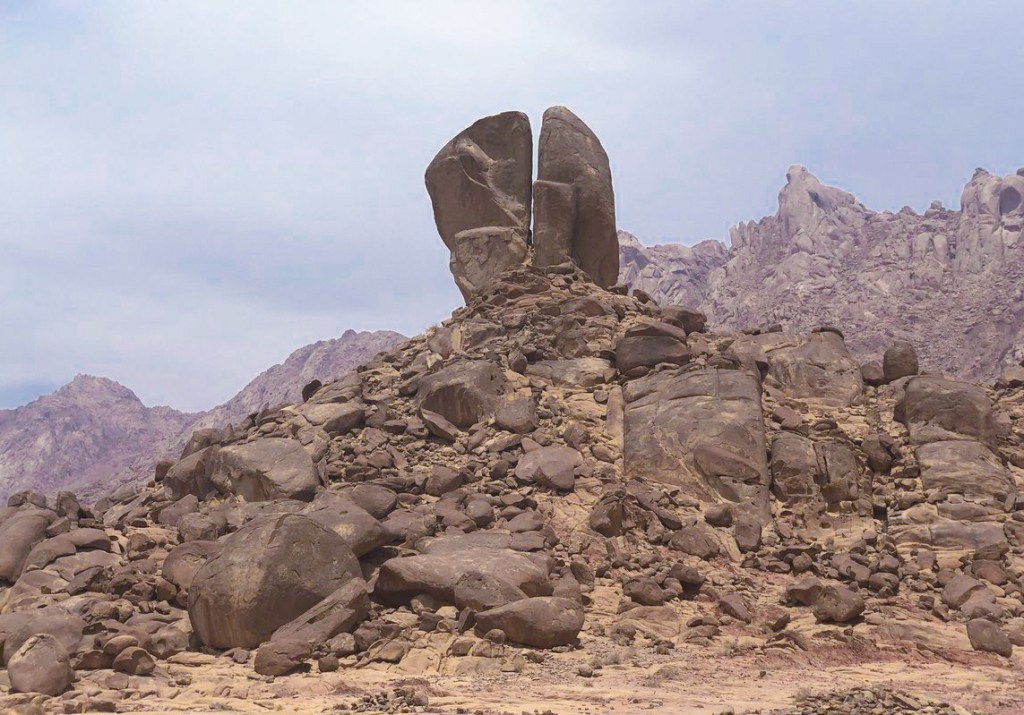
Now I want to bring this around to Messiah and explain what this has to do with Him. He is the Rock that was struck so that we can receive living water. When Jesus says, “on this rock I will build my church” (Mt. 16:18), the gospel uses the Greek word petra, which means “a mass of rock” (Vine’s Complete Expository Dictionary). The antecedent this refers back to Peter’s profession of faith: “You are the Christ, the Son of the living God” (16:16). Jesus is the Rock. The Apostle Paul makes this connection very explicit in his letter to the Corinthian church:
“10 For I do not want you to be unaware, brothers, that our fathers were all under the cloud, and all passed through the sea, 2 and all were baptized into Moses in the cloud and in the sea, 3 and all ate the same spiritual food, 4 and all drank the same spiritual drink. For they drank from the spiritual Rock that followed them, and the Rock was Christ. 5 Nevertheless, with most of them God was not pleased, for they were overthrown in the wilderness.” (1 Cor. 10:1-5).
That same word Paul used for Rock is petra too, a massive rock, very much an equivalent to the Hebrew tzur.
Now I want to break down the details of how Jesus is the Rock. Jesus was struck on our behalf to give us life, just like the rock at Horeb was struck to give the Israelites life. Jesus was struck down in the sight of the leaders (the scribes, Pharisees, and Sanhedrin) of Israel who condemned Him to death and mocked Him on the Cross, just like the rock at Horeb was struck in the sight of the leaders (“elders”) of Israel. The witnesses of the crucifixion tested Jesus by saying, “You who would destroy the temple and rebuild it in three days, save yourself! If you are the Son of God, come down from the cross” (Mt. 27:40), just like the Israelites tested God at Horeb by asking, “Is the Lord among us or not?” (Ex. 17:7). Just like I said you would think the Israelites would have known by now that God had their back in the wilderness, you would think that after Jesus’ miraculous ministry, the people would have believed Him too. But they did in neither case. I think the parallel is striking and the Bible makes the typology explicit. Jesus is the Rock.
Doesn’t the Bible say God is the Rock? Yes, it does. Moses, the one who struck the rock, says God is the Rock (Deut. 32:4). So you could argue that Moes struck God. If Moses says God is the Rock, and Jesus says He is the Rock, and Paul says Jesus is the Rock, then is that contradictory? Not if Jesus is God. If Moses struck the rock, and the Rock is God, and if Jesus was stuck, and Jesus is the Rock, can’t we logically conclude Jesus is God?
Furthermore, after crossing the Red Sea, Moses and all the Israelites, sang,
“The Lord is my strength and my song,
and he has become my salvation;
this is my God, and I will praise him,
my father’s God, and I will exalt him” (Ex. 15:2).
That word for salvation is yesuah. It means, “salvation, deliverance, help, victory, prosperity…to rescue from distress or danger” (The Complete Word Study Dictionary: Old Testament). When used as a name, it’s Yesua or Yeshua, but in Hebrew, the two are written identically. Therefore, it could be argued that Moses prophesied that God became Jesus, Yeshua. It could be translated, “he has become my Yeshua,” or, “he has become my Jesus.”
In his letter to the Phillipians, Paul writes,
“5 Have this mind among yourselves, which is yours in Christ Jesus, 6 who, though he was in the form of God, did not count equality with God a thing to be grasped, 7 but emptied himself, by taking the form of a servant, being born in the likeness of men. 8 And being found in human form, he humbled himself by becoming obedient to the point of death, even death on a cross” (2:5-8).
The Apostle John says,
In the beginning was the Word, and the Word was with God, and the Word was God…And the Word became flesh and dwelt among us, and we have seen his glory, glory as of the only Son from the Father, full of grace and truth” (Jn. 1:1, 14).
According to these two passages, God became Jesus. God became Yeshua or yesuah. God became salvation. When we apply this truth to ourselves personally as Moses did, He becomes “my salvation.”
Just like the Rock at Horeb, Jesus said He gives us living water (Jn. 4:10-11, Jn 7:38). Jesus said, “Whoever believes in me, as the Scripture has said, ‘Out of his heart will flow rivers of living water.’” John says this is referring to the Holy Spirit (7:39), which could only come after Jesus’ mission was complete (Jn. 16:7). When we believe, the Holy Spirit lives in our heart and gives us living water. Many Christians say Jesus is in their heart. Since the Holy Spirit is God too, I don’t think there is a problem with saying that.
I am literally writing this while kids are running around me screaming and interrupting me every minute. If this comes out any bit coherent it is all to the glory of God. I only do what He allows me to do. God loves me. And I love my kids.
Closing Thoughts
Maybe you feel like you are stuck between a sea and an army. Maybe you are thirsty. Maybe you are hungry. Maybe you are being attacked by Amalekites (metaphorically of course). Maybe you’re being let go from your job. Maybe your spouse, who promised to love you their whole life, is letting you go. As global events are concerned, maybe Iran is about to let its whole arsenal go like how Pharaoh sent out all his chariots. Fulani Muslims are continuing to slaughter Nigerian Christians. Al-Shaara’s army is killing Kurds and kidnapping women as sex slaves. China continues to crack down on Christian evangelism. Columbia now confiscates Bibles at checkpoints. The rhetoric of American liberals grows more and more dangerous against Christians, and those who propagate and who are persuaded by such words will progressively act upon that rhetoric. To some, who are in positions of political power, Christians are the greatest threat to democracy (in their opinion). To others who influence thousands and even millions of followers, Christians are a “cancer.” And even in the conservatives, more and more are disfavoring Christians and Jews. To some conservatives, like Tucker Qatarlson, Christians Zionists are a “brain virus,” people who he dislikes more than any other, more than murderers and rapists implicitly. It’s nothing God hasn’t handled before, and He’s not in the business of abandoning those who trust in Him. Time and time again, I’ve tried to show that Jesus is the Messiah, the Savior, and He can and will deliver us from all our trials. I’d we believe in Him and repent of our sins, we will be saved. This is so important. I wouldn’t spend my spare time doing whatever I can to educate and persuade people if it wasn’t. I get no reward for this (besides my own spiritual benefit from studying God’s word) but the hope of making an eternal difference for somebody. Whether the Lord comes in our days or we meet Him at the end of our days, the time is short. We don’t know how many days we have left. Today is the day to repent or rededicate our walks of faith or simply give today all we’ve got. Until next time, God bless.
Poem
Adonai Nissi, raise Your banner high,
The Mighty One Who rides upon the clouds,
The All-Consuming Fire in darkened shrouds,
Go, lead the way ahead me in the sky.
My Living Water, quench me, lest I die,
And take my bitter cup and make it sweet,
And take me to Your mountain where we meet.
O Rock of Ages, struck to bring me night,
Bread of Heaven, hear my desperate cry,
Fill me, that I never hunger again.
Be my rear guard, fight, and defend me when
My enemies against me, toward me fly.
Salvation's What You are, Who You became.
Salvation's only Yours. It is Your Name.
Sources
“Journey to the real Mount Sinai: An Arabian Adventure! – Discovered Sinai.” Discoveredsinai.com. Accessed 28 Jan. 2026.
The Bible. English Standard Version. Biblegateway.com. Accessed 29 Dec. 2025
The Complete Jewish Study Bible. Peabody, Hendrickson Publishers, 2016.
The Interlinear Bible. Hendrickson Publishers, United States of America. August 2010.
Vine’s Complete Expository Dictionary. Nashville, Thomas Nelson, 1996.

 Valley Princess
Leave a comment