Torah: Exodus 10:1-13:16
Haftarah: Jeremiah 46:13-28
I am a little bit delayed in posting this because I thought I had completely lost my work. A mishap between my malware and firmware erased my file, but my husband was able to restore it from an earlier version. Praise God! If you use Microsoft, watch out for that latest update. It’s giving a lot of people trouble.
Long ago, the Jewish sages created the parsha, a reading calendar to be read annually throughout all the synagogues every sabbath. They are from the Torah (the first five books of the Bible), and the Haftarah (selected readings from the prophetic books or Nevi’im of the Old Testament or Ketuvim). Today, I continue my series exploring the Messiah in each of these portioned readings that was planned and scheduled in ancient days and appointed for our present days. For January 24, 2026, Bo (Go), the readings are cited above. I would encourage you to read those passages first before you read my post, or at least read them in tandem.
This portion is absolutely full this week, so I will have to be selective about what I discuss. It was during the week of this appointed portion that I was born. It includes the last three plagues of Egypt: locusts that covered the earth, a three-day long palpable darkness, and the death of the firstborn of every household that did not put the blood of the lamb on their doors. It includes the final liberating exodus of the Israelites from the land of Egypt, the institution of the Passover, the institution of the Feast of Unleavened Bread, and the consecration of the firstborn. I could probably go really deep on all these aspects, but I will give a cursory summary of how the final plague, the first two instituted feasts, and the consecration of the firstborn are about the Messiah who frees us from our sins, sets His people today apart, and makes a distinction between believers and the world.
The Death of the Firstborn
First, let’s look at the last plage, the death of the firstborn.
“4 So Moses said, “Thus says the Lord: ‘About midnight I will go out in the midst of Egypt, 5 and every firstborn in the land of Egypt shall die, from the firstborn of Pharaoh who sits on his throne, even to the firstborn of the slave girl who is behind the handmill, and all the firstborn of the cattle. 7But not a dog shall growl against any of the people of Israel, either man or beast, that you may know that the Lord makes a distinction between Egypt and Israel’” (Ex. 11:4-7).
Without the blood of the Passover Lamb, the firstborn of every household would die. God gives them and any Egyptians who would listen to Him instructions about what to do to spare their lives. They must kill a lamb and put its blood on the lintel and two doorposts of their homes. By doing so, the angel of death would pass over their homes.
Why the firstborn? In The Feasts of the Lord by Kevin Howard and Marvin Rosenthal, they argue that we are all a sort of firstborn. The firstborn assumes the responsibility of his household. We are all responsible for our tent, our body (see 2 Cor. 5:1-4), and what we do in it. Therefore, we are accountable for our own sin. There is no father or elder brother to step in and represent and take the heat. It’s just you and God. It’s just me and God. The Apostle Paul says in Romans 14:12, “So then each of us will give an account of himself to God.” The author of Hebrews says, “And no creature is hidden from his sight, but all are naked and exposed to the eyes of him to whom we must give account” (4:13). The Apostle Peter says, “they will give account to him who is ready to judge the living and the dead” (1 Pet. 4:5).
The firstborn who died in Egypt, I would argue, are a representation of this spiritual meaning. They followed the leadership of worldly wisdom, Pharaoh, not the word of God through Moses. Thus it cost them their lives. The representatives of every home in Egypt had the choice to obey God or not, because the instructions involved their sovereignty over their own homes.
So am I supposed to literally go slaughter a lamb and paint my doorway with its blood to save my life from God’s wrath? Well, not today. For one, my HOA wouldn’t appreciate that, but more importantly, according to Howard and Rosenthal, that was the historic Passover that happened once. Now we have a commemorative Passover every year, which is a remembrance of that event. Historically once and symbolically thereafter, the lamb was slaughtered in substitution for the firstborn.
We don’t slaughter lambs today because the sacrificial system ended with the destruction of the temple in AD 70 by Titus, but moreover, temple or no temple, there is a firstborn who did step in between us and God and took the heat for our mistakes, and His Name is Jesus, Yeshua, Salvation. Jesus was Mary’s firstborn son (Lk. 2:7) according to the flesh, but He is also the firstborn positionally in a spiritual sense. Paul, in his letter to the Colossians says,
“15 He is the image of the invisible God, the firstborn of all creation. 16 For by him all things were created, in heaven and on earth, visible and invisible, whether thrones or dominions or rulers or authorities—all things were created through him and for him. 17 And he is before all things, and in him all things hold together. 18 And he is the head of the body, the church. He is the beginning, the firstborn from the dead, that in everything he might be preeminent. 19 For in him all the fullness of God was pleased to dwell, 20 and through him to reconcile to himself all things, whether on earth or in heaven, making peace by the blood of his cross” (1:15-20).
As “the firstborn of all creation” and as “the firstborn from the dead,” Jesus is Lord of creation and salvation. He made us and saved us. He is the ultimate firstborn. He was before all creation, and He set a pattern for those He saves from sin to follow. His life in the body was an example for us to follow. His death, resurrection, and ascension is a template that all who follow Him will follow. Romans 8:29 says, “For those whom he foreknew he also predestined to be conformed to the image of his Son, in order that he might be the firstborn among many brothers.” His followers will die in the body, be raised to life, and be “caught up” in “the clouds” to be with the Lord forever as He was (1 Thes. 4:17).
The Passover Lamb
I know I already touched on the Passover lamb in the previous section, but in this section I will focus on that image more deeply, and how exactly Jesus is both the Firstborn and the Passover Lamb. The Apostle Paul clearly says, “Christ, our Passover lamb, has been sacrificed” (1 Cor. 5:7). Jesus’ sacrifice also atoned for sins. John the Baptist declared, “Behold, the Lamb of God, who takes away the sin of the world!” (Jn. 1:29). As Isaiah prophesied 700 years before, He was “like a lamb that is led to the slaughter” (53:7) who “has borne our griefs and carried our sorrows” (vs, 4), “stricken for the transgression of my people” (vs. 8). “[H]is soul makes an offering for guilt” (vs. 10). “[H]e bore the sins of many, and makes intercession for the transgressors” (vs. 12).
“[H]e was pierced for our transgressions;
he was crushed for our iniquities;
upon him was the chastisement that brought us peace,
and with his wounds we are healed.
6 All we like sheep have gone astray;
we have turned—every one—to his own way;
and the Lord has laid on him
the iniquity of us all” (vs. 5-6).
Abraham prophesied, “God will provide for himself the lamb for a burnt offering, my son” (Gen 22:8).
The Lord was very precise in how He had Jesus fulfill the role as Passover Lamb, to the day. Exodus 12:2-6 says,
2 “This month shall be for you the beginning of months. It shall be the first month of the year for you. 3 Tell all the congregation of Israel that on the tenth day of this month every man shall take a lamb according to their fathers’ houses, a lamb for a household. 4 And if the household is too small for a lamb, then he and his nearest neighbor shall take according to the number of persons; according to what each can eat you shall make your count for the lamb. 5 Your lamb shall be without blemish, a male a year old. You may take it from the sheep or from the goats, 6 and you shall keep it until the fourteenth day of this month, when the whole assembly of the congregation of Israel shall kill their lambs at twilight.
The following is something I learned from a teaching by Jonathan Cahn. Jesus entered Jerusalem on a Sunday, what Christians know as Palm Sunday. But on the Jewish calendar, it was Nisan 9. That year, the Passover would begin on Friday, Nisan 14. Therefore, on the appointed day to bring the Passover lamb into the house, God brought His Passover Lamb into His house, just like He commanded the Israelites thousands of years earlier. See Mt. 21:1-17, Mk. 11:1-11, Lk.19:28-48, and Jn. 12:12-19.
Jesus was the Lamb “without blemish” (Ex. 12:5). Isaiah prophesied, “he had done no violence, and there was no deceit in his mouth” (53:9) because He was “the righteous one, my [God’s] servant” (vs. 11). The Apostle Peter says,
“And if you call on him as Father who judges impartially according to each one’s deeds, conduct yourselves with fear throughout the time of your exile, 18 knowing that you were ransomed from the futile ways inherited from your forefathers, not with perishable things such as silver or gold, 19 but with the precious blood of Christ, like that of a lamb without blemish or spot (1 Pet. 1:17-19).
The author of Hebrews says, “For we do not have a high priest who is unable to sympathize with our weaknesses, but one who in every respect has been tempted as we are, yet without sin” (4:15).
Let’s continue looking at the institution of Passover in Exodus:
7 “Then they shall take some of the blood and put it on the two doorposts and the lintel of the houses in which they eat it. 8 They shall eat the flesh that night, roasted on the fire; with unleavened bread and bitter herbs they shall eat it. 9 Do not eat any of it raw or boiled in water, but roasted, its head with its legs and its inner parts. 10 And you shall let none of it remain until the morning; anything that remains until the morning you shall burn. 11 In this manner you shall eat it: with your belt fastened, your sandals on your feet, and your staff in your hand. And you shall eat it in haste. It is the Lord’s Passover. 12 For I will pass through the land of Egypt that night, and I will strike all the firstborn in the land of Egypt, both man and beast; and on all the gods of Egypt I will execute judgments: I am the Lord. 13 The blood shall be a sign for you, on the houses where you are. And when I see the blood, I will pass over you, and no plague will befall you to destroy you, when I strike the land of Egypt (Ex. 12:7-13).
Let’s talk about the doorposts and lintel. I’ve seen demonstration of this, where Dr. Kevin Diekilman showed how they would have dipped the bundle of hyssop into the container holding the blood of the lamb, which would have been placed in the doorway where your feet tread, then lift it up to brush the lintel, then the two doorposts on either side. Likewise, Jesus’ blood was at His feet where he was crucified, on His head where He was beaten and where He wore a crown of thorns that no doubt made His head bleed, and on either side where His hands were crucified. As a lintel and doorposts would be made of wood, so the cross was made of wood. As the whole lamb was roasted, all of Jesus suffered the agony of hell’s flames on the cross. The Bible describes hell as an unquenchable fire (Is. 66:24, Jer. 17:21, Ez. 20:47, Mk. 9:48). 1 Peter 2:24 says, “He himself bore our sins in his body on the tree, that we might die to sin and live to righteousness. By his wounds you have been healed.” Just as nothing remained of the Passover lamb until morning, so Jesus was taken down from the cross before the Sabbath (Mk. 15:42-47). Just as the Passover Lamb should be eaten in haste, the betrayal, arrest, and sentencing of Jesus happened very quickly, literally overnight. Just as the blood of the Passover lamb saved the Israelites from the angel of death, the blood of Christ the Passover Lamb saves all who apply His blood to the doors of their hearts.
43 And the Lord said to Moses and Aaron, “This is the statute of the Passover: no foreigner shall eat of it, 44 but every slave that is bought for money may eat of it after you have circumcised him. 45 No foreigner or hired worker may eat of it. 46 It shall be eaten in one house; you shall not take any of the flesh outside the house, and you shall not break any of its bones. 47 All the congregation of Israel shall keep it. 48 If a stranger shall sojourn with you and would keep the Passover to the Lord, let all his males be circumcised. Then he may come near and keep it; he shall be as a native of the land. But no uncircumcised person shall eat of it. 49 There shall be one law for the native and for the stranger who sojourns among you” (Ex. 12:43-49).
The Passover lamb wasn’t for everyone, “no foreigner” but only for those who were considered “a native of the land.” The qualification for that wasn’t birth, but choice. A “stranger” could become like an Israelite and have the same legal standing. Circumcision was the sign by which one became like “a native of the land,” which is symbolic of the permanent removal of sin. Col. 2:11-12 says, “11 In him also you were circumcised with a circumcision made without hands, by putting off the body of the flesh, by the circumcision of Christ, 12 having been buried with him in baptism, in which you were also raised with him through faith in the powerful working of God, who raised him from the dead.” Even at the time of the giving of the Torah, Moses says, “Circumcise therefore the foreskin of your heart, and be no longer stubborn” (Deut. 10:16). Just as the foreigner in ancient Israel could partake in the Passover Lamb after circumcision, so today anyone can partake in Christ, our Passover Lamb, after having “the circumcision of Christ.”
Just as the Passover lamb could have none of its bones broken, so none of Jesus’ bones were broken:
“31 Since it was the day of Preparation, and so that the bodies would not remain on the cross on the Sabbath (for that Sabbath was a high day), the Jews asked Pilate that their legs might be broken and that they might be taken away. 32 So the soldiers came and broke the legs of the first, and of the other who had been crucified with him. 33 But when they came to Jesus and saw that he was already dead, they did not break his legs. 34 But one of the soldiers pierced his side with a spear, and at once there came out blood and water. 35 He who saw it has borne witness—his testimony is true, and he knows that he is telling the truth—that you also may believe. 36 For these things took place that the Scripture might be fulfilled: ‘Not one of his bones will be broken.’ 37 And again another Scripture says, ‘They will look on him whom they have pierced’” (Jn. 19:31-37).
Pesach Lamb
written Sunday, April 17, 2016
Yeshua is the Pesach Lamb
Without spot or blemish.
For thirty years He lived with us
And Him did we cherish.
Inside our homes did He come stay
And at out table eat.
Our children did delight in Him
And call His name so sweet
Until the time they would take Him
By darkness of the night,
Prepare Him for the sacrifice
And kill Him at twilight,
For though it was but three o’clock
The sky turned to darkness.
The moon, earth’s lintel, rose blood red
As God’s judgment passed us.
His lot was bitter as the herbs,
His tears for us He shed,
His body roasted in God’s wrath.
To cover us, He bled.
Though His whole being was consumed
None of His bones they broke.
He gave His Spirit of His own
As the old prophets spoke.
Jesus is the Seder Lamb.
The Lord is calling out
To lead us from slavery to sin
To freedom’s victory shout.
The Night of Watching
There is a verse that stood out to me during this time of reading: “42 It was a night of watching by the Lord, to bring them out of the land of Egypt; so this same night is a night of watching kept to the Lord by all the people of Israel throughout their generations” (Ex. 12:42). I thought that was interesting phrasing. Then I looked up “watch” in the New Testament, and where I found it centered was around the Passover in which Jesus was crucified.
“Then he said to them, ‘My soul is very sorrowful, even to death; remain here, and watch with me’” (Mt. 26:38).
“And he came to the disciples and found them sleeping. And he said to Peter, ‘So, could you not watch with me one hour? Watch and pray that you may not enter into temptation. The spirit indeed is willing, but the flesh is weak’” (Mt. 26:40-41).
“Then they sat down and kept watch over him there” (Mt. 27:36).
“When the centurion and those who were with him, keeping watch over Jesus, saw the earthquake and what took place, they were filled with awe and said, ‘Truly this was the Son of God!’” (Mt. 27:54).
It appears that just as Passover was a night of watching, so the Passover upon which Jesus died was a night of watching. You know, I learned that flour kosher for Passover matza has to be “watched,” that is, verified kosher. I wonder if there is a connection there with Exodus 12:42. If so, when Jesus kept watch, urged His disciples to keep watch, and was watched so closely Himself, I guess that Jesus’ betrayal and crucifixion was pretty kosher! It’s an interesting thought that might be worth exploring.
Concerning the day of redemption from this age, when believers will be called out in haste, Jesus says, “Watch therefore, for you know neither the day nor the hour” (Mt. 25:13).
The Feast of Unleavened Bread
The Feast of Unleavened Bread began at the same time as Passover.
14 “This day shall be for you a memorial day, and you shall keep it as a feast to the Lord; throughout your generations, as a statute forever, you shall keep it as a feast. 15 Seven days you shall eat unleavened bread. On the first day you shall remove leaven out of your houses, for if anyone eats what is leavened, from the first day until the seventh day, that person shall be cut off from Israel. 16 On the first day you shall hold a holy assembly, and on the seventh day a holy assembly. No work shall be done on those days. But what everyone needs to eat, that alone may be prepared by you. 17 And you shall observe the Feast of Unleavened Bread, for on this very day I brought your hosts out of the land of Egypt. Therefore you shall observe this day, throughout your generations, as a statute forever. 18 In the first month, from the fourteenth day of the month at evening, you shall eat unleavened bread until the twenty-first day of the month at evening. 19 For seven days no leaven is to be found in your houses. If anyone eats what is leavened, that person will be cut off from the congregation of Israel, whether he is a sojourner or a native of the land. 20 You shall eat nothing leavened; in all your dwelling places you shall eat unleavened bread” (Ex. 12:14-20).
In the Bible, leaven is used as a symbol of sin. Not is every instance, but many times.
“6 Your boasting is not good. Do you not know that a little leaven leavens the whole lump? 7 Cleanse out the old leaven that you may be a new lump, as you really are unleavened. For Christ, our Passover lamb, has been sacrificed. 8 Let us therefore celebrate the festival, not with the old leaven, the leaven of malice and evil, but with the unleavened bread of sincerity and truth. (1 Cor. 5).
“9 A little leaven leavens the whole lump…13 For you were called to freedom, brothers. Only do not use your freedom as an opportunity for the flesh, but through love serve one another. 14 For the whole law is fulfilled in one word: “You shall love your neighbor as yourself.” 15 But if you bite and devour one another, watch out that you are not consumed by one another” (Gal. 5:9-15).
“6 Jesus said to them, ‘Watch and beware of the leaven of the Pharisees and Sadducees.’ 7 And they began discussing it among themselves, saying, ‘We brought no bread.’ 8 But Jesus, aware of this, said, ‘O you of little faith, why are you discussing among yourselves the fact that you have no bread? 9 Do you not yet perceive? Do you not remember the five loaves for the five thousand, and how many baskets you gathered? 10 Or the seven loaves for the four thousand, and how many baskets you gathered? 11 How is it that you fail to understand that I did not speak about bread? Beware of the leaven of the Pharisees and Sadducees.’ 12 Then they understood that he did not tell them to beware of the leaven of bread, but of the teaching of the Pharisees and Sadducees” (Mt. 16:6-12).
“15 And he cautioned them, saying, ‘Watch out; beware of the leaven of the Pharisees and the leaven of Herod’”(Mk. 8:15).
“53 As he went away from there, the scribes and the Pharisees began to press him hard and to provoke him to speak about many things, 54 lying in wait for him, to catch him in something he might say. 12 In the meantime, when so many thousands of the people had gathered together that they were trampling one another, he began to say to his disciples first, “Beware of the leaven of the Pharisees, which is hypocrisy. 2 Nothing is covered up that will not be revealed, or hidden that will not be known. 3 Therefore whatever you have said in the dark shall be heard in the light, and what you have whispered in private rooms shall be proclaimed on the housetops” (Lk. 11:53-12:3).
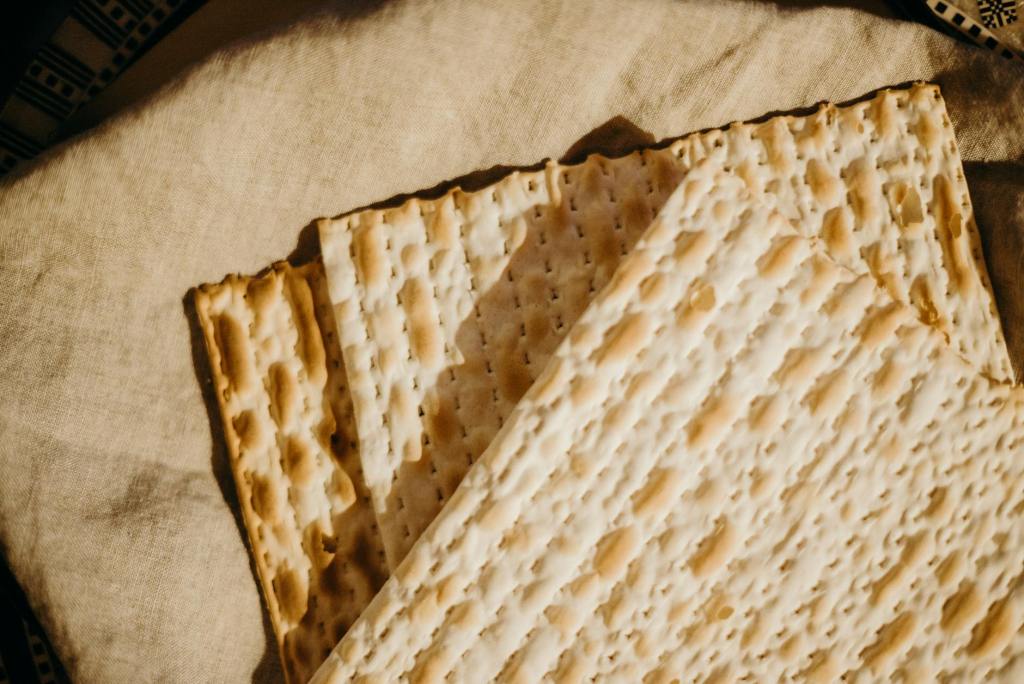
Jesus is the sinless unleavened bread. When Jesus took the matza during the Passover meal and broke it, He said it was His body given for us (Lk. 22:19). Therefore, Jesus is the unleavened bread of the Feast of Unleavened Bread.
Now as a quick side note about tradition, I want to talk about something called the afikomen. I know I said I would stick with Scripture this time, but this is so significant that I can’t stand to pass it by. I get so excited when I discover Jesus in the Jewish feasts and traditions. It’s not that I try reading my assumptions into them, but when I learn about them, then I find myself exclaiming, “That’s Jesus!” I’m sure Jesus is up in heaven slapping His head and saying, “Didn’t I tell you that this is my body and my blood like 2000 years ago?” But He is in all the details of the Seder that are not necessarily recorded in Scripture. The afikomen is the middle piece of matza in a stack of three which is broken early in the meal and part of it is set aside and hidden until the end of the meal. The Complete Jewish Study Bible says,
“A particularly intriguing element incorporated by rabbis is the matza tash, a linen pouch or plate with three different sections. A piece of matza is placed within, individually set apart yet united in the one container. Rabbinic commentaries don’t give the exact origin of this custom. They speculate the matza tash represents unity—perhaps the unity of the people of Isra’el through the forefathers (Avraham, Yitz’chak, and Ya’akov), or the unity of the families of Isra’el (Aharon, the Levites, and the common people). Messianic believers see in this the tri-unity of God
During the first part of the Seder, the middle piece of matza is taken out and broken in half. Half of the matza is placed back in the matza tash. The other half is wrapped in a linen napkin and hidden somewhere in the room by the leader of the Seder. The hidden matza is called the afikomen, a Greek word meaning ‘that which comes last.’ Rabbis say it alludes to the fact that the afikomen is the last thing tasted at the Seder, the dessert. Others have suggested the translation ‘he will come again.’ This sense of the word has much meaning to the messianic believer since it pictures the crucifixion, burial, and resurrection and return of Messiah” (87).
Howard and Rosenthal render afikomen as “I came.” All of these translations have great messianic meaning. If He is “that which comes last,” He did come last in that He came in the last days (Heb. 1:2, Gen. 49:1). The children get to go find the afikomen at the end and it’s like the dessert after the meal. We’ve done this a couple of times with our friends, and the husband, who is Jewish, leads the Seder. My kids and their kids have so much fun looking for the afikomen! Jesus is the second person of the Trinity, and His body was broken for us. He was wrapped in white linen just like the afikomen, and He was laid aside in a tomb just like the afikomen is hidden. The disciples went searching and found Him and his burial clothes after He was raised. Jesus said, “I thank you, Father, Lord of heaven and earth, that you have hidden these things from the wise and understanding and revealed them to little children; yes, Father, for such was your gracious will” (Luke 10:21). See also Matthew 11:25-26. We must be like children to find the kingdom of God (Matthew 18:2-3, 19:14, Mark 10:14-15, Luke 18:16-17), just like the children go to find the afikomen. Oh thank you Jesus! May we find our dessert! Jesus is the dessert after the whole meal. He is the One we have been looking forward to.
Afikomen of the Seder
written Sunday, April 17, 2016
Jesus is the afikomen.
He is the Broken Bread.
It is by His stipes we are healed
That we may live instead.
The holes remind us He was pierced.
His hands and feet they nailed
Upon the cross, and with a spear
They pierced His side and wailed.
The blackened marks of the flatbread
Remind us He was whipped
With thirty-nine lashes of pain.
From His robe He was stripped.
He was unleavened, without sin
And baked by earth’s hot trials.
He was set apart by God’s will
For all men to revile.
Wrapped into white linen cloths
And hidden from men’s eyes,
His risen self did children see,
But not the strong or wise.
His linen facecloth, folded neat,
Was set off to the side
For Peter and John then to find,
For death He had defied.
Jesus is the afikomen.
May we like children too
Find the hidden things of God
And find Messiah: You.
The Consecration of the Firstborn
“The Lord said to Moses, 2 ‘Consecrate to me all the firstborn. Whatever is the first to open the womb among the people of Israel, both of man and of beast, is mine.’…11 ‘When the Lord brings you into the land of the Canaanites, as he swore to you and your fathers, and shall give it to you, 12 you shall set apart to the Lord all that first opens the womb. All the firstborn of your animals that are males shall be the Lord’s. 13 Every firstborn of a donkey you shall redeem with a lamb, or if you will not redeem it you shall break its neck. Every firstborn of man among your sons you shall redeem. 14 And when in time to come your son asks you, ‘What does this mean?’ you shall say to him, ‘By a strong hand the Lord brought us out of Egypt, from the house of slavery. 15 For when Pharaoh stubbornly refused to let us go, the Lord killed all the firstborn in the land of Egypt, both the firstborn of man and the firstborn of animals. Therefore I sacrifice to the Lord all the males that first open the womb, but all the firstborn of my sons I redeem’” (Ex. 13:3, 11-15).
The firstborn of Israel from the initial Passover on were to be redeemed. Later, the Torah specifies what this is, and I will love getting into it later, but this post is long enough, so suffice it to say for now, “He who did not spare his own Son but gave him up for us all, how will he not also with him graciously give us all things? (Rom. 8:32).
Bless Me Also!
Reading the story this time, I noticed a very strong connection between Pharoah and Esau. When Esau and Isaac realized that Jacob had taken the blessing,
“33 Then Isaac trembled very violently and said, ‘Who was it then that hunted game and brought it to me, and I ate it all before you came, and I have blessed him? Yes, and he shall be blessed.’ 34 As soon as Esau heard the words of his father, he cried out with an exceedingly great and bitter cry and said to his father, ‘Bless me, even me also, O my father!… Have you not reserved a blessing for me?’ 37 Isaac answered and said to Esau, ‘Behold, I have made him lord over you, and all his brothers I have given to him for servants, and with grain and wine I have sustained him. What then can I do for you, my son?’ 38 Esau said to his father, ‘Have you but one blessing, my father? Bless me, even me also, O my father.’ And Esau lifted up his voice and wept” (Gen. 27:34, 36b-38).
Esau despised his birthright (Gen. 25:34). He had already turned down the great calling and blessing he could have had on his life. Likewise, Pharoah hardened his heart against God and lost all the blessing that Egypt had received from God through Joseph. Moreover, by his rejection, he brought plagues upon Egypt. When he realizes all was lost, just like Esau did, he exclaimed something very similar:
“Up, go out from among my people, both you and the people of Israel; and go, serve the Lord, as you have said. 32 Take your flocks and your herds, as you have said, and be gone, and bless me also!” (Ex. 12:31).
Even though he rejected everything, he still wanted to be blessed, just like Esau. As Esau lifted up his voice and wept, so also “there was a great cry in Egypt” (vs. 30). It’s a fascinating parallel. How many people live in complete rebellion against God, His ways, His calling, and yet they expect to be blessed? Perhaps we have all done that at some point.
Closing Remarks
Like I said, last week’s portion is not coincidentally scheduled to be read during ongoing real-world modern events. I hope and pray that the same people I mentioned last week who are being brutally oppressed by leaders hard-hearted as Pharoah are going to be liberated soon from their oppression, even during this very week’s portion. As a matter of fact, this week’s Haftarah says of Egypt,
“Why are your mighty ones face down?
They do not stand
because the Lord thrust them down” (Jer. 46:15).
Today, I think the present Iranian regime is a lot like the Egypt of the Exodus and the Egypt of which Jeremiah spoke. As for ancient Egypt’s mercenaries, Jeremiah says,
“Even her hired soldiers in her midst
are like fattened calves;
yes, they have turned and fled together;
they did not stand,
for the day of their calamity has come upon them,
the time of their punishment” (46:21).
Pro-Iranian militias who are helping crush the protests are a lot like those mercenaries for Egypt. Could the timing of this Parsha be God-ordained? Could freedom from slavery to this regime be around the corner? That is in God’s hands. Our ultimate salvation is an eternal salvation, not an earthly one. However, God can use human rulers to liberate God’s people during this age. God used a Persian king to return the Jews to their homeland after their exile. God used England, the UN, and America to rebirth the nation of Israel after it was “dead” for almost two thousand years. Will God use human rulers to liberate the oppressed in our day? I hope so, but we can’t count on it. Psalm 118:8-9 says, “It is better to take refuge in the Lord than to trust in man. It is better to take refuge in the Lord than to trust in princes.”
Even if princes are trustworthy and good, it won’t matter in eternity unless those who are freed are also freed by God’s Son from their sins. No amount of freedom on earth can spare any human from the slavery of their sins in this life or in eternity. Jesus said, “For what does it profit a man to gain the whole world and forfeit his soul? For what can a man give in return for his soul?” (Mk. 8:36-37). We will all give an account to the King of Kings one day for every word we spoke (Mt. 12:36), and our best deeds will be shown to be like filthy rags (Is. 64:6) in the light of the Light of the World, just like the brightest outdoor daylight reveals blemishes and colors imperceivable by a candle in a cave. Even if no earthly liberation comes to the oppressed, every single soul has access to eternal liberation through the Lord’s Passover Lamb. If you know you are a sinner, deserving of God’s wrath, and if you believe in Jesus Christ, that He is the perfect Son of God Who took on flesh to live a perfect life on your behalf and died a criminal’s death on your behalf, if you believe He was raised from the dead and ascended into heaven, and if you ask Him to forgive you of your sins as you put your trust in Him, He will save you. You will live with Him and all God’s children forever in perfect peace and joy. There’s no guessing. There’s no uncertain hope. It simply is. And you can count on that freedom, no matter what comes this day. What has come and what may be yet to come for the people of Iran may be horrific, but Jeremiah said to the Egyptians,
“26 I will deliver them into the hand of those who seek their life, into the hand of Nebuchadnezzar king of Babylon and his officers. Afterward Egypt shall be inhabited as in the days of old, declares the Lord” (46:26).
People can rebuild from the ashes of war, and no matter what, God will redeem your life if you trust in Him, even unto death. Until next time, God bless.
Sources
The Bible. English Standard Version. Biblegateway.com. Accessed 22 Jan. 2026.
The Complete Jewish Study Bible. Peabody, Hendrickson Publishers, 2016.
Howard, Kevin and Marvin Rosenthal. The Feasts of the Lord. Orlando, Zion’s Hope. 1997.

 Valley Princess
Leave a comment