Torah: Exodus 6:2-9:35
Haftarah: Ezekiel 28:25-29:21
Long ago, the Jewish sages created the parsha, a reading calendar to be read annually throughout all the synagogues every sabbath. They are from the Torah (the first five books of the Bible), and the Haftarah (selected readings from the prophetic books or Nevi’im of the Old Testament or Ketuvim). Today, I continue my series exploring the Messiah in each of these portioned readings that was planned and scheduled in ancient days and appointed for our present days. For January 17, 2026, Va’era (I Appeared), the readings are cited above. I would encourage you to read those passages first before you read my post, or at least read them in tandem.
This portion of Exodus takes us from God’s imperative on Moses to prophesy to the Hebrews and to Pharaoh, through the initial showdown between Moses and Pharoah’s magicians in Pharoah’s courtroom, and through the first seven plagues on Egypt. Those plagues, namely, were as follows:
- River into blood
- Frogs
- Lice (first created sign) (false prophets can’t create, neither can Satan)
- Swarms of insects
- Livestock disease
- Boils or infected sores
- Hail on everything in the field
As you would suppose from me by now, again, I find a strong connection in this portion to, you guessed it, Jesus. If you’re wondering how on earth I see it this time, stick with me, because it’s going to get good. First, I want to talk about the pattern of God giving Himself new names, the correlation of plunder, the serpent of Moses’ staff and what it more deeply represents, and the meaning of the Egyptian plagues.
New Names
Just as God revealed Himself by a new Name to Moses at the time of His calling, YHWH, God would reveal Himself by a new Name at the time of the Prophet like Moses: Jesus. God said to Moses,
I appeared to Abraham, to Isaac, and to Jacob, as God Almighty [El Shaddai], but by my name the Lord [YHWH] I did not make myself known to them. (Ex. 6:3).
God has many names, and being called by an additional Name in no way nullifies His previously known Names. Just as the name YHWH would come with an explosion of signs and wonders in Egypt to prove that He is the real God, so the Name of Jesus came with an explosion of signs and wonders to prove that Jesus was who He said He was.
The Promise
Again, I also must mention that just like in every parsha, there is the Lord’s promise of the land to Israel:
4 I also established my covenant with them [Abraham, Isaac, and Jacob] to give them the land of Canaan, the land in which they lived as sojourners… 8 I will bring you into the land that I swore to give to Abraham, to Isaac, and to Jacob. I will give it to you for a possession. I am the Lord. (Ex. 6:4, 8).
I also want to take the time here to point out that God had no conditions on His promise at all. He simply said He would give it. We’ll take all the passages in the rest of the Torah as we get to them, but please take note right now that from Abraham until this point in the story with Moses, God’s promise of the land to Israel is unconditional. Why do I make a point of that? Because people say Israel today is not the real Israel, or God has rejected them. We cannot be fooled into replacement theology. We have to stick with Scripture and look at history, which corroborates Scripture. God still remembers His covenant.
The Moses-Jesus Template
Just as God’s multiplication of signs and wonders in Egypt did not convince Pharaoh, but hardened his heart, so did the multiplication of Jesus’ signs and wonders not convince the Scribes and Pharisees of His day, but hardened their hearts. Just as God purposed His signs and wonders to work toward the culmination of the Exodus because Pharaoh would reject Moses, God also purposed Jesus’ signs and wonders to work toward the culmination of the crucifixion because the worldly powers of Jesus’ day would reject Him.
“’…you and the elders of Israel shall go to the king of Egypt and say to him, ‘The Lord, the God of the Hebrews, has met with us; and now, please let us go a three days’ journey into the wilderness, that we may sacrifice to the Lord our God.’ 19 But I know that the king of Egypt will not let you go unless compelled by a mighty hand. 20 So I will stretch out my hand and strike Egypt with all the wonders that I will do in it; after that he will let you go. 21 And I will give this people favor in the sight of the Egyptians; and when you go, you shall not go empty, 22 but each woman shall ask of her neighbor, and any woman who lives in her house, for silver and gold jewelry, and for clothing. You shall put them on your sons and on your daughters. So you shall plunder the Egyptians” (Ex. 3:18-22).
Of what I believe prophesies Jesus, Isaiah writes,
Yet it was the will of the Lord to crush him;
he has put him to grief;
when his soul makes an offering for guilt,
he shall see his offspring; he shall prolong his days;
the will of the Lord shall prosper in his hand.
11 Out of the anguish of his soul he shall see and be satisfied;
by his knowledge shall the righteous one, my servant,
make many to be accounted righteous,
and he shall bear their iniquities.
12 Therefore I will divide him a portion with the many,
and he shall divide the spoil with the strong,
because he poured out his soul to death
and was numbered with the transgressors;
yet he bore the sin of many,
and makes intercession for the transgressors (Is. 53:10-12).
Don’t miss the correlation between these two passages. Both are God’s will. Both involved suffering. God said the Israelites would plunder the Egyptians, and they did at the moment they were thrown out of Egypt by Pharaoh. Isaiah says the suffering servant (aka Jesus) would have divided to Him “a portion with the many” and “spoil with the strong.” Again, the connection between freedom from slavery and freedom from sin is made, because the suffering servant of Isaiah “bore the sins of many” “when his soul makes an offering for guilt” and “because he poured out his soul to death and was numbered with the transgressors.” It is at the moment of the suffering servant’s death atoning for sin that God gives Him a portion and spoil, and it is at the moment of the Israelites eviction from slavery that they plunder the Egyptians. It’s easy to know what the Israelites plunder was. It’s plainly told us in the Bible:
35 The people of Israel had also done as Moses told them, for they had asked the Egyptians for silver and gold jewelry and for clothing. 36 And the Lord had given the people favor in the sight of the Egyptians, so that they let them have what they asked. Thus they plundered the Egyptians (Ex. 12:35).
But what is the portion and spoil of Isaiah’s suffering servant? I’d like to turn to Jesus’ words for some enlightenment.
19 “Do not lay up for yourselves treasures on earth, where moth and rust destroy and where thieves break in and steal, 20 but lay up for yourselves treasures in heaven, where neither moth nor rust destroys and where thieves do not break in and steal. 21 For where your treasure is, there your heart will be also (Mt. 6:19).
Therefore, understanding Jesus as Isaiah’s suffering servant, His portion and spoil is in heaven, not on earth. Now stay with me. I’m about to go through several passages, and I promise I will tie them all together to this point.
10 According to the grace of God given to me, like a skilled master builder I laid a foundation, and someone else is building upon it. Let each one take care how he builds upon it. 11 For no one can lay a foundation other than that which is laid, which is Jesus Christ. 12 Now if anyone builds on the foundation with gold, silver, precious stones, wood, hay, straw— 13 each one’s work will become manifest, for the Day will disclose it, because it will be revealed by fire, and the fire will test what sort of work each one has done. 14 If the work that anyone has built on the foundation survives, he will receive a reward (1 Cor. 3:10-14).
4 As you come to him, a living stone rejected by men but in the sight of God chosen and precious, 5 you yourselves like living stones are being built up as a spiritual house, to be a holy priesthood, to offer spiritual sacrifices acceptable to God through Jesus Christ (1 Pet. 2:4-5).
Concerning the New Jerusalem, John writes,
“19 The foundations of the wall of the city were adorned with every kind of jewel. The first was jasper, the second sapphire, the third agate, the fourth emerald, 20 the fifth onyx, the sixth carnelian, the seventh chrysolite, the eighth beryl, the ninth topaz, the tenth chrysoprase, the eleventh jacinth, the twelfth amethyst. 21 And the twelve gates were twelve pearls, each of the gates made of a single pearl, and the street of the city was pure gold, like transparent glass” (Rev. 21:19-21).
This is the portion and spoil of Jesus when He dies on the cross. He took with Himself the saints to heaven. They are His treasure. The treasure they store in heaven by building on the foundation of the gospel with “gold” and “silver” and “precious stones” is the treasure. The people, the stones, are adorned with every kind of precious stone. Jesus’ plunder is believers! It’s us! He freed us from sin like Moses led the Egyptians out of slavery. He receives His portion when He atoned for sin and freed us from slavery to sin like the Israelites received their plunder when they were freed from Egypt. You are a treasure. You are more precious than gold.
Serpents
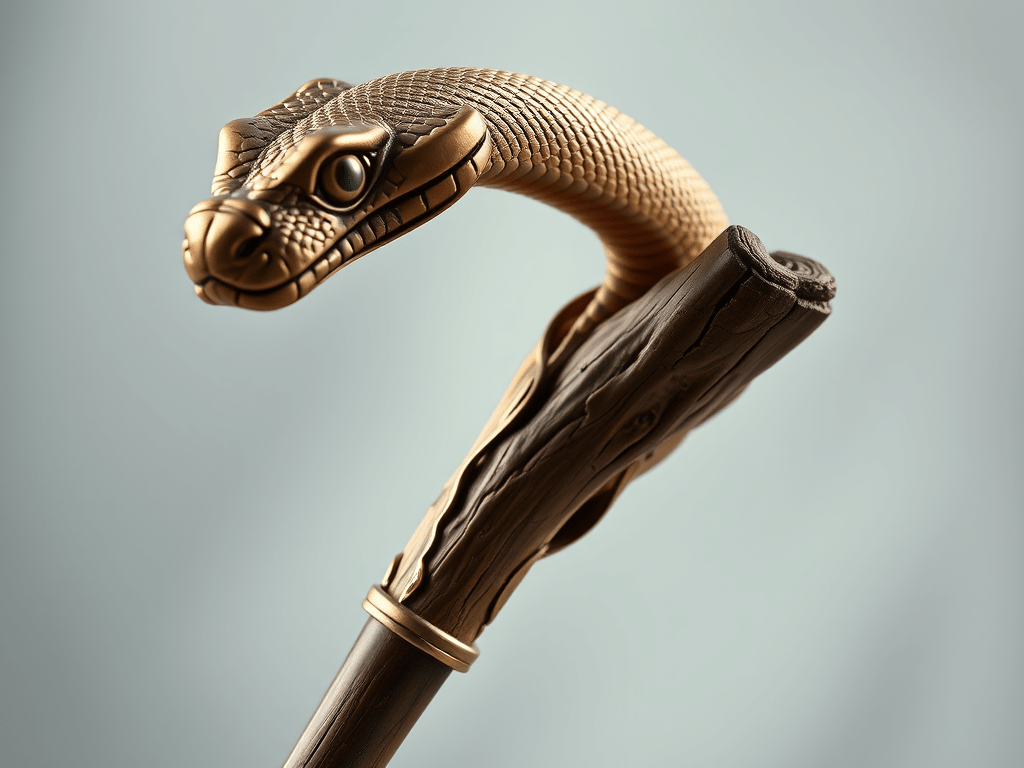
Next, let’s talk about how Moses’ staff turned into a serpent. Why a serpent? There may be more to this, but just looking at it Biblically, we see the serpent in Genesis chapter 3, and it’s not good. The serpent deceived Eve and introduced sin into the world. Because of the serpent’s cunning, the whole earth was cursed, and people and plants and animals started to suffer and die. The staff turns into a serpent. A staff comes from a tree. The serpent in Genesis 3 tricked Eve into eating from the forbidden tree. Most children’s Bible story book’s show an apple tree with a snake slithering out of it toward Eve who’s being modestly covered by a bush or something right there by the tree. So why did God give Moses for his first sign his staff (or Arron’s) turning into a serpent? Let’s look at the passage, and then I’ll give you my hunch.
8 Then the Lord said to Moses and Aaron, 9 “When Pharaoh says to you, ‘Prove yourselves by working a miracle,’ then you shall say to Aaron, ‘Take your staff and cast it down before Pharaoh, that it may become a serpent.’” 10 So Moses and Aaron went to Pharaoh and did just as the Lord commanded. Aaron cast down his staff before Pharaoh and his servants, and it became a serpent. 11 Then Pharaoh summoned the wise men and the sorcerers, and they, the magicians of Egypt, also did the same by their secret arts. 12 For each man cast down his staff, and they became serpents. But Aaron’s staff swallowed up their staffs. 13 Still Pharaoh’s heart was hardened, and he would not listen to them, as the Lord had said (Ex. 7:8-13).
There is another serpent later, in the wilderness. God told Moses to make a bronze serpent and to lift it up on a pole. When the Israelites were dying from the plague of serpents caused by their sin, they could look at the serpent on the pole and be healed. Like the staff that turned into a single serpent that swallowed the serpents of all the magicians, the bronze serpent neutralized the venomous power of the fiery serpents in the wilderness.
4 From Mount Hor they set out by the way to the Red Sea, to go around the land of Edom. And the people became impatient on the way. 5 And the people spoke against God and against Moses, “Why have you brought us up out of Egypt to die in the wilderness? For there is no food and no water, and we loathe this worthless food.” 6 Then the Lord sent fiery serpents among the people, and they bit the people, so that many people of Israel died. 7 And the people came to Moses and said, “We have sinned, for we have spoken against the Lord and against you. Pray to the Lord, that he take away the serpents from us.” So Moses prayed for the people. 8 And the Lord said to Moses, “Make a fiery serpent and set it on a pole, and everyone who is bitten, when he sees it, shall live.” 9 So Moses made a bronze[c] serpent and set it on a pole. And if a serpent bit anyone, he would look at the bronze serpent and live (Num. 21:4-9).
There could arguably be a thematic connection between the serpent of the Exodus, and the bronze serpent. Now fast forward to the gospel of John. Jesus tells Nicodemus,
14 And as Moses lifted up the serpent in the wilderness, so must the Son of Man be lifted up, 15 that whoever believes in him may have eternal life (Jn. 3:14-15).
Jesus was prophesying His death, that He would be crucified, lifted up on a cross. If the serpent represents the deceiver, Satan (Rev. 12:9, 20:2), then why does God use this as His first sign in Egypt? Why does He use this to heal the Israelites in the wilderness? Why does Jesus use this as a description of Himself? The serpent represents sin, from the garden, to the secret arts of the magicians (who worshiped pagan gods), to the mutiny of the Israelites in the desert. I believe 2 Corinthians 5:21 can shed some light on this.
21 For our sake he made him to be sin who knew no sin, so that in him we might become the righteousness of God.
Jesus became sin. If the serpent represents sin, then Jesus became the serpent so that we could become His righteousness. Just like the serpent that came from the staff swallowed all the other serpents of the magicians, Jesus swallowed up death by His life which He gives to us (see 1 Cor. 15:54 and 2 Cor. 5:4). “Death is swallowed up in victory” (1 Cor. 15:54) and “what is mortal may be swallowed up by life” (2 Cor. 5:4). Therefore, the first sign Moses performs to Pharaoh is a foreshadowing of Jesus Himself and His greater redemption of all believers from the power of sin, the curse, and death. Is this amazing or what?
Pharoah asked for a sign (Ex. 7:9), but the sign of the serpent didn’t impress him. He didn’t care (Ex. 7:13). Likewise, take a look at Matthew 12:38-40:
38 Then some of the scribes and Pharisees answered him, saying, “Teacher, we wish to see a sign from you.” 39 But he answered them, “An evil and adulterous generation seeks for a sign, but no sign will be given to it except the sign of the prophet Jonah. 40 For just as Jonah was three days and three nights in the belly of the great fish, so will the Son of Man be three days and three nights in the heart of the earth.
He was again referring to His death. Jesus was performing miracles, and they weren’t impressed. In fact, this group of people, Jesus called a brood of vipers (Mt. 12:34)! Jesus swallowed up the criticism of these snakes with miracles and their rationalizing with His irrefutable arguments, especially the week before His crucifixion (Mt. 22:46, Mk. 12:34, Lk. 20:40). But they followed the path of Pharaoh, and hardened their hearts.
Plagues and Demons
As for the plagues of Egypt, archaeologist Kevin Diekilman argues that each plague attacked and delegitimized an Egyptian god. I will leave a link below to his video walking through how each plague correlates to the dethroning of an Egyptian god. I think I have written enough otherwise, I should not get into its detail here, but I will add this to that thesis:
For we do not wrestle against flesh and blood, but against the rulers, against the authorities, against the cosmic powers over this present darkness, against the spiritual forces of evil in the heavenly places (Eph. 6:12).
21 Baptism, which corresponds to this [the ark and the global flood], now saves you, not as a removal of dirt from the body but as an appeal to God for a good conscience, through the resurrection of Jesus Christ, 22 who has gone into heaven and is at the right hand of God, with angels, authorities, and powers having been subjected to him (1Pet. 3:21-22).
As believers wrestle against spiritual warfare, there was a spiritual war Jesus fought too on the cross, an invisible one to human eyes, a spiritual one. By the cross and His resurrection, all spiritual beings, holy and evil, are subject to Him. The evil ones are subject to the Name of Jesus now because He saved His people from their sins and Satan and his minions use our sins to condemn us before God. Their power is now gone. Jesus defeated them.
Okay great, but what does this have to do with the plagues of Egypt? Because behind the gods are the “angels, authorities, and powers.” In Leviticus, God explains how to worship Him in the tabernacle, and in the middle of it, He says,
“7 So they shall no more sacrifice their sacrifices to goat demons, after whom they whore. This shall be a statute forever for them throughout their generations” (Lev. 17:7).
Wait, what? Yes, God said that. He said the Israelites used to sacrifice to demons. When they sacrificed to the gods of Egypt, they sacrificed to demons. Demons, or fallen angels, are behind the gods.
In his first letter to the Corinthians, Paul says,
…I imply that what pagans sacrifice they offer to demons and not to God. I do not want you to be participants with demons. 21 You cannot drink the cup of the Lord and the cup of demons. You cannot partake of the table of the Lord and the table of demons (1 Cor. 10:20-21).
Again, pagan worship and sacrifice is the worship of demons. Jesus defeated all these powers on the cross just like the plagues of Egypt defeated every Egyptian god, the demons. Jesus said,
17 And these signs will accompany those who believe: in my name they will cast out demons; they will speak in new tongues; 18 they will pick up serpents with their hands; and if they drink any deadly poison, it will not hurt them; they will lay their hands on the sick, and they will recover” (Mk. 16:17-18).
…“I saw Satan fall like lightning from heaven. 19 Behold, I have given you authority to tread on serpents and scorpions, and over all the power of the enemy, and nothing shall hurt you. 20 Nevertheless, do not rejoice in this, that the spirits are subject to you, but rejoice that your names are written in heaven” (Lk. 18-20).
That same authority over demons Jesus has, He gives to believers in His Name. These passages continue to reveal the connection between snakes and demons, and how the showdown in Egypt was between the One Who became sin for us and the demons who accuse us of our sins.
One indicator that this is a spiritual battle between Creator God and demons is in the third plague: lice or gnats. They are created from the dust when Moses strikes the earth. God is known to create life out of dust. See Adam and Eve as explicit examples of this in Genesis. But demons cannot create. They can only steal, kill, and destroy (Jn. 10:10). Therefore, the demons cannot create lice or gnats out of the dust. The magicians acknowledge “This is the finger of God” (Ex. 8:19). Similarly, Jesus uses this phrase, “finger of God,” in relation to Himself. Some people accused Jesus of having a demon Himself and using that demonic power to cast out demons. But He point out this illogical conclusion. Why would Satan cast out Satan? Can Satan cast out himself? No, but God casts Him out. Therefore, Jesus casts Him out. Jesus does something demons cannot do, cast out demons, and thus He says, “20 But if it is by the finger of God that I cast out demons, then the kingdom of God has come upon you” (Lk. 11:20). Just like the finger of God came upon Egypt, so the finger of God came upon the “Pharaohs” of Jesus’ time when He did something only God can do.
There are seven plagues in this portion. After the sixth angel blows the shofar or trumpet in Revelation,
20 The rest of mankind, who were not killed by these plagues, did not repent of the works of their hands nor give up worshiping demons and idols of gold and silver and bronze and stone and wood, which cannot see or hear or walk, 21 nor did they repent of their murders or their sorceries or their sexual immorality or their thefts.
Pharoah’s Plagues and the Tribulation
The world, in the tribulation, will follow the path of Pharoah. The world will harden its heart to the One Who sends the signs that it is time to repent. But God has not destined believers for wrath (1 Thes. 5:9). He will make a distinction between His children and the unrepentant world. Great persecution comes, just like the Israelites suffered before their liberation, and it became worse because God sent Moses to proclaim their coming liberation. So also the persecution of believers grows worse in the Great Persecution before being delivered by the One Whom we will meet in their air (I Thes. 4:17). But the Great Persecution is not the Great Tribulation. The Great Persecution is the suffering of believers caused by an evil world. The Great Tribulation is the suffering of unbelievers caused by a just God.
I know there are many people around the world who are suffering under oppression right now—Syria, Nigeria, Ukraine, Sudan, and other places—especially Iran right now. Iran is shut off from the internet right now, but there is some news getting through. The daughter of an IRGC officer, who identified as Fatima, called in to a program to reveal the horrors of the regime and her own family, risking her life, and perhaps even sacrificing her life, because by the end of her call, she revealed her true identity. “Save us, King of Kings,” she cried, “if you can hear us.” If I could talk to that woman today, if she still lives, I would tell her that the King of Kings does hear, and He will avenge every wrong one day when He comes on the clouds, just as it says in Rev. 19:16, “On his robe and on his thigh he has a name written, King of kings and Lord of lords.”
“…the people of Israel groaned because of their slavery and cried out for help. Their cry for rescue from slavery came up to God. 24 And God heard their groaning, and God remembered his covenant with Abraham, with Isaac, and with Jacob. 25 God saw the people of Israel—and God knew” (Ex. 2:23-25).
It is absolutely no coincidence that the parsha during this time covers the Exodus. Just as God remembered His covenant with Israel and delivered them from Egypt, God hears the cries of every child born in His image, and He remembers His covenant through Jesus Christ:
19 And he took bread, and when he had given thanks, he broke it and gave it to them, saying, “This is my body, which is given for you. Do this in remembrance of me.” 20 And likewise the cup after they had eaten, saying, “This cup that is poured out for you is the new covenant in my blood (Lk. 22:19-20).
This covenant is for all who call upon His Name (Acts 2:21). My brothers and sisters in Iran, your blood is being spilled in the streets, in the hospitals, in the prisons, and even in your own homes, and it may feel like it is to no avail. Israel felt the same way under their harsh slavery:
5 Moreover, I have heard the groaning of the people of Israel whom the Egyptians hold as slaves, and I have remembered my covenant. 6 Say therefore to the people of Israel, ‘I am the Lord, and I will bring you out from under the burdens of the Egyptians, and I will deliver you from slavery to them, and I will redeem you with an outstretched arm and with great acts of judgment. 7 I will take you to be my people, and I will be your God, and you shall know that I am the Lord your God, who has brought you out from under the burdens of the Egyptians. 8 I will bring you into the land that I swore to give to Abraham, to Isaac, and to Jacob. I will give it to you for a possession. I am the Lord.’” 9 Moses spoke thus to the people of Israel, but they did not listen to Moses, because of their broken spirit and harsh slavery.
Do not despair. God will redeem you through Jesus Christ just like He redeemed Israel. What oppresses you is an earthly regime, but Jesus’ kingdom is not of this world (Jn. 18:36). Trust what He says, and listen, because He hears you and He will redeem you and bring you into His eternal kingdom. He did spill His blood for you, and it was not in vain. His blood accomplished your liberty. We can trust Him. He has proven Himself. I am praying for you. I hear you. Until next time, God bless.
The Serpent Inversion
A serpent brought the curse into the world,
Hanging from the tree of knowledge, sorrow,
That serpent, dragon, from heaven was hurled
Who would likewise ruin man’s tomorrow.
His remaining time he can but borrow
Because of the One Who became sin too,
Who knew no sin so that humans could know
His righteousness, that righteousness imbue,
And that the accuser He can subdue.
He is the snake of Moses’ Aaron’s staff,
Who swallowed up the devil’s retinue,
The bronze serpent proving death’s power chaff.
With Jesus’ last breath, valedictory,
Sin’s curse is swallowed up in victory.
Sources
The Bible. English Standard Version. Biblegateway.com. Accessed 17 Jan. 2026.
The Complete Jewish Study Bible. Peabody, Hendrickson Publishers, 2016.

 Valley Princess
Leave a comment