Torah: Genesis 44:18-47:27
Haftarah: Ezekiel 37:15-28
Long ago, the Jewish sages created reading calendars to be read annually throughout all the synagogues every sabbath. They are the Parsha (from the Torah, the first five books of the Bible), and the Haftarah (selected readings from the prophetic books of the Old Testament). Today, I continue my series exploring the Messiah in each of these portioned readings that was planned and scheduled in ancient days and appointed for our present days. For December 27 this year, the readings are cited above. I would encourage you to read those passages first before you read my post, or at least read them in tandem.
The Old Testament foretells a messiah. He is a suffering savior, such as in Isaiah 53, but also a kingly savior, such as Ezekiel 37. Other passages describe him as conquering, vanquishing, bringing forth justice, punishing the guilty, ruling the nations, and restoring righteousness. Can this be the same messiah? It doesn’t sound like the same person. How can a king rule and reign and have dominion forever and yet suffer and die? So the sages came up with an explanation. According to the Talmudand Jewish thought, there are two messiahs: Mashiach ben Yoseph (Messiah son of Joseph) and Mashiach ben David (Messiah son of David) (Sukkah 52a:6, Kol HaTor 1:2).
Joseph is the archetype of the suffering servant. He did no wrong, he was sold into slavery, and he saved the lives of his family who forsook him. Joseph himself confesses that all his suffering was for a better greater plan: “because it was to save lives that God sent me ahead of you” (Genesis 45:5). Messianic believers understand Joseph’s story as a foreshadowing of Messiah. Joseph’s descension into prison is like Jesus’ descent into death. Joseph’s rising out of prison is like Jesus’ resurrection. Joseph’s sudden new position as second in the kingdom of Egypt is like Jesus’ glorification and ascension into heaven where He sat down at the right hand of the Father. Joseph said, “So it was not you who sent me here, but God. He has made me a father to Pharaoh, and lord of all his house and ruler over all the land of Egypt” (Gen. 45:8). After Jesus’ resurrection and just before His ascension, He said, “All authority in heaven and on earth has been given to me” (Mt. 28:18b). Philippians 2:9-10 says, “9 Therefore God has highly exalted him and bestowed on him the name that is above every name, 10 so that at the name of Jesus every knee should bow, in heaven and on earth and under the earth.” Just like the whole known world came and bowed before Joseph (including his brothers) for grain during the famine, the world will bow before Jesus.
Judah is the archetype of the one who leads through representation, responsibility, and direction. Judah, in this parshah from Genesis, takes the place as intercessor for his brother Benjamin, committed to his promise to be a pledge for his life so that he could return safely to his father, Israel (or Jacob). Jesus, likewise, intercedes for us to the Father in heaven, having pledged His life to the point of death so that we may be brought safely to our heavenly Father. When it came time for Israel and his family to journey to Egypt, Israel, the father, sent Judah ahead to lead the way. God the Father sent Jesus ahead of us to show us the way to heaven. He suffered, died, rose, and was glorified so that believers may have an example to follow in our suffering, die to ourselves and the world, rise to eternal life one day, and be glorified with the glory Jesus shares with us in heaven.
Joseph and Judah are messianic figures, though irreconcilable to the sages. Although Joseph is one who suffers and rules, the sages couldn’t understand how a coming messiah could do both. Not even Jesus’ disciples understood when Jesus was with them. No one understood. Perhaps it is because the suffering servant is prophesied to die. Regardless, the sages could not reconcile a suffering servant and a conquering king as one in the same person. They proposed two messiahs. It’s almost like God, in His amazing omniscience, built in a check for this theory into His Word and into the reading schedule created by the ancient Jewish sages.
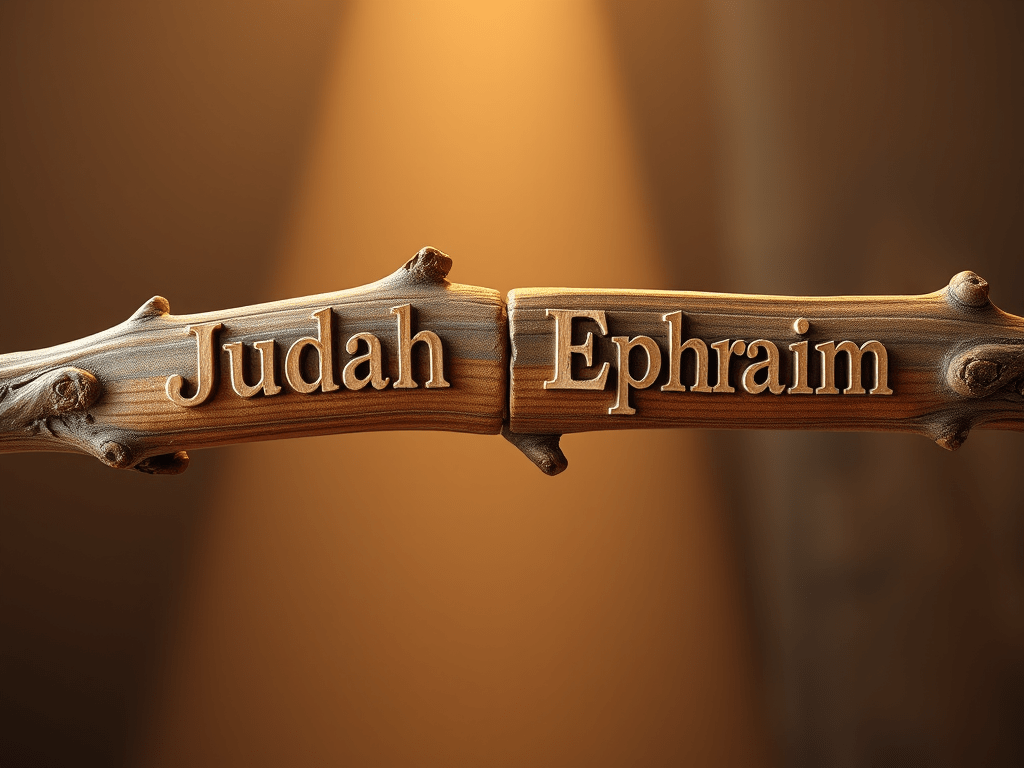
15 The word of the Lord came to me: 16 “Son of man, take a stick and write on it, ‘For Judah, and the people of Israel associated with him’; then take another stick and write on it, ‘For Joseph (the stick of Ephraim) and all the house of Israel associated with him.’ 17 And join them one to another into one stick, that they may become one in your hand. 18 And when your people say to you, ‘Will you not tell us what you mean by these?’ 19 say to them, Thus says the Lord God: Behold, I am about to take the stick of Joseph (that is in the hand of Ephraim) and the tribes of Israel associated with him. And I will join with it the stick of Judah, and make them one stick, that they may be one in my hand. 20 When the sticks on which you write are in your hand before their eyes, 21 then say to them, Thus says the Lord God: Behold, I will take the people of Israel from the nations among which they have gone, and will gather them from all around, and bring them to their own land. 22 And I will make them one nation in the land, on the mountains of Israel. And one king shall be king over them all, and they shall be no longer two nations, and no longer divided into two kingdoms. 23 They shall not defile themselves anymore with their idols and their detestable things, or with any of their transgressions. But I will save them from all the backslidings in which they have sinned, and will cleanse them; and they shall be my people, and I will be their God.
24 “My servant David shall be king over them, and they shall all have one shepherd. They shall walk in my rules and be careful to obey my statutes. 25 They shall dwell in the land that I gave to my servant Jacob, where your fathers lived. They and their children and their children’s children shall dwell there forever, and David my servant shall be their prince forever. 26 I will make a covenant of peace with them. It shall be an everlasting covenant with them. And I will set them in their land and multiply them, and will set my sanctuary in their midst forevermore. 27 My dwelling place shall be with them, and I will be their God, and they shall be my people. 28 Then the nations will know that I am the Lord who sanctifies Israel, when my sanctuary is in their midst forevermore.” (Ez. 37:15-28).
As a quick historical note, Ephraim is one of the sons of Joseph, and his descendants became a tribe named after him. The name of the tribe of Ephraim came to represent the ten northern tribes during the divided kingdom.
Ezekiel 37 is a prophecy absolutely fulfilled in several ways: first the reunification of the northern and southern kingdom, second, the singular Servant King Whose throne is forever, and third, the return of Israel to their own land.
By the time you get to the New Testament, there is no separation between the descendants of the ten northern tribes and the two southern tribes (Judah and Benjamin). The northern kingdom descendants that were left and the southern kingdom descendants that were left were living together as one people, the Jews. The ten tribes were not completely lost as some claim, and the New Testament gives us proof of that. This story comes from the day Jesus’ parents took Him to the temple for the first time since His birth, the day Mary brought her offerings for purification:
“36 And there was a prophetess, Anna, the daughter of Phanuel, of the tribe of Asher. She was advanced in years, having lived with her husband seven years from when she was a virgin, 37 and then as a widow until she was eighty-four. She did not depart from the temple, worshiping with fasting and prayer night and day. 38 And coming up at that very hour she began to give thanks to God and to speak of him to all who were waiting for the redemption of Jerusalem” (Lk. 2:36-38).
Here you have a descendant of one of the northern tribes of the northern kingdom, Israel, living in the region of the old southern kingdom, Judah, permanently, in the temple area at that. Surely she was not the only one left of Israel. And God said He would reunite the two kingdoms by joining them with the stick of Judah (Ez. 37:19). The ten tribes are not lost. True, there are some who were lost, and some who have remained distinct still, like the Jews from Ethiopia who have just returned to Israel in the 20th century, but they were never entirely lost to known history, and Luke chapter two provides an example of that. Archaeologist Joel Kramer has a great video about this in greater detail, and I will leave his video at the bottom of this post for you.
Second, Ezekiel’s prophecy is fulfilled in the Servant King Who will reign forever. God said He would join the tribes to Judah, to David specifically, and “one king shall be king over them all” (vs. 22), “and they shall all have one shepherd” (vs. 24), “and David my servant shall be their prince forever” (vs. 25). Both Mary, Jesus’ mother, and Joseph, Jesus’ adoptive father, were descendants of David. Luke chapter three gives us the genealogy of Jesus through Mary, and at the time Gabriel visited Mary to tell her what God was about to do through her, he told her, “32 He will be great and will be called the Son of the Most High. And the Lord God will give to him the throne of his father David, 33 and he will reign over the house of Jacob forever, and of his kingdom there will be no end” (Lk. 1:32-33). Matthew chapter one records Joseph’s genealogy from David. So both biologically and culturally (being raised in Joseph’s household), Jesus is the Son of David. Throughout Jesus’ entire ministry, Jews and Gentiles acknowledged this in a way that is also a messianic title:
“And as Jesus passed on from there, two blind men followed him, crying aloud, “Have mercy on us, Son of David” (Mt. 9:27),
“And all the people were amazed, and said, ‘Can this be the Son of David?”’ (Mt. 12:23),
“And behold, a Canaanite woman from that region came out and was crying, ‘Have mercy on me, O Lord, Son of David; my daughter is severely oppressed by a demon’” (Mt. 15:22),
“And behold, there were two blind men sitting by the roadside, and when they heard that Jesus was passing by, they cried out, “Lord, have mercy on us, Son of David!” (Mt. 20:30),
and during His triumphal entry into Jerusalem,
“the crowds that went before him and that followed him were shouting, ‘Hosanna to the Son of David! Blessed is he who comes in the name of the Lord! Hosanna in the highest!’”(Mt. 21:9).
The Pharisees too acknowledged the title of Son of David was messianic:
41 Now while the Pharisees were gathered together, Jesus asked them a question, 42 saying, “What do you think about the Christ? Whose son is he?” They said to him, “The son of David.” 43 He said to them, “How is it then that David, in the Spirit, calls him Lord, saying,
44 “‘The Lord said to my Lord,
“Sit at my right hand,
until I put your enemies under your feet”’?
45 If then David calls him Lord, how is he his son?” 46 And no one was able to answer him a word, nor from that day did anyone dare to ask him any more questions. (Mt. 22:41-46).
Under this Son of David, this King, God “will save them from all the backslidings in which they have sinned, and will cleanse them” (Ez. 37:23). It is totally fitting, then, that Gabriel told Joseph, “[Y]ou shall call his name Jesus [Salvation], for he will save his people from their sins” (Mt. 1:21). Under this King, this Prince, this Son of David, God said, “26 I will make a covenant of peace with them. It shall be an everlasting covenant with them” (vs. 26). Isaiah tells us He is the Prince of Peace (Is. 9:6). Jesus proclaimed that his role as the suffering servant fulfills this when He said at the last Passover meal with His disciples, the Last Supper, “This cup that is poured out for you is the new covenant in my blood” (Lk. 22:20). Jesus’ atoning work for our souls gives us eternal peace.
The final part of Jesus as the King Who will reign forever has yet to be fulfilled. When this happens, He will fulfill His complete role as Messiah ben Judah:
“And I will set them in their land and multiply them, and will set my sanctuary in their midst forevermore. 27 My dwelling place shall be with them, and I will be their God, and they shall be my people. 28 Then the nations will know that I am the Lord who sanctifies Israel, when my sanctuary is in their midst forevermore” (Ez. 37:26b-28).
The Apostle John tells us this will be fulfilled after Jesus returns to rule and reign as King forever:
“’Behold, the dwelling place of God is with man. He will dwell with them, and they will be his people, and God himself will be with them as their God’… 22 And I saw no temple in the city, for its temple is the Lord God the Almighty and the Lamb.” (Rev. 21:3b, 22).
God’s sanctuary is His temple. This sounds like Ezekiel! You can’t make this stuff up!
But this won’t happen unless the third element of Ezekiel’s prophecy is fulfilled, the return of Israel to her own land:
“Behold, I will take the people of Israel from the nations among which they have gone, and will gather them from all around, and bring them to their own land. 22 And I will make them one nation in the land, on the mountains of Israel” (Ez. 37:21b-22a),
“And I will set them in their land and multiply them, and will set my sanctuary in their midst forevermore” (vs. 26b).
Israel has returned to their land, and more Jews are returning still. Moreover, the central part of the flag of the modern state of Israel is the star of David, the symbol of the King from Judah, from the line of David’s kingdom. Thus is modern Israel joined to Judah too. God will also make sure they all return and that they will stay there forever. This is not political. This is Biblical. That is why the enemy rages so strongly against the Jews’ existence, let alone their sovereignty in their land. But it will come to pass so that “[t]hen the nations will know that I am the Lord who sanctifies Israel, when my sanctuary is in their midst forevermore” (vs. 28). We know from Revelation 21 that His sanctuary is Himself and the Lamb. When Israel is in their land forever, God, in the form of Jesus, will dwell in that land with them forever. Just like Joseph revealed Himself to his brothers and reconciled himself to them, Jesus will reveal Himself to Israel and reconcile them to Himself one day. Jesus says to us what Jacob said to his brothers: “And now do not be distressed or angry with yourselves because you sold me here, for God sent me before you to preserve life” (Gen. 45:5). The suspense hanging in the balance during the last parshah is resolved. The State of Israel is part of God’s plan, that their life would be preserved. Am Israel chai!
Before I close this commentary on this parsha/haftarah, I want to talk about the sticks of Ezekiel’s prophecy. I wondered what these sticks were like. Were they like the sticks my kids pick up in the woods for a campfire? Were they more substantial sticks likes a staff? The word Ezekiel uses is es, which is “[a] masculine noun referring to a tree, wood, timber, a stick, a plank. It refers to trees of all kinds…garden trees…special trees used figuratively…a specific kind of olive tree…pieces of wood for various purposes…gopher wood…articles made of wood…timbers in a building or house…a tree or pole on which a slain person was hanged…gallows…firewood” (The Complete Word Study Dictionary: Old Testament, page 858, Strong’s Concordance number 6086). So the answer to my question is Ezekiel’s “sticks” could have been anything above, This could have even been a miraculous combining that occurred when Ezekiel put them together. God used plants and parts of plants to show His miraculous power. Aaron’s staff budded, for example (Num. 17). I also think about how Paul in his letter to the Romans uses the metaphor of being cut off or grafted in (chapter 11). Unbelievers who are born into the covenant are cut off for their unbelief, Gentile believers are grafted in, and even unbelievers who are born in the covenant who become believers are grafted in again. Perhaps we can liken ourselves to the stick of Ephraim that joins itself to the stick of Judah, the Son of David, Jesus Christ. We are grafted in. Jesus said,
“11 And I am no longer in the world, but they are in the world, and I am coming to you. Holy Father, keep them in your name, which you have given me, that they may be one, even as we are one… 20 “I do not ask for these only, but also for those who will believe in me through their word, 21 that they may all be one, just as you, Father, are in me, and I in you, that they also may be in us, so that the world may believe that you have sent me” (Jn. 17:11, 20-21).
Believers are joined to one another because we are joined to Messiah, the es of Judah. We are grafted in. We are one.
The scheduled passages from Genesis and Ezekiel are the perfect pairing together, for they give us the full picture of God’s plan for the world through Israel in the Messiah, the fulfillment of God’s promise to Abraham, Isaac, and Jacob. Messiah ben Joseph and Messiah ben Judah are one in Jesus Christ, the Son of David, the King, the Prince forever, and believers are one in Him. If you are already joined to Judah through Messiah, then let us pray for God to hasten the day all of Ezekiel is fulfilled. If you are not joined to Judah, then I’d encourage you to continue to think about these things and ask God to show you, so that you may put your faith in His Servant, Jesus Christ, the King forever, and live with Him forever, just like He promised.
What brother becomes a servant
To serve his subject, me?
What king would have this in his plan,
His eternal decree?
What prince pursues a rebel rude
With tenderness and time,
Forgiving every felony
And cleansing every crime?
What ruler freely fellowships
With such a sinful serf,
Selecting to subject himself
To my transgressive turf?
What sovereign pays my penalty
For breaking his own law?
What royalty redeems a rat
Not holding him in awe?
What pharaoh ever fed the mouth
Of his betrayer arch?
What stateliness would stoop
To satiate a swine's throat parched?
What eminence enables me to live
When I should die?
What regency restores my life
And hears me when I cry?
Messiah ben Yosef is he
Who suffered in my slavery.
What power pursues my enemies
And gives me the victory?
What greatness goes the extra mile
To intercede for me?
What venerable one vouched for me
Valuing my wretched soul?
What king saves my sad lost cause,
Restoring what I stole?
What magnate makes his life a pledge
For my ill existence?
What regent's responsibility
Is my mean subsistence?
What monarch moves to the front lines
To show the path to peace?
What legendary lord would lead
Me to where joys won't cease?
What highness acts as a herald
And goes before my way,
Announcing my approach to land
Where I've no right to stay?
What great guide goes ahead of me
To Goshen fat with grain,
Who beckons me from a blanched land
To leave my pallid pain?
Messiah ben Judah is he.
He fights and wins my victory.
In Yeshua, Salvation's name
These two saviors are the same.
Sources
The Bible. English Standard Version. Biblegateway.com. Accessed 26 Dec. 2025.
The Complete Word Study Dictionary: Old Testament. AMG Publishers, Chattanooga. October 2003.
The Interlinear Bible. Hendrickson Publishers, United States of America. August 2010.
Sefaria.org. “Mashiach.” Kol HaTor 1:2. Accessed 27 Dec. 2025.

 Valley Princess
Leave a comment