Haftarah: Zechariah 2:10 (2:14 in Jewish Bibles)-4:7
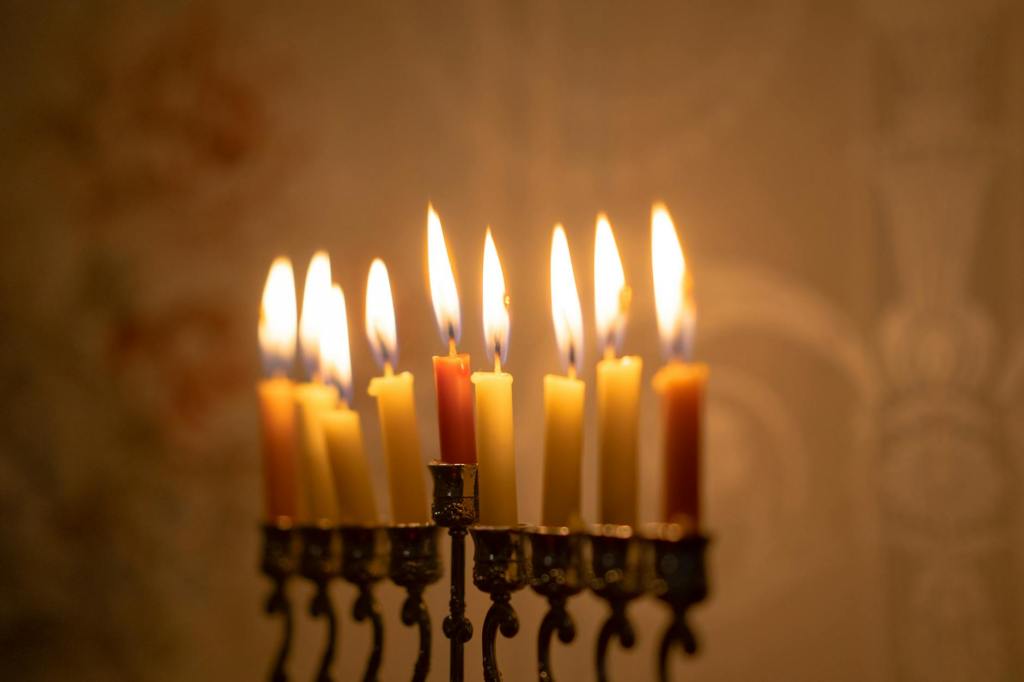
Long ago, the Jewish sages created reading calendars to be read annually throughout all the synagogues every sabbath. They are the Parsha (from the Torah, the first five books of the Bible), and the Haftarah (selected readings from the prophetic books of the Old Testament). Today, I continue my series exploring the Messiah in each of these portioned readings that was planned and scheduled in ancient days and appointed for our present days. For December this year, the first shabbat of Chanukah, the readings are cited above. I would encourage you to read those passages first before you read my post, or at least read them in tandem.
I know it’s late, but it is still Chanukah, and I couldn’t let it pass without giving it some attention. When it comes to the prophets, there are some that really confuse me (Join the club, right?), and Zechariah is one of those. But with the help of the Holy Spirit, we can understand these things otherwise considered mysteries or just not considered at all. The sages considered this passage worth our attention during Chanukah.
My process in tackling this passage will be to go through it systematically. First, Chapter 2 verse 10 (or 14) says,
Sing and rejoice, O daughter of Zion, for behold, I come and I will dwell in your midst, declares the Lord.
The JSB translates it as, “For, here, I am coming; and I will live among you.” John 1:14 says,
And the Word became flesh and dwelt among us, and we have seen his glory, glory as of the only Son from the Father, full of grace and truth.
God came to dwell, or live with us in the form of Jesus Christ. Next, verse 11 (or 15):
And many nations shall join themselves to the Lord in that day, and shall be my people. And I will dwell in your midst, and you shall know that the Lord of hosts has sent me to you.
In John 10:16, Jesus says,
And I have other sheep that are not of this fold. I must bring them also, and they will listen to my voice. So there will be one flock, one shepherd.
The gospel of Jesus Christ has gone throughout the whole world. There are still people groups who have not heard the gospel, and there are still many languages into which the Scripture has not been translated, but the gospel has gone around the globe. I think that qualifies as “many nations.” Pray that all nations will be added to that list one day, and soon.
Now next I want to talk about something very significant. Zechariah quotes God as directly saying, “and you shall know that the Lord of hosts has sent me to you.” That sounds like a strange thing for God to say. Who can send God? In its simplest reading, God is saying He will send Himself. But why did He say it that way? I don’t call my husband and say, “I am sending myself to you.” No, I say, ” I am coming to you.” So why does God speak in such an awkward way here? Check it out. The Apostle John who walked with Jesus during His ministry, wrote,
In this the love of God was made manifest among us, that God sent his only Son into the world, so that we might live through him. In this is love, not that we have loved God but that he loved us and sent his Son to be the propitiation for our sins. Beloved, if God so loved us, we also ought to love one another. No one has ever seen God; if we love one another, God abides in us and his love is perfected in us.
By this we know that we abide in him and he in us, because he has given us of his Spirit. And we have seen and testify that the Father has sent his Son to be the Savior of the world (1 Jn. 4:9-14).
So if we break it down, it’s really Jesus speaking to Zechariah: “and you shall know that the Lord of hosts has sent me to you.” Jesus is the Son of God. Jesus is God. I think we’re parsing hairs here, but I hope you get my gist. Moreover, during Chanukkah, in the temple, Jesus plainly said, “I and the Father are one” (Jn. 10:30), and Jews there
Zechariah says that many nations will join themselves to God when He sends Himself. Well, when Jesus came, He gave the great commission:
Go therefore and make disciples of all nations, baptizing them in the name of the Father and of the Son and of the Holy Spirit, teaching them to observe all that I have commanded you. And behold, I am with you always, to the end of the age.” (Mt. 28:19-20).
This also helps us understand why God says, “I will dwell in your midst” twice in Zechariah, once in verse 10(14) and once in verse 11(15). Jesus dwelt with us in the flesh as John chapter one beautifully summarizes, but He also promised, right before He ascended to heaven, “I am with you always, to the end of the age.”
Next, verse 12 says,
And the Lord will inherit Judah as his portion in the holy land, and will again choose Jerusalem.
Watch out now, that sounds too Zionist. Before “Zionism” was a term, God was a Zionist. It’s not called Palestine. It’s called the holy land. It’s not called Al-Quds. It’s called Yerushalayim. I’m just sayin. When you pick a fight with God’s people, you pick a fight with God. The Bible says the Lord will inherit Judah and pick Jerusalem. And if you do buck at this, the following verse gives a warning:
Be silent, all flesh, before the Lord, for he has roused himself from his holy dwelling.
The prophets told us time and time again that God will have a bone to pick with all the nations who fight against Israel in their land. And that’s one thing Chanukah is about. It’s about God’s people taking back what belongs to Him, what God promised to their stewardship, and sanctifying it again. The Maccabees led a campaign to take back Jerusalem and set out to sanctify the temple again, which had been desecrated by the Greeks under Antiochus Epiphanes (his name literally “god manifest”). He put himself in God’s place and tried to take what belonged to God. Don’t be like that guy. Trust what God told Zechariah.
Next, we have a vision God gave Zechariah:
Then he showed me Joshua the high priest standing before the angel of the Lord, and Satan standing at his right hand to accuse him. And the Lord said to Satan, “The Lord rebuke you, O Satan! The Lord who has chosen Jerusalem rebuke you! Is not this a brand plucked from the fire?” Now Joshua was standing before the angel, clothed with filthy garments. And the angel said to those who were standing before him, “Remove the filthy garments from him.” And to him he said, “Behold, I have taken your iniquity away from you, and I will clothe you with pure vestments.” And I said, “Let them put a clean turban on his head.” So they put a clean turban on his head and clothed him with garments. And the angel of the Lord was standing by.
And the angel of the Lord solemnly assured Joshua, “Thus says the Lord of hosts: If you will walk in my ways and keep my charge, then you shall rule my house and have charge of my courts, and I will give you the right of access among those who are standing here. Hear now, O Joshua the high priest, you and your friends who sit before you, for they are men who are a sign: behold, I will bring my servant the Branch. For behold, on the stone that I have set before Joshua, on a single stone with seven eyes, I will engrave its inscription, declares the Lord of hosts, and I will remove the iniquity of this land in a single day. In that day, declares the Lord of hosts, every one of you will invite his neighbor to come under his vine and under his fig tree” (3:1-10).
Okay, so there is a lot to tackle here. The CJSB commentary says Joshua represents “all of the priests down through the years,” but I would like to add that he also represents, as high priest, the nation of Israel to God. Indeed, he interceded for them on Yom Kippur, and if he made a single mistake on that day, the sins of Israel would not be removed for the year. And it was through the temple that the nations of the world would be forgiven too. I’ve already covered this in my post Sukkot Shabbat During the Middle Days: Numbers 29. So holistically, the accuser, Satan, is accusing Joshua the high priest, the priesthood as a whole, Israel as a whole, even the world as a whole.
Now this is another interesting moment where God refers to Himself in third person. Joshua is standing before the Angel of the Lord, and the Lord says to Satan, “The Lord rebuke you!” Now I believe the Angel of the Lord here is God. Who else would the high priest stand before? And if the Angel of the Lord is not God, and God is present in this scene, why aren’t Joshua and the others there standing before God instead of the angel? It’s because God is the Angel. When you’re in a room with the king, you stand before the king, not his servant. The angel, or God, commands those before him to remove Joshua’s filthy garments from his body and put on clean clothes, including a turban, which would have been part of the high priest’s clothing.
Isaiah 64:6 says,
We have all become like one who is unclean,
and all our righteous deeds are like a polluted garment.
We all fade like a leaf,
and our iniquities, like the wind, take us away.
Isaiah 1:18 says,
Come now, let us reason together, says the Lord: though your sins are like scarlet, they shall be as white as snow; though they are red like crimson, they shall become like wool.
Going back to Zechariah chapter 3, God says, “I will remove the iniquity of this land in a single day.” When will this happen? According to the passage, when God brings his servant, the Branch. Isaiah chapter 1 says,
“There shall come forth a shoot from the stump of Jesse, and a branch from his roots shall bear fruit….In that day the root of Jesse, who shall stand as a signal for the peoples—of him shall the nations inquire, and his resting place shall be glorious” (vs. 1, 10).
He is the Branch and the Root. Interesting. However, this branch is like a servant according to Zechariah. In the letter to the Philippians, the Apostle Paul writes that Jesus “emptied himself, by taking the form of a servant, being born in the likeness of men” (2:7). This is a Messianic name. And Joshua the high priest and the others who serve as priests are signs of Him. How so? Because He will hold a priestly role, removing sins and interceding before God for those in filthy garments. Hebrews 2:17 says, “Therefore he had to be made like his brothers in every respect, so that he might become a merciful and faithful high priest in the service of God, to make propitiation for the sins of the people.” This propitiation would be done in a single day, like Yom Kippur, the Day of Atonement. Jesus’ betrayal, sentencing, suffering, and death all happened on a single Jewish day, which is sundown to sundown. It could take days for this process to occur, let alone death by crucifixion (which could take days, hence why soldiers broke the legs of the criminals to accelerate their death). But it all happened to Jesus in a single day. That’s why Pilate was surprised to hear Jesus was already dead (Mk. 15:44). And on the cross, Jesus cried out, “Father, forgive them!” (Lk. 23:34). So it happened. In a single day, God took away their sins, indeed, all our sins.
Now let’s talk about what this stone with seven eyes before Joshua engraved with words from God is supposed to be. I would argue that this too is a symbol of Jesus. I have already talked extensively about how Jesus is the Stone in my post He Went Out: Jacob’s Foundation to the World. What’s with the seven eyes? I have a hunch that it’s tied to the seven-branch menorah in the next chapter. First, let’s talk about the meaning of the number seven. Many argue it means completion, and there is also an argument that it means holy. I explain these meanings of the number more extensively in my most Sukkot Shabbat During the Middle Days: Numbers 29. So these eyes function completely, they are holy eyes.
Now what’s the connection between the seven eyes and seven lights on the menorah again? Well, Jesus says in Luke 11:34, “Your eye is the lamp of your body. When your eye is healthy, your whole body is full of light, but when it is bad, your body is full of darkness.” The CJSB says Jesus “quotes a common proverb and comments on it…because in Judaism ‘having a good eye’ (an ‘ayin tovah) means being generous or looking at people positively. ‘Having a bad eye’ (an ‘ayin ra’ah) means being stingy or having a negative outlook toward others” (see CJSB footnote for Mt. 6:22-23). So if seven means complete or holy, and the eyes and lamp can be understood as the same thing, then God would demonstrate his complete, holy goodwill and generosity in the Stone, the Branch. Whereas Satan has a bad eye in Zechariah 3, thinking badly of Joshua and accusing him, God has a good eye by defending Joshua, removing his filth, and ultimately removing the sin of the land in a single day. Romans 10:12 says, “For there is no distinction between Jew and Greek; the same Lord is Lord of all and bestows his riches upon all who call upon him.” A branch is also part of a menorah. The menorah in Zechariah’s vision has seven branches like the menorah in the temple. According to former pastor and present Biblical archaeologist Kevin Dieckilman, the holy place was called the world and the menorah was called the light of the world. It literally was the only light in the holy place. Well, didn’t Jesus say He is the Light of the World? He did!
Again Jesus spoke to them, saying, “I am the light of the world. Whoever follows me will not walk in darkness, but will have the light of life” (Jn. 8:12).
What are the two olive trees on the right and left of the menorah? I’m still working on that. I don’t feel too bad because Zechariah didn’t get it either, and he’s the one who actually saw it and spoke with the Angel. Some say it represents the offices of priest and king anointed by God. If this is accurate, then I could argue Jesus fulfills both of those offices as the Anointed One. I have already talked about His fulfillment of the office of high priest. Later in this post, I talk about His connection to Zerubbabel, the governor and descendant of David of the tribe of Judah. The author of Hebrews definitely makes a defense for His role as priest and king. Following this vision, the Angel says,
Then he said to me, “This is the word of the Lord to Zerubbabel: Not by might, nor by power, but by my Spirit, says the Lord of hosts (vs. 6).
God did fulfill His agenda not by might nor power. Jesus came as a suffering servant. He divested His power and rights to give us power in His name through His Spirit.
Who are you, O great mountain? Before Zerubbabel you shall become a plain. And he shall bring forward the top stone amid shouts of ‘Grace, grace to it!’”
By God’s Spirit the mountain shall become a plain.
He said to them, “Because of your little faith. For truly, I say to you, if you have faith like a grain of mustard seed, you will say to this mountain, ‘Move from here to there,’ and it will move, and nothing will be impossible for you” (Mt. 17:20).
And Jesus answered them, “Truly, I say to you, if you have faith and do not doubt, you will not only do what has been done to the fig tree, but even if you say to this mountain, ‘Be taken up and thrown into the sea,’ it will happen” (Mt. 21:21).
Now the top stone is translated by the JSB as “capstone.” The full verse is translated like this: “What are you, you big mountain? Before Z’rubavel you will become a plain; and he will put the capstone in place, as everyone shouts, ‘It’s beautiful! Beautiful!’” Zerubbabel did complete the reconstruction of the temple that was destroyed by the Babylonians, but he is also the ancestor of Jesus. His family lineage would pave the way for Jesus, the culmination of the promise, the temple of God. Jesus referred to His body as the temple (Jn. 2:19-21). Jesus is the Stone, the capstone of God’s divine epic. The capstone is the last stone to go in a construction. Jesus completes the story God has been building through all of time. A capstone protects. Jesus protects us from the accusations of Satan. A capstone is also for beauty. That is why everyone In Zechariah’s vision shouts, “It is beautiful!” Many other translations say “grace to it” or “bless it,” so I don’t want to just cater the Bible to my fancy. I’m not a Bible scholar. During Jesus’ triumphal entry, the people did shout, “Blessed is he who come in the name of the Lord!” And Jesus said that Israel will say the same thing when He returns again.
Psalm 118:21-23 says,
I thank you that you have answered me
and have become my salvation.
The stone that the builders rejected
has become the cornerstone.
This is the Lord’s doing;
it is marvelous in our eyes.
The cornerstone is the first stone laid, and a capstone is the last stone laid. So why did I pull in Psalm 118? In Revelation 22:13, Jesus says, “I am the Alpha and the Omega, the first and the last, the beginning and the end.” The Branch and the Root, remember? Salvation in Hebrew is yeshua. God became Yeshua. Yeshua is a variant of Y’hoshua, Joshua. God became Joshua, the high priest in Jesus. Jesus had God written all over Him. Indeed, He is the Word of God (Jn. 1:1). He came to fulfill the law (Mt. 5:17). The first tablets were written on by God Himself. They were broken by disobedience. God would send His law again in Jesus and it would not be broken this time because Jesus kept it perfectly.
If you haven’t already, trust in the work of God through Jesus Christ, and He will cleanse you from all unrighteousness (1 Jn. 1:19). His good eye will shine on you. He will come again and reign from Jerusalem. He will claim what is His. He will sanctify His possession and His dwelling place. Dedicate your self to Him. Be among those who join themselves to Him through faith, and you can shout on that day with everyone else who believes, “It is Beautiful! Blessed is He Who comes in the Name of the Lord!”
I am hard pressed for time to write my own poem about Chanukah right now. I’m sure I will later, but I wanted to go ahead and get this out while it is Chanukah. Here is a song that came to my mind as I thought about dedication, which is what Chanukah is about, dedication to God. This hymn is by Frances Ridley Havergal (1836-1879).
Take My Life and Let It Be
1 Take my life and let it be
consecrated, Lord, to thee.
Take my moments and my days;
let them flow in endless praise,
let them flow in endless praise.
2 Take my hands and let them move
at the impulse of thy love.
Take my feet and let them be
swift and beautiful for thee,
swift and beautiful for thee.
3 Take my voice and let me sing
always, only, for my King.
Take my lips and let them be
filled with messages from thee,
filled with messages from thee.
4 Take my silver and my gold;
not a mite would I withhold.
Take my intellect and use
every power as thou shalt choose,
every power as thou shalt choose.
5 Take my will and make it thine;
it shall be no longer mine.
Take my heart it is thine own;
it shall be thy royal throne,
it shall be thy royal throne.
6 Take my love; my Lord, I pour
at thy feet its treasure store.
Take myself, and I will be
ever, only, all for thee,
ever, only, all for thee.

 Valley Princess
Leave a comment