Numbers 29
Ezekiel 38:18-39:16
Long ago, the Jewish sages created reading calendars to be read annually throughout all the synagogues every sabbath. They are the Parsha (from the Torah, the first five books of the Bible), and the Haftarah (selected readings from the prophetic books of the Old Testament). Today, I continue my series exploring the Messiah in each of these portioned readings that was planned and scheduled in ancient days and appointed for our present days. For October 11 this year, the readings are cited above. I would encourage you to read those passages first before you read my post, or at least read them in tandem.
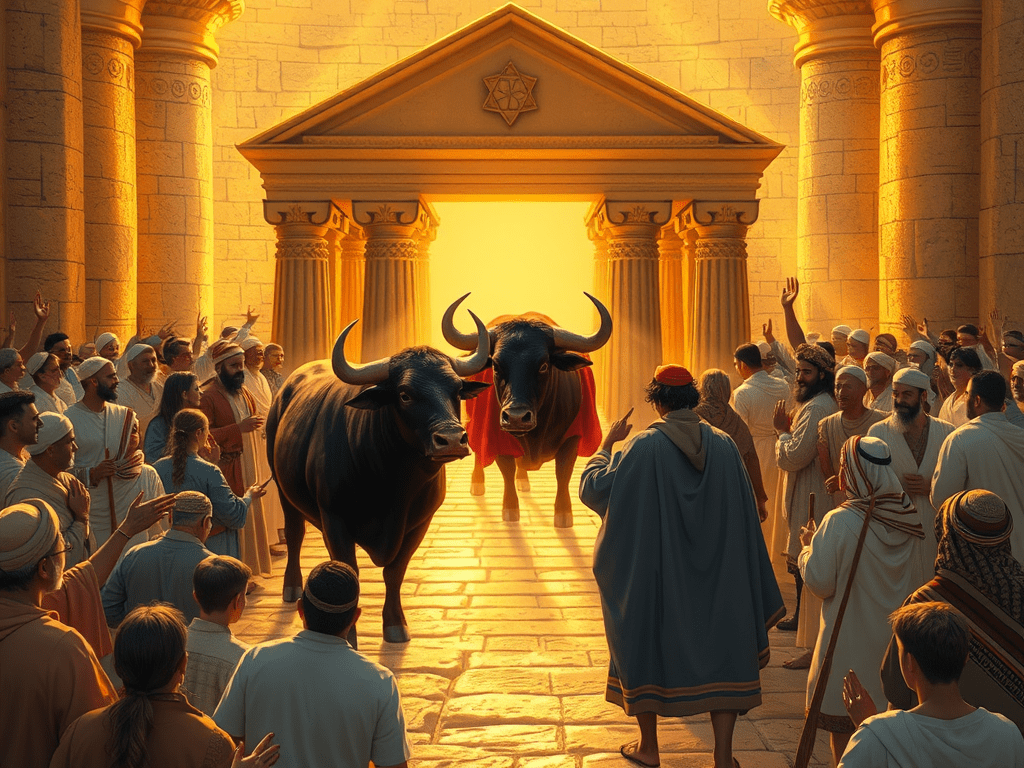
Numbers chapter 29 seems like an outdated mundane list of to-do’s for a now obsolete sacrificial system, but is there more to this chapter? On the first day of Sukkot, thirteen bulls were supposed to be offered, along with other items, which remain the same throughout the seven days of Sukkot. But the number of bulls changes every day. The pattern counts by one in decreasing order, until you get to seven bulls on the seventh day, and then only one bull is offered on the eight day. The total number of bulls adds up to 70. The Talmud offers an interesting insight into this pattern. Remember how I said two posts ago that Sukkot won’t be just for Jews but for the world?
According to the Talmud, Sukkot 55b,
“Rabbi Elazar said: These seventy bulls that are sacrificed as additional offerings over the course of the seven days of Sukkot, to what do they correspond? They correspond to the seventy nations of the world, and are brought to atone for their sins and to hasten world peace. Why is a single bull sacrificed on the Eighth Day of Assembly? It corresponds to the singular nation, Israel.”
According to tradition, 70 nations went out from Babel over the earth. These are the original nations or people groups.
According to Dr. Baruch,
“The meaning of the number thirteen is found when the numbers one and twelve are combined. We have learned that twelve refers to the people of G-d and the number one relates to HaShem; therefore, the number thirteen speaks of a unity between G-d and His people…The numbers six and seven are related to this idea. The only way that there can be unity between man and a Holy G-d is when sinners are made holy (7) by the grace of God (6).”
Thirteen is also the numerical value of the word love in Hebrew and the covenant name of God, YHWH. So the bulls of the first day of offering could imply the unity of God and mankind.
Regarding the seventh day, we have seven bulls being offered. Dr. Baruch says Christians often interpret seven as the number of completion (as I have done even on this very blog), and we can get that from Genesis 2:1-2, but that’s not its meaning in Scripture from a holistic approach. Seven is more associated with holiness and rest. So the nations, by the end of the seventh day, are brought to holiness and rest in God.
The sages have already been cited in the Talmud as understanding the bull of the eight day as the singular nation of Israel. Yitzchak Reuven of the Temple Institute also discusses the eight day as a day between God and Israel, a private day. How could Biblical eschatology correspond to this teaching? Romans 11:25 says,
“a partial hardening has come upon Israel, until the fullness of the Gentiles has come in.”
This verse indicates that once the Gentiles who will be saved are brought into salvation, the partial hardening on Israel toward the Gospel will be lifted, and they will be brought into salvation as a nation too. I’m not indicating all Jews are hardened. Quite the contrary. The Scripture says the hardening is “partial.” On that last day, Israel will believe on a large scale, like a revival scale. This follows the pattern of Numbers 29 according to the sages. Atonement is made for the nations, and then Israel on the last day.
Let’s look back at the salvation of the Gentiles or other nations again. In Revelation 7:9-10, we get a picture of all these nations at the end:
“9 After this I looked, and behold, a great multitude that no one could number, from every nation, from all tribes and peoples and languages, standing before the throne and before the Lamb, clothed in white robes, with palm branches in their hands, 10 and crying out with a loud voice, ‘Salvation belongs to our God who sits on the throne, and to the Lamb!’”
White is the traditional attire worn on Yom Kippur, and palm branches are traditionally used to worship God during Sukkot.
Remember how I posted last time about Jesus being the tabernacle and temple of God’s presence? The Talmud quotes Rabbi Yoḥanan,
“Woe unto the nations of the world that lost something and do not know what they lost. When the Temple is standing, the seventy bulls sacrificed on the altar during the festival of Sukkot atones for them. And now that the Temple is destroyed, who atones for them?”
Well, if you understand Jesus is the temple of God’s presence as He Himself declared, then He atones for them. Those atoned for from the nations proclaim, “Salvation belongs to our God who sits on the throne, and to the Lamb.”
Sukkot is about bringing back in the nations that dispersed at Babel and the salvation of Israel. I would like to close this post with a question. Are you a part of that? If you’re not sure, the Gospel is simple. All have sinned (Rom. 3:23), but whoever believes in Jesus Christ as the Son of God and Savior of the world will be saved (Acts 16:31). He died for your sins (1 Cor. 15:3). All you have to do is receive that truth and believe it (John 1:12). Confess your sins to God (1 Jn. 1:9), ask Him to forgive you because of the atoning work of Jesus on the cross, and commit your life to Him. Then you will be among the throng before the throne of God rejoicing in His salvation.
Thanks for reading, and God bless.
Sources
LoveIsrael.org. “Hebrew Numerology-Seven.” HEBREW NUMEROLOGY, explained. Number SEVEN explained.
LoveIsrael.org. “Hebrew Numerology-Thirteen.”HEBREW NUMEROLOGY, explained. THIRTEEN, explained.
Talmud Sukkot 55b. Sefaria. Sukkah 55b:10 with Connections

 Valley Princess
Leave a comment