Torah: Genesis 41:1-44:17
Haftarah: 1 Kings 3:15-4:1
Long ago, the Jewish sages created reading calendars to be read annually throughout all the synagogues every sabbath. They are the Parsha (from the Torah, the first five books of the Bible), and the Haftarah (selected readings from the prophetic books of the Old Testament). Today, I continue my series exploring the Messiah in each of these portioned readings that was planned and scheduled in ancient days and appointed for our present days. For December 20 this year, the readings are cited above. I would encourage you to read those passages first before you read my post, or at least read them in tandem.
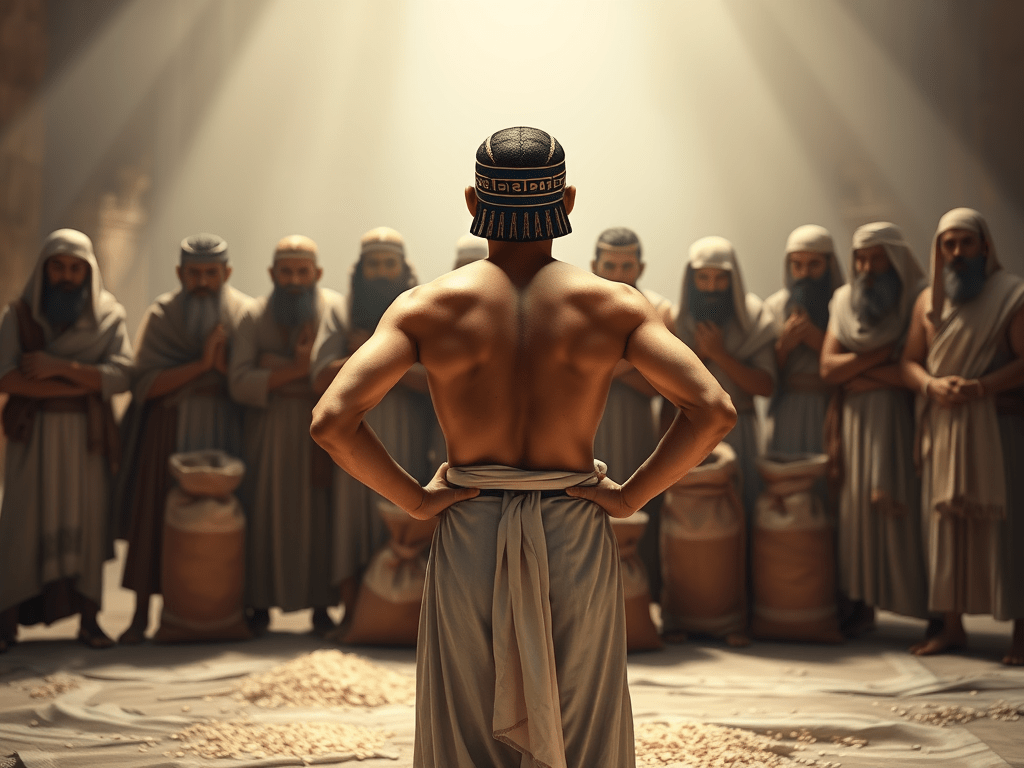
This portion begins with Pharoah’s dream and ends with the dramatic climax between Joseph and his brothers, who still didn’t know it was him. Their money they tried to buy grain with had been returned to their bags with their grain. Then silver cup was found in Benjamin’s sack, and they already vowed that the one with the cup would become Joseph’s slave. The brothers return and Judah offered all of themselves to Joseph as slaves, but Joseph turned down his offer. He wanted only the one who had the cup, Benjamin. Would the brothers let him have Benjamin and then be on their merry way? Or had they changed? Would they look out for themselves or would they look out for Benjamin? If you don’t know what happened next, the portion leaves the reader at a real cliff hanger. Even if you do know what happened next, it’s hard to be satisfied reading only to 44:17. Have you ever re-watched your favorite TV series and found it hard to stop watching at the season finale? Have you ever been tempted to go ahead and begin watching the first episode of season two? I get the feeling that the way this portion is broken up is intended to have that same effect.
Judah had already convinced Israel to let Bejamin return with them to Egypt. Sometime before that, Reuben could not convince Israel to let Benjamin go, even though he offered the lives of his two sons if Benjamin didn’t return safely (I can hear Reuben’s sons saying, “Thanks, Dad.”). How did Judah persuade Israel? He pledged his own life (Genesis 42:37, 43:8-9). It is fitting that his descendant according to the flesh, Jesus Christ, would, as fully worthy, offer himself as our substitute.
Jesus said to them, “I am the bread of life; whoever comes to me shall not hunger, and whoever believes in me shall never thirst. But I said to you that you have seen me and yet do not believe. All that the Father gives me will come to me, and whoever comes to me I will never cast out. For I have come down from heaven, not to do my own will but the will of him who sent me. And this is the will of him who sent me, that I should lose nothing of all that he has given me, but raise it up on the last day. For this is the will of my Father, that everyone who looks on the Son and believes in him should have eternal life, and I will raise him up on the last day” (Jn. 6:35-40).
Now at this point you might be wondering why I was setting up Joseph as the Messianic figure in the last post, but now I am framing Judah in that context. Good question. I will dive deeper into this more next time, but to suffice it to say for now, the sages saw this same disparity between a suffering messiah and a victorious kingly messiah (since the kings came from Judah and Judah himself takes the leadership role). They then said there are two messiahs, and messiah ben Joseph and a messiah ben Judah. So how does a believer make sense of this with Jesus? You’ll just have to wait until next time. If you read the above excerpt from John chapter 6, I think you’ll notice images and characteristics Jesus talks about as being tied to Joseph: Bread of Life, quenching thirst, will of the Father. But for now, in the parshah, Judah postured himself as a messianic figure, pledging his own life and interceding.
From this point on in the story, Judah, though the fourth born, takes the leadership role out of the brothers. Judah became the mouthpiece of the brothers to Joseph. Judah admitted the guilt of himself and his brothers publicly to Joseph: “What shall we say to my lord? What shall we speak? Or how can we clear ourselves? God has found out the guilt of your servants; behold, we are my lord’s servants, both we and he also in whose hand the cup has been found” (Genesis 44:16). It’s so hard for me to stop just here and not go into the next portion, but I’ll do my best. Suffice it to say, Judah took the role of eldest brother, not Reuben, not Simeon, and not Levi. It’s like the Biblical narrative has shown us without telling us that they have been disqualified. True, Judah wasn’t exactly a knight in shining armor, but the Biblical narrative also gives us signs of his repentance (confession and behavior change) where it does not show us such repentance from his brothers. Judah confessed his unrighteousness after the drama with Tamar, and at the end of this portion, he confessed not only his guilt but that of his brothers and began to take to role of intercessor, putting his very self on the line. Even if his efforts failed, at least he he did his best, that he tried. I am thankful for this story as it shows that how we begin is not what matters, but where we go from there. Thousands of years later, his descendant according to the flesh, Jesus Christ, would intercede for us to the Father on the cross and even intercedes for us this very moment in heaven before the Father, and He would not fail as the Righteous One. In his letter to the Romans, Paul writes, “Who is to condemn? Christ Jesus is the one who died—more than that, who was raised—who is at the right hand of God, who indeed is interceding for us” (8:34).
In this portion, it is true that Judah is becoming a messianic figure and we are left at a cliffhanger, but this portion is also developing Joseph’s messianic symbolism. See, Joseph was born and raised a Hebrew. He was given a Hebrew name at his birth, he spoke Hebrew, he dressed like a Hebrew, and he subsisted like a Hebrew as a shepherd with his brothers. Twenty years after his brothers sold him into slavery, he was like a completely different person. They certainly didn’t recognize him. He had an Egyptian name, he spoke Egyptian, he dressed like an Egyptian, and he held an Egyptian governmental position, the second most powerful one in the kingdom of Egypt for that matter. By all things considered, Joseph was an Egyptian to the known world. But he was still Joseph. He was still their brother. He was still a Hebrew. He may have acted cold and callous with them, but his heart was still warm to them. He had to step aside privately and cry so he did not give his identity away. Why was he waiting so long to tell them? Why did he return their money to their sacks? Why did he put the silver cup in their sacks? Perhaps Joseph was telling them that he loved them so much that he did not require their payment. The grain was a gift. Perhaps it was a test (especially with the silver cup) to see if they had changed or not.
Okay, so how is any of this messianic? Well, Jesus was born a Jew, He was given a Jewish name, he grew up speaking Hebrew, He dressed like a Jew, and He worked like a poor Jewish carpenter and later stepped into the role of a Jewish rabbi. He was given the name Yeshua, which is Hebrew meaning savior, salvation, or God saves. But then His name was written down in Greek, then into Latin, then, well, it goes on. He has His name in its own version for just about every language on earth now, and many of them don’t sound similar at all, let alone similar to His original Hebrew name. When Christianity became the official religion of Rome, the artwork of the church changed His appearance. He was depicted more like the Greek god Zeus. So 400 years out from His historical earthly ministry, Jesus was by all superficial appearances like a completely different person, not Jewish. Beyond that, church decisions removed Easter from Passover and placed Christmas at a pagan holiday, Saturnalia. The church actively separated Jesus from His Jewishness to make Him look Gentile. And for 2000 years the Jewish people as a whole have not recognized Him as their own. The world has been going to Him for the last 2000 years to quench their spiritual thirst and satisfy their spiritual hunger, but the Jews (as a whole and speaking very generally and poetically) have not recognized him as their brother. Today, Jews perform mitzvahs in order to gain favor with God and enter their names into the Book of Life. But Jesus says no, keep your mitzvahs for yourselves. He gives eternal life freely. Romans 6:23 says, “For the wages of sin is death, but the free gift of God is eternal life in Christ Jesus our Lord.” Isaiah 55:1 says, ““Come, everyone who thirsts, come to the waters; and he who has no money, come, buy and eat! Come, buy wine and milk without money and without price.” Because of reformed Judaism after the destruction of the temple and sacrificial system, mitzvahs are the way to gain God’s favor. That doesn’t make sense if it’s free. For the most part, it doesn’t make sense to Jews still, much like the returned money to Joseph’s brothers was baffling. Don’t worry, God will have a way to bring this all-full circle and make sense one day, just like it would for Joseph and his brothers, but that’s for next week.
How then does all this culminate? How does the story of messiah ben Judah end? How does the story of messiah be Joseph end? And how do they fit together when the sages couldn’t figure it out?
I could try to use this week’s Haftarah as a teaser to next week’s portion. The haftarah is about King Solomon. He just had a dream. God asked him what he wanted. He asked for wisdom to rule. God promised him that and so much more because he asked for wisdom and nothing else.
And all Israel heard of the judgment that the king had rendered, and they stood in awe of the king, because they perceived that the wisdom of God was in him to do justice (1 Kgs. 3:28).
I suppose thiswas chosen to pair with this Parshah because God’s Spirit was perceivable in Joseph to whoever was around him. But Solomon is descended from Judah, not Joseph, and Jesus is descended from Solomon. How does this tie to Jesus? The operating of the Spirit is not based on the flesh, but God used the flesh (the line of Judah) to demonstrate His Spirit, ultimately in Jesus. Luke 2:52 says, “And Jesus increased in wisdom and in stature and in favor with God and man.” When he left His 40-day fast and temptation by Satan in the wilderness, Luke writes, “And Jesus returned in the power of the Spirit to Galilee, and a report about him went out through all the surrounding country” (4:14).
May the world go to Jesus as the Bread of Life and the Living Water, may the heart of Israel’s sons change, may they recognize Jesus, their brother, and may we all take refuge in the Lion of Judah Who gave His life as a pledge for us all and intercedes for us in heaven.
I hope this has been an enjoyable and fun read for you, if you like exegesis.
The Cliffhanger
It had been 20 years since he was sold.
A drought, famine, overtook all the land.
No visions now. What would the future hold?
“In Egypt is plenty across the sand.”
The brothers went. They did not understand.
They bowed before their brother, so estranged;
Egyptian speech, dress, second in command.
They did not know that this was God-arranged.
Their silver from the slave for grain exchanged,
Into their sacks returned and homeward sent.
The test was set. Had Israel’s sons changed?
The money. The silver cup. What was meant?
Zaphenath-paneah was the man’s name,
But Joseph underneath, he was the same.
If you want a book of my poetry, I have one available on Amazon right now, Learning to Love: A Collection of Poetry and 40 Daily Devotions. Proceeds go to charity. All of it is original. No AI. Until next time, God bless.

 Valley Princess
Leave a comment