Torah: Leviticus 1:1-6:7(5:26)
Haftarah: Isaiah 43:21-44:23
This post is a continuation of my exploration of the Torah portion Vayikra (He Called). In my last post The Burnt Offering He Called for, I focused on the burnt offering and how it represents both Jesus and the spiritual and sometimes literal self-sacrifice God requires of believers. For this post, I will focus on the grain offering and how that relates to Messiah Jesus. Again, I’ve had to heavily rely on other commentary to wrap my head around the sacrifices, and I provide my sources at the end.
The Grain Offering
Leviticus 2 covers the stipulations of the grain offering (minhah). Minhah basically means “tribute, gift,” harkening more to the offering’s function than its contents. Jesus, who was born in Bethlehem (meaning House of Bread), on the night He was betrayed unto death, “took bread, and after blessing it broke it and gave it to the disciples, and said, ‘Take, eat; this is my body’” (Mt. 26:26). Instead of gift and tribute being given to God by men, Jesus, God incarnate, gave to humans. Jesus said, “the Son of Man came not to be served but to serve, and to give his life as a ransom for many” (Mt. 20:28). Jesus, in this sense, in the minhah.
Next, Jesus is the minhah in the sense of its substance in addition to its function, which I explained above. What the ESV translates as “fine flour” is solet, which is semolina flour, which is the substance of the flour, not the manner in which it is prepared. Semolina comes from the inner kernels of the wheat, considered the choice part of the wheat. Jesus is the only beloved Son of God. Being born as a human, He is the choice grain from the earth’s populace. God said, “This is my beloved Son, with whom I am well pleased” (Mt. 3:17). Jesus used grain as a metaphor for humanity. Here is an example in one story:
35 And Jesus went throughout all the cities and villages, teaching in their synagogues and proclaiming the gospel of the kingdom and healing every disease and every affliction. 36 When he saw the crowds, he had compassion for them, because they were harassed and helpless, like sheep without a shepherd. 37 Then he said to his disciples, “The harvest is plentiful, but the laborers are few; 38 therefore pray earnestly to the Lord of the harvest to send out laborers into his harvest” (Mt. 9:35-38).
By combining the definition of the substance of minhah as the choice grain, and the Bible’s usage of grain as a metaphor for humanity, Jesus is therefore the choice grain required for the minhah.
The minhah had to have oil poured onto it and have frankincense put on it. This oil would have been olive oil. It was the same type of oil used for fueling the menorah. Oil was also a symbol of being anointed. Jesus was the anointed one. The term “anointed one” is used Biblically to identify the king (Ps. 132:10), and it was also used in Messianic reference (Dan. 9:25-26). Jesus is the King, from the line of David, the line of anointed ones, and He is the Messiah. Therefore, he is the One anointed with oil. According to the JPS Commentary “oil was initially poured over the semolina flour…along with frankincense,” but “oil might also be applied in any of several ways to the dough at later stages” (10). Oil is a symbol of being anointed with the Holy Spirit too. The power of the Holy Spirit caused Jesus’ conception (Lk. 1:35), and the Holy Spirit filled Jesus when He began his three-year earthly ministry (Lk. 4:14), just to name a couple of “application points”. Even until the end, when He prayed in the Garden of Gethsemane (meaning Olive Press), the last stage of His preparation for sacrifice is connected to olive oil. Jesus’ entire life was for the purpose of the cross. From beginning to end, Jesus’ life is connecting to the anointing. Secondly, the minhah required frankicense be placed upon it. Do we see frankincense associated with or joined with Jesus in any way? Actually, we do. The wisemen, who called Jesus the King of the Jews (Anointed One), offered Jesus frankincense as one of their gifts to Him (Mt. 2:11). Jesus’ entire earthly life before was the preparation process for that sacrificial moment. Therefore, Jesus fulfills the requirements of having oil and frankincense to be offered with the minhah.
The minhah was brought to “Aaron’s sons the priests” (Lev. 2:2), then to the altar, and so too was Jesus. Matthew 26:57 says, “Then those who had seized Jesus led him to Caiaphas the high priest, where the scribes and the elders had gathered.” This Caiaphas was one of “Aaron’s sons the priests.” After the sanhedrin condemned Him to death, they led him to the Roman authorities (because under Roman law they couldn’t execute people themselves). It is from there He was led to the place that would functino as the altar, and altar of earth, unhewn stone. “
And when they had mocked him, they stripped him of the robe and put his own clothes on him and led him away to crucify him” (Mt. 27:31). Jesus was brought to “Aaron’s sons the priests” just like the minhah was, and then taken to the altar, in the same relative order.
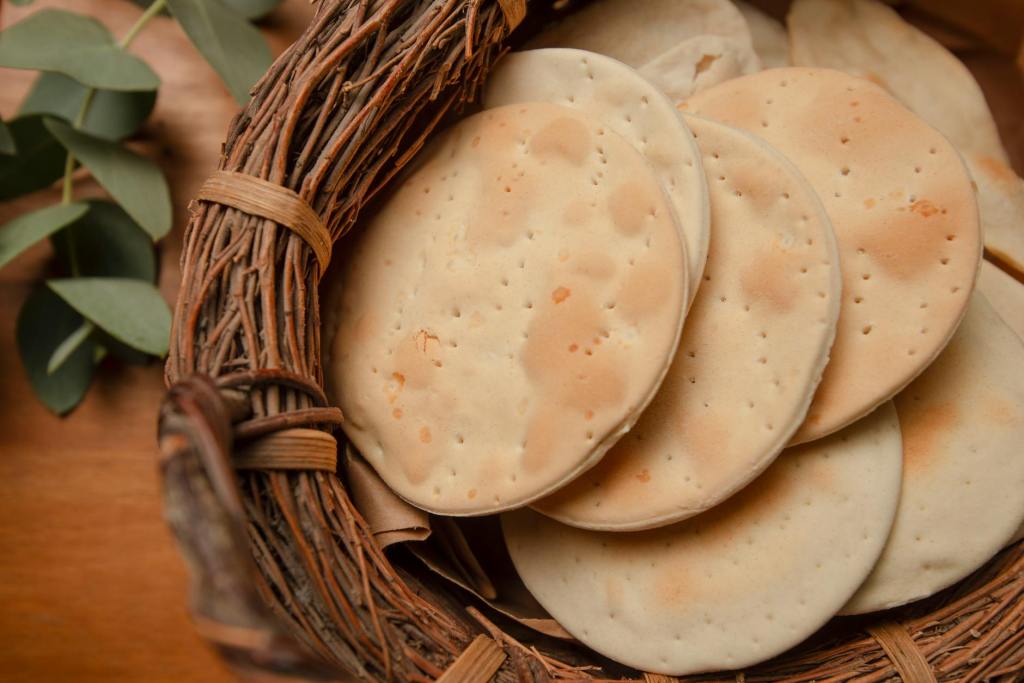
The minhah had to be unleavened, which is matsah. There are different types of bread. There is hamets, which is leavened bread, and is connected to the meaning “sour, fermented” (12). Perhaps it’s this symbolic meaning that is connected with the grain offering requirement of unleavened bread, that is matsah. Hamets could be offered on the table of showbread, and it could be offered during firstfruits, but not on the altar. Considering leaven as a symbol of corruption (fermentation, souring), Jesus was absent of any leaven, for He, “in every respect has been tempted as we are, yet without sin” (Heb. 4:15). The New Testament uses leaven to describe a variety of sins which would infect the entire “lump” of dough (the person) if they were contaminated with even a little bit, for “9 A little leaven leavens the whole lump” (Gal. 5:9).
Jesus said to them, “Watch and beware of the leaven of the Pharisees and Sadducees’” (Mt. 16:6).
6 Your boasting is not good. Do you not know that a little leaven leavens the whole lump? 7 Cleanse out the old leaven that you may be a new lump, as you really are unleavened. For Christ, our Passover lamb, has been sacrificed. 8 Let us therefore celebrate the festival, not with the old leaven, the leaven of malice and evil, but with the unleavened bread of sincerity and truth. (1 Cor. 5:6-8).
Since Jesus is absent of any of these or other sins, He is therefore unleavened.
Considering decomposition in the fermenting and souring process, Jesus was raised before His body decomposed. In Acts 2:27, Peter, during his sermon at Shavuot (Pentecost), quoted Psalm 16:10 in relation to Jesus: “For you will not abandon my soul to Sheol, or let your holy one see corruption.” Therefore, Jesus fulfills the requirement of being unleavened for the minhah. Wait a minute, one might think. Jesus, in the Gospels, associates Himself with the Passover matsah, not the grain offering, but the two are connected “as regards leaven,” for “a connection between the prohibition stated here and the Passover laws is certainly to be assumed” (JPS Torah Commentary: Leviticus, 12).
The minhah had to be broken in pieces (Lev. 2:6), and Jesus was broken too. 1 Corinthians 11:23b-24a says, “the Lord Jesus on the night when he was betrayed took bread, 24 and when he had given thanks, he broke it, and said, “This is my body, which is for you.” Jesus is therefore the minhah that had to be broken to be offered.
The minhah could not be offered with any honey. Jesus’ sacrifice was in no way sweet. It was very bitter. He was blindfolded, beaten, hit, spat upon, mocked, lashed 39 times with the cat of nine tails, forced to carry a heavy wooden beam on His freshly lashed back and significant blood loss until He could carry it on His own no more, marched two-fifths of a mile in a humiliating procession, nailed to a cross, and left to be gawked at and mocked for a good three hours until He gave up His Spirit. His body was left hanging indecently on the cross until Joseph of Arimathea took it down to bury it before the Sabbath that evening. There was nothing sweet about this event. Therefore, Jesus’ sacrifice fulfills the requirement to contain no honey.
The minhah had to be offered with salt. I can’t see how the Old Testament reveals the explicit meaning of salt, and my commentary doesn’t help me out either other than its for the sake of uniformity with animal sacrifices in which the salt “functioned to remove whatever blood remained after slaughter” (13). But there has to be more of a root to this than mere practicality. It’s all a shadow of Messiah Who came. So I will rely on the New Testament and common sense in this section. Salt adds flavor to things, which makes life more pleasant, and a certain amount of salt is also essential for survival. Jesus said, “I came that they may have life and have it abundantly” (Jn. 10:10). This life Jesus speaks of is a life that can be both experienced and enjoyed, which are the two functions of salt I just mentioned. Salt is also a preservative. A preservative keeps something from spoiling. Jesus said,
“37 All that the Father gives me will come to me, and whoever comes to me I will never cast out. 38 For I have come down from heaven, not to do my own will but the will of him who sent me. 39 And this is the will of him who sent me, that I should lose nothing of all that he has given me, but raise it up on the last day. 40 For this is the will of my Father, that everyone who looks on the Son and believes in him should have eternal life, and I will raise him up on the last day” (Jn. 6:37).
By not being lost and by receiving eternal life, those who have faith in Jesus will be preserved.
Philippians 1:6 says, “And I am sure of this, that he who began a good work in you will bring it to completion at the day of Jesus Christ.” Those who God began to work in will be preserved. They will not spoil nor be spoiled up to “the day.”
The Bible frequently admonishes believers to endure to the end. Those who endure implicitly preserve themselves or are preserved from spoiling until the end. Matthew 24:13 says, “the one who endures to the end will be saved.”
Jesus told the Jews He preached to that they are the salt of the earth. “You are the salt of the earth, but if salt has lost its taste, how shall its saltiness be restored? It is no longer good for anything except to be thrown out and trampled under people’s feet” (Mt. 5:13). They can, however, lose their saltiness, that is, they are not preserved. This can be true for anybody who claims to believe in Jesus, Jew or Gentile. If they do not endure, they are not preserved.
But Jesus did persevere. He did endure. He was preserved. He lived His life without sin and faithfully died under the will of the Father. He was the salt. Jesus said in the same passage from Matthew 5 that they (Jews) were the light of the world and He also said He was the Light of the World. It’s not that far of a stretch to say that Jesus functions as the salt He admonishes His hearers to be. He wouldn’t ask them to do anything He Himself did not do. Therefore, Jesus is the salt that enhances life, gives life, and preserves life.
In the requirements concerning function, essence, preparation, and offering, Jesus fulfills them all.
Leviticus chapter two also gives instructions about the gain offering of firstfruits. The Hebrew word for firstfruits, bikkurim, derives from the same root for firstborn of both animals and humans. Therefore, the firstfruits and the firstborn are connected. The grain to be presented in Lev. 2:14 is “grain just prior to ripening,” which is the understanding of the grain that was destroyed by the hailstorm in the Egyptian plague (JPS Torah Commentary: Leviticus, 13). I’ve already talked in older posts about Jesus connected to the firstborn and to the firstborn of Passover and the Passover lamb: see Bo (Go) and His Rulings Are Upright. This Hebrew etymological connection of bikkurim to the firstborn also connects the essence of the Egyptian plagues to one another. God was taking the firstfruits of Egypt’s various types of firstfruits, the first of the grain and the first of livestock and humans. God therefore requires the firstfruits and firstborn of grain, animals, and humans in His Commandments. The Egyptians rejected God, and therefore they paid the price themselves. The Israelites and anyone else who joined themselves to the Israelites as part of the “mixed multitude” (Ex. 12:38) offered the Passover lamb in exchange for their firstborn and later when the law was given, grain offerings of firstfruits. Jesus is the substitutionary requirement for these different elements, including the bikkurim. The same basic truth is the same for us today. We can trust in Jesus as our offering of firstfruits. My hope and prayer is that you, my readers, put your confidence in Him instead of experiencing the cost yourself as the Egyptians did in the plagues.
The New Testament explicitly ties the firstfruits with Jesus (1 Cor. 15:20-23).
Jesus is the grain offering, minhah, and the grain offering of firstfruits, bikkurim. I hope and pray that this enlightens you to the depths of the details of the sacrifices and how they connect to Messiah, of which they are a shadow. I pray you partake of His life broken for you and me.
I want to thank you for your patience as I take more time to wade through the first portion of Leviticus. I promise I will get through it and catch up, but I want to do it justice. Until next time, God bless.
Sources
The Bible. English Standard Version. Biblegateway.com. Accessed 28 Mar. 2026.
The Complete Jewish Study Bible. Peabody, Hendrickson Publishers, 2016.
The JPS Torah Commentary: Leviticus. Philadelphia, The Jewish Publication Society, 1989.

 Valley Princess
Leave a comment