Torah: Exodus 21:1-24:18
Haftarah: Jeremiah 34:8-22
Long ago, the Jewish sages created the parsha, a reading calendar to be read annually throughout all the synagogues every sabbath. They are from the Torah (the first five books of the Bible), and the Haftarah (selected readings from the prophetic books or Nevi’im of the Old Testament or Ketuvim). Today, I continue my series exploring the Messiah in each of these portioned readings that was planned and scheduled in ancient days and appointed for our present days. For February 14, 2026, Mishpatim (Rulings), the readings are cited above. I would encourage you to read those passages first before you read my post, or at least read them in tandem.
This portion begins with various rulings on social situations between people concerning slaves and restitution for losses in various situations, includes the confirming of the covenant between God and Israel, and ends with Moses, Aaron, Aaron’s sons, and 70 elders actually beholding God on the mountain while they ate and drank. Perhaps for the modern reader, it starts out kinda dull and ends with a whopper scene. As always, there is meaning behind its format and presentation, and I will tackle one subject at a time (not comprehensively), looking for how this reading relates to the Messiah.
Rules for Slavery
Slavery, as we understand it today, is terrible. Slavery still goes on today all around the world underneath people’s noses. Today, we call it human trafficking. America began with the stain of slavery. An estimated 12 million people were sold by their own into slavery, and that’s just to the Americas. Then, for centuries, their children were born into the hopeless life-long condition of slavery–that is, if they survived to have children, let alone survive the horrifically inhumane trip across the Atlantic. Equiano is one of the amazing survivors who was able to keep a record for us of these terrible stories. This reading falls in February this year, and February is Black History Month in the United States. The African slave trade was cruel, monstrous, and evil. People were sold for life, or born into slavery, and there was no hope of freedom. People were enslaved simply because of the color of their skin. This is not the type of slavery that Exodus chapter 21 is talking about. According to the standards of this chapter, the slave-owners and sellers should have been killed almost on the spot. The Haftarah makes it clear that the Jews who broke this law in Jeremiah’s generation would themselves be captured and killed.
17 “Therefore, thus says the Lord: You have not obeyed me by proclaiming liberty, every one to his brother and to his neighbor; behold, I proclaim to you liberty to the sword, to pestilence, and to famine, declares the Lord. I will make you a horror to all the kingdoms of the earth. 18 And the men who transgressed my covenant and did not keep the terms of the covenant that they made before me, I will make them like the calf that they cut in two and passed between its parts— 19 the officials of Judah, the officials of Jerusalem, the eunuchs, the priests, and all the people of the land who passed between the parts of the calf. 20 And I will give them into the hand of their enemies and into the hand of those who seek their lives. Their dead bodies shall be food for the birds of the air and the beasts of the earth. 21 And Zedekiah king of Judah and his officials I will give into the hand of their enemies and into the hand of those who seek their lives, into the hand of the army of the king of Babylon which has withdrawn from you. 22 Behold, I will command, declares the Lord, and will bring them back to this city. And they will fight against it and take it and burn it with fire. I will make the cities of Judah a desolation without inhabitant” (Jer. 34:17-22).
Exodus 21:16 says, “Whoever kidnaps someone must be put to death, regardless of whether he has already sold him or the person is found still in his possession.” Exodus 21:12 says, “Whoever attacks a person and causes his death must be put to death.” Likewise, all those slave traders and slave owners of the African slave trade who were responsible for the kidnapping and/or premature death of their slaves deserved capital punishment. Slavery is not ideal at all, but it was certainly never supposed to be a permanent involuntary state. Exodus 21 makes it clear that it is only for a certain period of time under specific conditions that honor human dignity and safety. This is more like the modern definition of indentured servitude than the modern definition of slavery. Some of my ancestors were indentured servants. That’s how they received their funding to cross the Atlantic to the New World. They agreed to serve their patrons for a fixed number of years to pay for their travel fare, and that was fine. The Bible does not justify the definition of slavery that developed during the African slave trade, nor does it justify the majority of slavery in the ancient world either. Compared to other ancient laws like Hammurabi’s Code, for example, the Bible defends the sanctity of life and basic human rights unlike any other. I’ll be honest, not all of it makes perfect sense to me, but it doesn’t have to make sense to me right now for it to be the best ruling God could give to the Israelites. Psalm 119:137 says, “You are righteous, Adonai; and your rulings are upright” (Complete Jewish Bible). Verse 160 says, “The main thing about your word is that it’s true; and all your just rulings last forever.” I understand for the most part that in this social structure God gave directions that protected the basic freedoms and rights of all individuals. As for the particulars I don’t yet understand, I trust God to show me one day as I grow in knowledge. Ideally, God wants all people to be free. In His eyes, everyone is enslaved to sin. Jesus came to free us from our sins (Jn. 8:34-36). I felt like I needed to say this because of the nature of our modern world’s understanding of slavery. The portion Mishpatim continues with various laws for compensation for loss and social justice. I won’t get into all of them, but I will focus on a few that I argue point to the Messiah.
The Firstborn
29 “You shall not delay to offer from the fullness of your harvest and from the outflow of your presses. The firstborn of your sons you shall give to me. 30 You shall do the same with your oxen and with your sheep: seven days it shall be with its mother; on the eighth day you shall give it to me” (Ex. 22:29[28]-30[29]).
The firstborn were at first to be given to the Lord as priests in the service of the tabernacle. God “changed” that later and made the Levites take that place. Many people criticize that Jesus could not fulfill a priestly role because He was born of the tribe of Judah, the kingly tribe, not Levi, the priestly tribe. But God at first commanded all firstborn, regardless of tribe, to be His. He later provided a way around that, but there’s a reason He organized the order of these commandments this way. It’s not like God changed His mind half-way through the Torah. So what is this telling us, then? I believe it tells us Jesus could be a priest for God because He was given for that purpose. He was not redeemed. The sons of the tribes were to be redeemed with silver (Lev. 18:16). In fact, Jesus was sold for silver (Mt. 26:15). He was in effect un-redeemed. Moreover, it was the priesthood that bought him (Mt. 26:14).
If this argument is unpersuasive so far, then we have to tackle the enigma of Samuel. Samuel was not born of the Levites. He was born from Ephraim (1 Sam. 1:1). He was dedicated by his mother, Hannah, before He was conceived. When he was weaned, she presented him at the temple to be in the priestly service of the Lord. She did not redeem him. So too was Jesus dedicated before He was in the womb of Mary. If Samuel could offer sacrifices in Israel, though he was not from the line of Levi, so could Jesus, if He was not redeemed. In fact, He was sold for 30 pieces of silver. Matthew takes this as the fulfillment of Zechariah chapter 11 (Mt. 27:9):
12 Then I said to them, “If it seems good to you, give me my wages; but if not, keep them.” And they weighed out as my wages thirty pieces of silver. 13 Then the Lord said to me, “Throw it to the potter”—the lordly price at which I was priced by them (Zech. 11:12-13).
My point is this: the Torah is organized such that any firstborn child who was not redeemed should serve the role the Levites primarily took. Moreover, because Jesus was sold to the priesthood, He served as a priest for even the priests at His crucifixion. He said, “Father, forgive them, for they know not what they do” (Lk. 23:34). Maybe you have some thoughts on this. You are welcome to write me. Leave a comment at the bottom of the page, or write a private message from the homepage. I welcome dialogue, and I believe that dialogue makes us stronger and better as people. Who knows? Maybe your dialogue can better help my understanding.
The Three Festivals
14 “Three times in the year you shall keep a feast to me. 15 You shall keep the Feast of Unleavened Bread. As I commanded you, you shall eat unleavened bread for seven days at the appointed time in the month of Abib, for in it you came out of Egypt. None shall appear before me empty-handed. 16 You shall keep the Feast of Harvest, of the firstfruits of your labor, of what you sow in the field. You shall keep the Feast of Ingathering at the end of the year, when you gather in from the field the fruit of your labor. 17 Three times in the year shall all your males appear before the Lord God” (Ex. 23:14-17).
God gave Israel seven appointed times, but this portion highlights these three festivals as pilgrimage feasts for everyone. If we understand these three feasts as a map of god’s eschatological plan, then we can understand why these were pilgrimage feasts. In The Feasts of the Lord, Howard and Rosenthal present Passover and Unleavened Bread as a combined fulfillment in Jesus’ crucifixion. Jesus was the Passover Lamb (1 Cor. 5:7). He is the Unleavened Bread of sincerity and truth (1 Cor. 5:8). For whoever should appear before God, he or she must go through the blood of the lamb and partake of the unleavened bread. All believers start their journey at the cross, at the feet of Jesus. I talk extensively about Jesus and Passover in my post Bo (Go). Secondly, Shavuot or Firstfruits was when everyone should come before God. In my last post, To Proclaim His Excellencies, I talk about how the Holy Spirit was given at Shavuot and sealed the firstfruits of the church. Likewise, all believers receive the Holy Spirit. Thirdly (and this is more my argument than Howard and Rosenthal’s), the Feast of Ingathering, Tabernacles or Sukkot, is about remembering the time in the wilderness, living in tents before God (Lev 23:39-43). The Bible likens the human body to the tent and this life to the wilderness of sojourning (2 Cor. 5:1-4). So too, all believers will be resurrected into new bodies (tents) and remember God’s faithfulness as He led us through this temporal earthly life unto eternal salvation and resurrection. Not all believers experience the same things. That’s what makes our testimonies different. That’s what makes us, well, us. But all believers hold a common salvation in Jesus, a common Holy Spirit, and a common resurrection. That’s why these three feasts were for everybody to attend in the Torah, I believe.
They Saw God and Lived
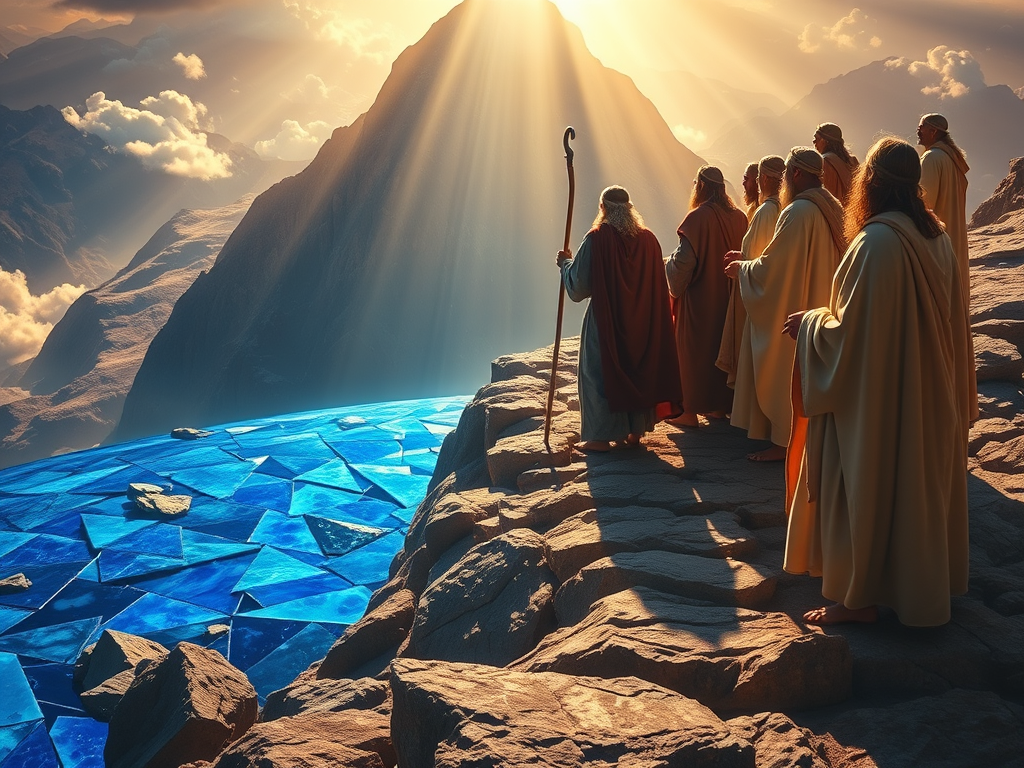
After Moses received this set of rulings, he presented them to the people, and they agreed to keep them. Then Moses made an altar (presumably the way God told him to make an altar in Ex. 20:24[21]-26[23]). Upon that altar they sacrificed burnt offerings (which were completely consumed by fire) and peace offerings (which could be eaten). The blood was splashed on the altar and the people. After this, Moses, Aaron, Nadab, Abihu, and seventy elders went up the mountain and saw God while they ate and drank, and they weren’t killed. They saw God and lived.
“and they saw the God of Israel. There was under his feet as it were a pavement of sapphire stone, like the very heaven for clearness. 11 And he did not lay his hand on the chief men of the people of Israel; they beheld God, and ate and drank” (Ex. 24:10-11).
Why were they able to behold God? They sacrificed to God. Burnt offerings atoned for sin (Job 1:5; 42:8), and peace offerings represented the peace between people and God and peace with one another. The burnt offerings atoned for their sins. The peace offerings proclaimed that they were in right standing with God and fellow man. Colossians 1:19-20 says,
19 For in him all the fullness of God was pleased to dwell, 20 and through him to reconcile to himself all things, whether on earth or in heaven, making peace by the blood of his cross.
As Moses, Aaron, his sons, and the elders were able to see God and live because of the blood of the covenant (Ex. 24:8), we can see God and live because of the blood of the covenant in Jesus Christ (Mt. 26:28, Mk. 14:24, Lk. 22:20, 1 Cor. 11:25). The language used in this portion about the blood of the covenant would have been familiar to the disciples when Jesus spoke of the blood of His covenant. They would have understood that language in the context of God’s covenant with Israel at Sinai (Zech. 9:11, Ex. 24:8). They would have understood (later if not at the moment) that Jesus was identifying Himself with God and His covenant with God’s. At the Last Supper, the same supper in which Jesus spoke of the blood of His covenant,
“8 Philip said to him, “Lord, show us the Father, and it is enough for us.” 9 Jesus said to him, “Have I been with you so long, and you still do not know me, Philip? Whoever has seen me has seen the Father. How can you say, ‘Show us the Father’?
The Promise
“25 Thus says the Lord: If I have not established my covenant with day and night and the fixed order of heaven and earth, 26 then I will reject the offspring of Jacob and David my servant and will not choose one of his offspring to rule over the offspring of Abraham, Isaac, and Jacob. For I will restore their fortunes and will have mercy on them” (Jer. 33:25-26).
This Haftarah portion is a pretty rough read. It starts out with how Judah broke the covenant given in Exodus 21 and how they would be destroyed because of it. This portion ends on a hopeful note. Jeremiah has to be read out of order to make that happen, but I believe it is to end on a note of hope. Israel did not live up to the rulings they agreed to obey at Mount Sinai. God punished them accordingly, but He never rejected them. He never will reject them. This is not the same as eternal spiritual salvation. Only those who trust is Jesus Christ, Yeshua ha Mashiach, will receive eternal life, and that is free to anybody, but the children of Israel can receive the promises in the Torah and eternal life when they obey God’s Torah and trust in His Savior. Acts 4:12 says, “And there is salvation in no one else, for there is no other name under heaven given among men by which we must be saved.” Peter, a Jew, said this to the Jewish scribes and priests.
Getting back to the promises to the descendants of Abraham, Jews, that promise is as secure as the sun and moon. What is that promise? The promise that they would be a special nation to God, that they would inherit the land God gave Abraham, and the Savior of the world and the Word of God would come from them. When Jehovah’s Witnesses came to my door, they were absolutely convinced that the Jews don’t exist anymore, that they had been replaced. When I cited this verse for them, I pointed to the sun. They have to do huge gymnastics to explain this text in any other way than its plain reading.
The servant from the line of David is Jesus Christ. He was chosen to rule over “the offspring of Abraham, Isaac, and Jacob” forever. In previous posts, I have gone over how His throne lasts forever because it was prophesied to be so, and He rose from the dead and lives forever. Because He still lives and always will, there is no progeny to pass the throne to anymore. So I can be confident that whenever I wake up and see the sun in the sky, Jesus is on the throne. God has not rejected His people, and Jesus is on the throne. Based on Jeremiah, if God rejected the Jews after a promise like this, why should I have confidence that He will keep His promises to me? I couldn’t be sure of that. But God does keep His promises. God has restored Israel and given them mercy and will continue to do so. It’s not because of human righteousness. It’s because of the blood of the covenant.
Closing
I hope this post blessed you. It certainly blessed me to study it. Jesus is in the Torah and Prophets, and He is prophesied to suffer and enter glory, just like He told the two disciples on the Emmaus road (Lk. 24:25-27). The Gospel is super simple. Just like Jesus walked the disciples down Emmaus’ road, here’s a quick walk down Romans’ Road:
1. No One Is Righteous
10 as it is written:
“None is righteous, no, not one;
11 no one understands;
no one seeks for God.
12 All have turned aside; together they have become worthless;
no one does good,
not even one.”
This is actually a quote of Psalm 14:1-13 and 53:1-3(2-4).
2. All have Sinned
“23 for all have sinned and fall short of the glory of God” (Rom. 3:23).
3. Sin Leads to Death
12 Therefore, just as sin came into the world through one man, and death through sin, and so death spread to all men because all sinned—” (Rom. 5:12).
4. God’s Free Gift is Eternal Life
23 For the wages of sin is death, but the free gift of God is eternal life in Christ Jesus our Lord.” (Rom. 6:23).
5. Jesus Christ Died for Sin
“8 but God shows his love for us in that while we were still sinners, Christ died for us.” (Rom. 5:8).
6. Confess and Believe, Salvation Receive
“9 because, if you confess with your mouth that Jesus is Lord and believe in your heart that God raised him from the dead, you will be saved. 10 For with the heart one believes and is justified, and with the mouth one confesses and is saved. 11 For the Scripture says, “Everyone who believes in him will not be put to shame.” 12 For there is no distinction between Jew and Greek; for the same Lord is Lord of all, bestowing his riches on all who call on him. 13 For “everyone who calls on the name of the Lord will be saved.” (Rom 10:9-13).
This passage quotes Is. 28:16 and Joel 2:32(3:5).
therefore here is what Adonai Elohim says:
“Look, I am laying in Tziyon
a tested stone, a costly cornerstone,
a firm foundation-stone;
he who trusts will not rush here and there.” (Is. 28:16, Complete Jewish Bible).32 And it shall come to pass that everyone who calls on the name of the Lord shall be saved. For in Mount Zion and in Jerusalem there shall be those who escape, as the Lord has said, and among the survivors shall be those whom the Lord calls” (Joel 2:32[3:5], English Standard Version).
I hope and pray that if you have not walked down Romans’ Road, that you would take that journey as I and many others have, and if you have walked the Romans’ Road, that you will pray for others and invite them to do the same. I think you will find the Romans’ Road is the Emmaus Road. They say all roads lead to Rome, but the Bible says all roads lead to Jerusalem. Until next time, God bless.
Faithfulness
God of Israel, righteous are Your rules,
That You’d render the Way for us to live–
All those who disregard it would be fools.
You free us from slavery to sin and give
Us precepts to filter our hearts, a sieve
Of instruction for life with our neighbors,
Give us cause to celebrate in festive
Joy over Your grace, mercy, and favors.
The righteous ruminates each word, savors
Your divine identity in each line,
Like refreshing all-surrounding zephyrs
Of peace–a jewel, a nugget of the sublime.
When the sun is high and the moon is full,
I know You’re on the throne, You are faithful.
Sources
The Bible. English Standard Version. Biblegateway.com. Accessed 15 Feb. 2026.
The Complete Jewish Study Bible. Peabody, Hendrickson Publishers, 2016.
Howard, Kevin and Marvin Rosenthal. The Feasts of the Lord. Orlando, Zion’s Hope. 1997.

 Valley Princess
Leave a comment