Torah: Genesis 32:3(4)-36:43
Haftarah: Hosea 11:7-12:11(12), Obadiah 1-21
Long ago, the Jewish sages created reading calendars to be read annually throughout all the synagogues every sabbath. They are the Parsha (from the Torah, the first five books of the Bible), and the Haftarah (selected readings from the prophetic books of the Old Testament). Today, I continue my series exploring the Messiah in each of these portioned readings that was planned and scheduled in ancient days and appointed for our present days. For December 6 this year, the readings are cited above. I would encourage you to read those passages first before you read my post, or at least read them in tandem. Again, thank you for your patience, as I know I am behind the reading schedule, but I promise that I am catching up. I am not a paid writer, so I write as I have time.
In this portion, there is a lot to cover, but I will focus on the relationship between Esau and Jacob and Jacob’s faith in God, foreshadowing the Messiah and how believers can hold the same faith of Jacob in times of distress.
Jacob returned to Canaan peacefully “in order that [he] may find favor in [Esau’s] sight” (Gen. 32:5). Jacob appeased Esau with gifts and divided his camp into two, “thinking, ‘If Esau comes to the one camp and attacks it, then the camp that is left will escape’” (vs. 8). I do not think this was doubt in Jacob’s mind that God would fulfill his promises, but perhaps he was trying to do his best to ensure his descendants would endure to receive the promise, even if not all of them did.
Jacob had a very candid time of prayer with the Lord before he crossed the river:
And Jacob said, “O God of my father Abraham and God of my father Isaac, O Lord who said to me, ‘Return to your country and to your kindred, that I may do you good,’ I am not worthy of the least of all the deeds of steadfast love and all the faithfulness that you have shown to your servant, for with only my staff I crossed this Jordan, and now I have become two camps. Please deliver me from the hand of my brother, from the hand of Esau, for I fear him, that he may come and attack me, the mothers with the children. But you said, ‘I will surely do you good, and make your offspring as the sand of the sea, which cannot be numbered for multitude’” (vs. 9-12).
In this prayer, Jacob expressed his fear, acknowledged his unworthiness, reminded God he was obeying Him, and reminded God of his promise, not that He forgot. That night, God wrestled with him, renamed him Israel, knocked his hip out of socket (ouch!), and blessed him. Perhaps God touched his hip to keep him humble. Paul mentioned a thorn in the flesh that God put there to keep him humble after all the amazing things God showed him (2 Cor. 12:7).
So why did God rename Jacob Israel? He says it is because “you [Israel] have striven with God and with men, and have prevailed” (vs. 28b). This was not a physical struggle with men that Israel endured, it was an ideological one. He strove with Esau over the birthright and blessing, and he strove with Laban over obeying God versus staying and continuing to serve Laban. So too for believers, when it comes to obeying people versus obeying God, we have to obey God and leave the outcome to God. Paul says in Ephesians, “For we do not wrestle against flesh and blood, but against the rulers, against the authorities, against the cosmic powers over this present darkness, against the spiritual forces of evil in the heavenly places” (6:12). Jacob did not go to war with Esau and his 400 men. He got down in prayer and called on God in faith, “he wept and sought his favor” (Hos. 12:4b).
The Bible records Jesus had a similar time of private prayer and wrestling with the Father the night He was betrayed. He went off to be alone, as Jacob had sent ahead his family and was alone.
Esau said he would kill Jacob when Isaac died (Gen. 27:42). Isaac was still alive when Jacob returned (Gen. 35:27). Esau received Jacob back and invited him to come home with him. But the rabbis understand Esau’s kiss and words as disingenuous. The Masoretic text, the oldest copy of the Old Testament besides the Dead Sea Scrolls, puts six dots over the word “kissed” to indicate something exceptional was happening: “he didn’t kiss him wholeheartedly” (CJSB footnote Gen. 33:4). Jacob seemed to know he could not trust Esau because he made excuses not to go with him and then he camped away from Esau.
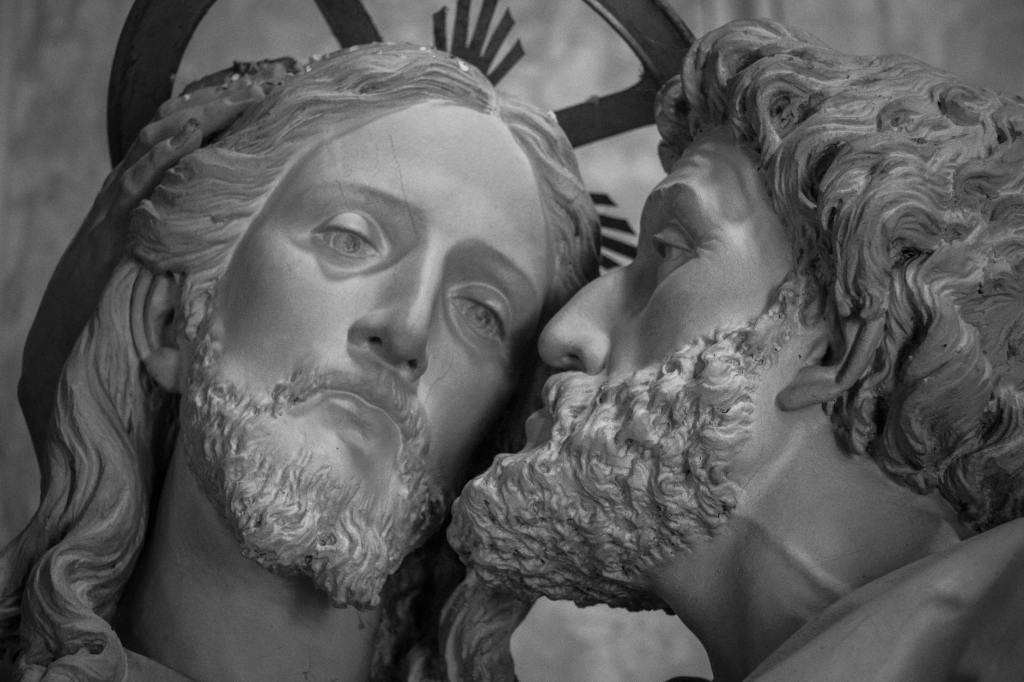
This reminds me of Jesus and Judas. On the Mount of Olives, after the Passover, Judas met Jesus on the mountain and kissed him disingenuously. With Judas was a group of armed men like with Esau there was a group of armed men. God delivered Israel from Esau because nothing violent came from their meeting, but God did not deliver Jesus. Jesus was handed over to be crucified for our sins. Matthew 21, Mark 12, and Luke 20 record Jesus’ parable of the tenants, which He told the week leading up to his crucifixion:
“Hear another parable. There was a master of a house who planted a vineyard and put a fence around it and dug a winepress in it and built a tower and leased it to tenants, and went into another country. When the season for fruit drew near, he sent his servants to the tenants to get his fruit. And the tenants took his servants and beat one, killed another, and stoned another. Again he sent other servants, more than the first. And they did the same to them. Finally he sent his son to them, saying, ‘They will respect my son.’ But when the tenants saw the son, they said to themselves, ‘This is the heir. Come, let us kill him and have his inheritance.’ And they took him and threw him out of the vineyard and killed him” (Mt. 21:33-39).
The only reason the Pharisees did not arrest Jesus on the spot was because they feared the crowds (Mt. 21:46).
The second time God renamed Jacob Israel, He promised,
“I am God Almighty: be fruitful and multiply. A nation and a company of nations shall come from you, and kings shall come from your own body. The land that I gave to Abraham and Isaac I will give to you, and I will give the land to your offspring after you” (Gen. 35:11b-12).
As we are in the Christmas season, the conflict between Esau and Jacob actually explains the rivalry between Harod the Great and Jesus. Herod was an Idumean, and the term Idumean was used in the New Testament for the people called Edomites in the Old Testament, the descendants of Esau. So you have (in the eyes of the Jews) an illegitimate descendant of Esau as king who was power hungry, paranoid, and jealous. When the magi came and asked him for the location of the One born King of the Jews, Herod was furious, but he put on a guise: “And he sent them to Bethlehem, saying, ‘Go and search diligently for the child, and when you have found him, bring me word, that I too may come and worship him’” (Mt. 2:8). Herod was definitely disingenuous. He tried to have Jesus killed by committing infanticide in Bethlehem (Mt. 2:16). Jesus had to flee. Jesus also fled Bethlehem down to Egypt for a time, until God gave Joseph a dream to return, like how God gave Jacob a dream to return. The fact that Herod would indiscriminately kill all the babies of Bethlehem to secure His own throne is not far from his character as described by Roman historical records that say a pig was safer in his household than his own family members. He had his sons and even his wife killed out of paranoia. He tried to win the approval of his subjects by marrying a Jewish woman of prestigious lineage, Mariamne, daughter of Hyrcanus II, the high priest. It’s very similar to Esau, who saw his marriage to two Hittite women was intolerable to his parents and married Mahalath the daughter of Ishmael to try to win their favor (Gen. 28:6-9). Herod is descended from Esau. Jesus is descended from Jacob, from Israel. Jesus was born King, similar to Jacob being the greater before the two boys were born. Jesus is the ultimate King of the kings God promised would be descended from Jacob. Jesus came from the kingly line of Judah, and his throne would have no end, as He is raised from the dead, whereas the other kings died and passed their kingdom to their sons until the Babylonian exile. As a side note, here again, God promised the land of Israel to Israel’s descendants.
Before Jacob and Esau were born, God told Rebecca, “Two nations are in your womb, and two peoples from within you shall be divided; the one shall be stronger than the other, the older shall serve the younger” (Gen. 25:23). Esau was born first, and then Jacob, who was holding Esau by the heel when they were born. I think this is why Rebecca worked so hard to get Jacob the blessing. She was going to do everything she could in alliance with God’s plan, even if it meant tricking her husband, Isaac, who loved Esau because of his game, what he hunted. Loving Esau because of the game he hunted was a worldly reason to favor someone. Even the name of his descendants, Edom, means red, the color of the earth, the color of the worldly. When he begged Jacob for some stew, the Hebrew literally says, “Give me some of that red, red stuff!” He wanted the worldly. The Bible doesn’t say whether Rebecca told Isaac the oracle she received from God, but I would assume so. Rebecca favored the son whom God said would be greater. Again, when it came to obeying a person versus obeying God, it could be argued that Rebekkah chose to obey God over Isaac.
The rivalry between Edom and Israel continued through the Exodus (Num. 20) and into the age of the kings of Israel (1 Sam. 14:47; 2 Sam. 8:13-14; 1 Kings 11:14-22; 2 Kings 8:2, 8:20,14:7, 14:22; 1 Chron. 18:13). Obadiah speaks in a very condemning way about Edom because of the way they treated Israel:
“Because of the violence done to your brother Jacob,
shame shall cover you,
and you shall be cut off forever.
On the day that you stood aloof,
on the day that strangers carried off his wealth
and foreigners entered his gates
and cast lots for Jerusalem,
you were like one of them” (Ob. 10-11).
It’s noteworthy that Obadiah specifies that Edom cast lots for Jerusalem and the Gospels tell us the soldiers who crucified Jesus cast lots for His clothing.
Like Esau, Edom, and Herod, the world fights against God’s chosen, His chosen people and His Messiah. But believers must obey God over people, overcome their fear, and hold on to God’s promises. All the nations will come against believers and Jews one day that might not be that far away, but we can be confident of this:
“For the day of the Lord is near upon all the nations.
As you have done, it shall be done to you;
your deeds shall return on your own head.
For as you have drunk on my holy mountain,
so all the nations shall drink continually;
they shall drink and swallow,
and shall be as though they had never been.
But in Mount Zion there shall be those who escape,
and it shall be holy,
and the house of Jacob shall possess their own possessions” (Ob. 15-17).
As part of this week’s Haftarah, we have the directive:
“So you, by the help of your God, return,
hold fast to love and justice,
and wait continually for your God” (Hos. 12:6).
As God said, Jesus did not come in wrath, but to save (Hos. 11:9, Jn. 3:17). He will come again to bring justice to a corrupt world. Jesus is the descendant of Israel, the Son of the promise. Be like Israel, who put away his idols and went to “the God who answers me in the day of my distress and has been with me wherever I have gone” (Gen. 35:3:b) and He will receive you when He returns. Until next time, God bless.
The Kiss
“Would you betray me with a kiss?”
He asks, surrounded by armed men.
Like Esau. Disingenuous.
The pattern would repeat again.
He could call twelve legions of angels,1
Some with Jacob on his way,
To stop what the enemy wills.
But that is not God’s plan today.
He was no stranger to the heart of men,
Trusting His life to none.2
No hiding now because of sin,
Because His time had come.
Herod the Idumean tried
To kill Him at His birth,
To the wisemen lied,
Red with blood and earth.
He was born King of the Jews
And as the same He’d die,3
Their tribute: dust and spit and bruise
Upon the One like sapphire sky.
They slashed Him with the cords and whip.
His earth-red blood spilled openly.
Sapphire and red produce when dipped
Together, the color royalty.
O God of heaven, Son of worth,
What will become of me?
I, Esau, Judas, red as earth?
“Kiss the Son, lest He be angry,4
But not as disingenuous.
Give Him your heart, your all in this.”
- Mt. 26:53 2. Jn. 2:24-25 3. Mt. 27:37 4. Ps. 2:12
If you like this poem, I do have a published book available on Amazon as an eBook and in print. It is Learning to Love: A collection of Poetry and 40 Daily Devotions. This would make a good Christmas present for someone who loves poetry or who is looking for a new devotional to go through. It is also a good book for anyone who may be looking to begin the new year with a new devotional.

 Valley Princess
Leave a comment